
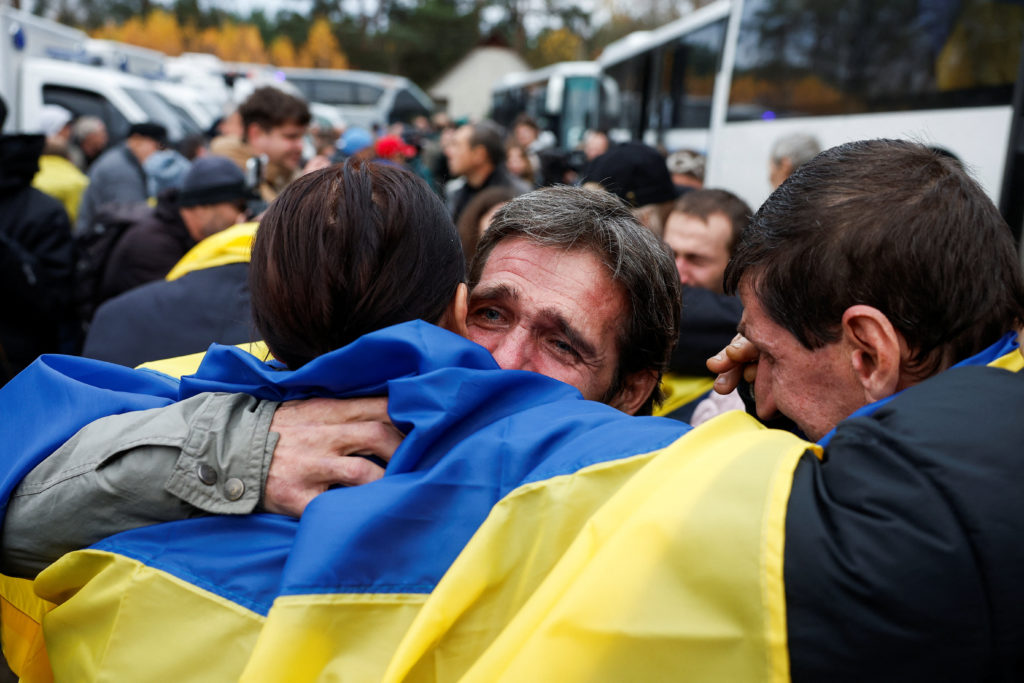
CHERNIHIV REGION, Ukraine — Civilians evacuated from the Russian-occupied city of Oleshky have reunited with loved ones after reaching Ukrainian-controlled territory through Belarus, following a major humanitarian operation made possible by a temporary ceasefire.
The evacuees crossed the Ukrainian-Belarusian border on Saturday, October 31, 2026, after travelling by road and air through Russian-controlled territory and Belarus. Their arrival was marked by emotional reunions, as relatives, volunteers and humanitarian workers gathered to welcome them.
Some evacuees stepped off buses wrapped in Ukrainian flags, while volunteers offered coffee, food and assistance to people who had endured a difficult journey out of the occupied city.

Temporary Ceasefire Makes Evacuation Possible
The evacuation was carried out under a temporary ceasefire in Ukraine’s southern Kherson region. The arrangement began early Tuesday and was expected to remain in place until Sunday evening, allowing humanitarian teams to deliver essential supplies and facilitate civilian evacuations.
The operation was described as one of the most significant localized humanitarian truces since Russia launched its full-scale invasion of Ukraine in February 2022.
The White House said U.S. First Lady Melania Trump helped broker the arrangement, while Pope Leo XIV also appealed to Russian and Ukrainian leaders to permit humanitarian assistance and the safe evacuation of civilians.
The temporary pause also allowed efforts to clear landmines along evacuation routes, reducing risks for residents and humanitarian personnel.
Families Reunite After Years of Separation
For many evacuees, reaching Ukrainian-controlled territory meant reuniting with relatives they had not seen for years.
Among those waiting at the border was 19-year-old Liza Paliy, who had been separated from her father for more than two and a half years after leaving Oleshky with her mother and sister.
She said the family had initially expected their separation to last only a month or two but had remained apart for years.
Another emotional reunion involved Ukrainian serviceman Dmytro, who embraced his wife, Larysa, after she arrived with other evacuees.
The reunions highlighted the personal consequences of the prolonged occupation and the challenges families have faced trying to maintain contact across areas controlled by opposing forces.
Residents Describe Severe Conditions in Oleshky
Evacuees described deteriorating living conditions in Oleshky, including shortages of food, restricted movement and the constant threat of drone attacks and landmines.
One resident, 48-year-old Ivan Yevhenovych, said obtaining basic food had become increasingly difficult since the spring. He also described the dangers of moving through streets where residents faced attacks and explosive hazards.
Before the ceasefire, approximately 2,000 people were estimated to remain in the city. Residents were offered the option of travelling to Ukrainian-controlled territory, moving to Russian-controlled areas or staying behind after humanitarian supplies were replenished.
Some chose not to leave because of their homes, property and animals. Others were concerned about the difficulties involved in making the journey.
Ukrainian authorities have not disclosed the exact number of people evacuated, citing concerns about protecting residents who remain in the city and preserving the possibility of future humanitarian operations. Melania Trump said the convoy could safely evacuate more than 750 people.
Humanitarian Organizations Assist Evacuees
Volunteers and humanitarian organizations, including the Red Cross, Doctors Without Borders and World Central Kitchen, were present at the border to provide assistance.
The evacuation included people of different ages, from infants to elderly residents. Ukraine’s human rights ombudsman, Dmytro Lubinets, said those rescued ranged from just over one year old to 94.
Some evacuees also brought their pets, including dogs, cats, a parrot and a raccoon.
Lubinets described the operation as an important humanitarian achievement and expressed hope that the arrangements could provide a model for addressing similar emergencies elsewhere.
Russia’s human rights commissioner, Yana Lantratova, also said both sides had agreed to pursue regular humanitarian missions in and around Oleshky. However, the living conditions of those who remained in the city continued to be a concern.
A Humanitarian Breakthrough Amid Continuing Conflict
The successful evacuation offers temporary relief for civilians affected by the war, but it does not signal an end to the wider conflict.
Fighting and drone attacks have continued in other parts of Ukraine and Russia, while millions of people remain affected by displacement, infrastructure damage and insecurity.
For the residents who reached the Ukrainian-Belarusian border, however, Saturday’s arrival marked an important moment after years of uncertainty and separation.
The operation has also renewed calls for humanitarian arrangements that allow civilians to receive essential supplies and leave dangerous areas safely.
As Ukrainian and Russian representatives consider further humanitarian missions, the situation in Oleshky remains a reminder of the urgent need to protect civilians caught in the conflict.
Swifteradio.com