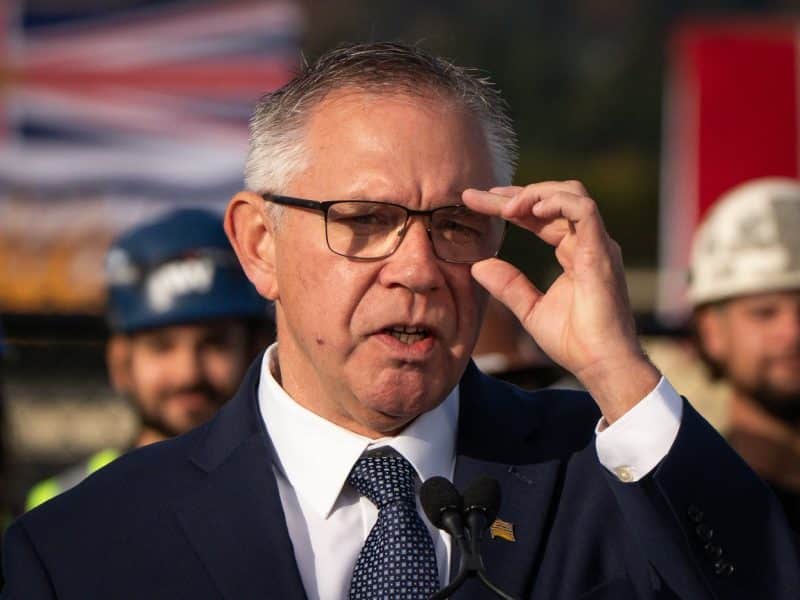
British Columbia Conservative interim leader Lorne Doerkson says his party’s target of achieving 3.2 per cent economic growth by 2029 is realistic, arguing that stronger investment in natural resources and other key industries could boost the province’s economy if voters elect a Conservative government.
Doerkson made the remarks during a campaign stop in Maple Ridge on Monday, October 19, 2026, just days before British Columbia’s provincial election scheduled for October 24.
The Conservative Party’s economic projection is significantly higher than the forecast in the province’s previous budget and exceeds recent national growth projections from the Bank of Canada and the International Monetary Fund. The proposal has therefore drawn criticism from the governing New Democratic Party (NDP), which questions whether the assumptions behind the Conservatives’ financial plan are achievable.

Conservatives Predict Stronger Economic Growth
The B.C. Conservatives’ platform projects economic growth of 2.5 per cent in 2027, 2.8 per cent in 2028 and 3.2 per cent in 2029.
The party argues that stronger economic activity would generate approximately $2.6 billion in additional revenue over three years compared with the NDP government’s projections. It says this growth would help reduce the provincial deficit while supporting its commitments on taxation, public services and economic development.
Doerkson maintains that the proposed growth rate is achievable because industries such as natural gas, forestry, mining and agriculture are prepared to expand their investments in British Columbia.
He argued that uncertainty under the previous NDP government had discouraged some businesses from committing additional capital to the province. A change in government, he suggested, could encourage companies to move forward with projects that would create jobs and increase economic activity.
However, the additional revenue depends on the province achieving the growth rates outlined in the Conservative platform. If economic performance falls short of those projections, the government could collect less revenue than anticipated.
Conservative Platform Promises to Reduce Deficit
The Conservatives say their economic plan would help reduce British Columbia’s deficit to approximately $10.8 billion by 2030 while allowing the government to maintain essential services.
Their proposed measures include reviewing government spending, freezing hiring outside frontline services and reducing spending on consultants. The party’s platform estimates that a core spending review could generate approximately $1.8 billion in savings over four years, while hiring restrictions and staff attrition could save another $2 billion over the same period.
The party has also proposed tax reductions intended to ease financial pressure on households and businesses.
Conservatives argue that economic expansion would increase government revenue without requiring major cuts to frontline services or additional tax increases. However, the success of that strategy would depend on whether projected growth and spending reductions materialize as expected.
NDP Leader David Eby Questions the Numbers
NDP Leader David Eby has challenged the Conservatives’ financial projections, arguing that their platform relies on overly optimistic economic assumptions and does not adequately account for the cost of several campaign promises.
Eby said the Conservatives had failed to fully cost certain commitments, including a proposed provincial sales tax exemption on alcohol, which he said could cost nearly $300 million.
The NDP has also argued that the Conservative platform contains gaps in its spending and revenue calculations, warning that the proposed tax cuts and other commitments could put additional pressure on provincial finances.
The disagreement highlights a central issue in the election campaign: whether British Columbia can generate enough economic growth to finance proposed tax reductions and spending commitments while reducing its deficit.
While the Conservatives maintain that stronger investment would expand the province’s revenue base, the NDP argues that the projections underestimate the financial risks associated with the plan.
Economic Growth Becomes Key Election Issue
With voters preparing to head to the polls on October 24, economic policy has become a major focus of the campaign.
The Conservatives are presenting their platform as a strategy for attracting investment, creating employment opportunities and improving the province’s financial position. The NDP, meanwhile, is questioning whether the proposed growth targets and spending plans can be delivered without affecting public services or increasing the deficit.
Ultimately, the debate will depend on economic conditions, business investment and the ability of any incoming government to manage revenue and expenditure responsibly.
Doerkson remains confident that the Conservatives’ 3.2 per cent growth target is achievable. However, the contrasting assessments from the two parties leave voters to consider how realistic the projections are and what risks they could pose to British Columbia’s finances.
Swifteradio.com