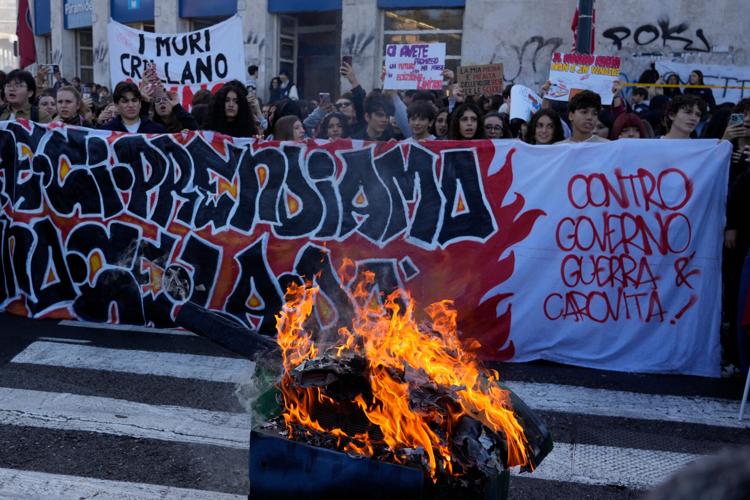
Thousands of workers and students took to the streets across Italy on Friday, November 20, as a nationwide general strike disrupted public services and demonstrations were held in more than 100 cities over stagnant wages, rising living costs and inadequate government investment in essential services.
The 24-hour strike, organised by Italy’s largest trade union, the General Confederation of Italian Labour (CGIL), brought together employees from public and private sectors, including education and healthcare workers.
Demonstrations took place in major cities, including Rome, Milan, Turin, Naples and Palermo, as protesters demanded better wages, stronger worker protections and increased funding for public services.

The industrial action also coincided with an International Day of Student Mobilisation, which saw young people organise demonstrations in more than 45 Italian cities. Their demands included greater investment in education, affordable housing and measures to address economic inequality.
Workers Demand Higher Wages and Better Living Conditions
CGIL said the strike was necessary to challenge economic policies that it believes have failed to adequately address the financial difficulties facing ordinary Italians.
The union is demanding higher salaries, renewed employment contracts, full pension adjustments in line with inflation and measures to prevent an increase in the retirement age.
CGIL Secretary-General Maurizio Landini called for significant changes to Italy’s economic and social policies, arguing that workers need stronger purchasing power to cope with rising household expenses.
The union also wants increased government investment in healthcare, education and other public services.
Landini criticised the government’s proposed 2027 budget, valued at approximately €26 billion, arguing that it does not provide sufficient support for workers, families and public institutions.
Students Join Nationwide Demonstrations
Students joined workers in demonstrations across the country, highlighting concerns about education funding, housing affordability and limited economic opportunities for younger generations.
In Rome, student groups marched through the city centre, while demonstrations were also organised in Milan, Bologna, Turin and Naples.
Young protesters argued that rising living expenses and insufficient investment in education were making it increasingly difficult for students to secure a stable future.
Some demonstrations also addressed concerns about government spending on military programmes, with activists calling for greater investment in social welfare, universities and public services.
The student mobilisation formed part of a wider European movement involving young people in several countries, including France, Germany, Britain, Austria and Belgium.
Public Services Face Disruptions
The nationwide strike affected several sectors, including schools, hospitals, local transportation and public administration.
Bus, tram and underground services experienced disruptions in some cities, although minimum service requirements remained in place to ensure essential transportation.
Air and rail services were excluded from the main CGIL strike following intervention by Italy’s transport strike regulatory authority. However, a separate rail strike organised by other unions was scheduled to begin at 9 p.m. on Friday and continue until 8 p.m. on Saturday.
Additional demonstrations were organised by grassroots unions, including Cobas and USB, contributing to the nationwide protests.
Meloni Government Faces Growing Pressure
The demonstrations have increased pressure on Prime Minister Giorgia Meloni’s government as parliament considers its proposed 2027 budget.
Opposition politicians, including representatives of the Democratic Party and the Five Star Movement, joined some of the demonstrations and criticised the government’s approach to wages and public spending.
However, Industry Minister Adolfo Urso described the strike as premature, arguing that the budget was still undergoing parliamentary examination and could be amended.
The government has defended its economic approach, while trade unions insist that stronger measures are needed to protect workers’ purchasing power and improve public services.
Friday’s nationwide mobilisation highlights growing dissatisfaction over wages, household expenses and public investment in Italy. With parliamentary elections scheduled for 2027, economic policy and living standards are likely to remain significant issues in the country’s political debate.
Swifteradio.com