
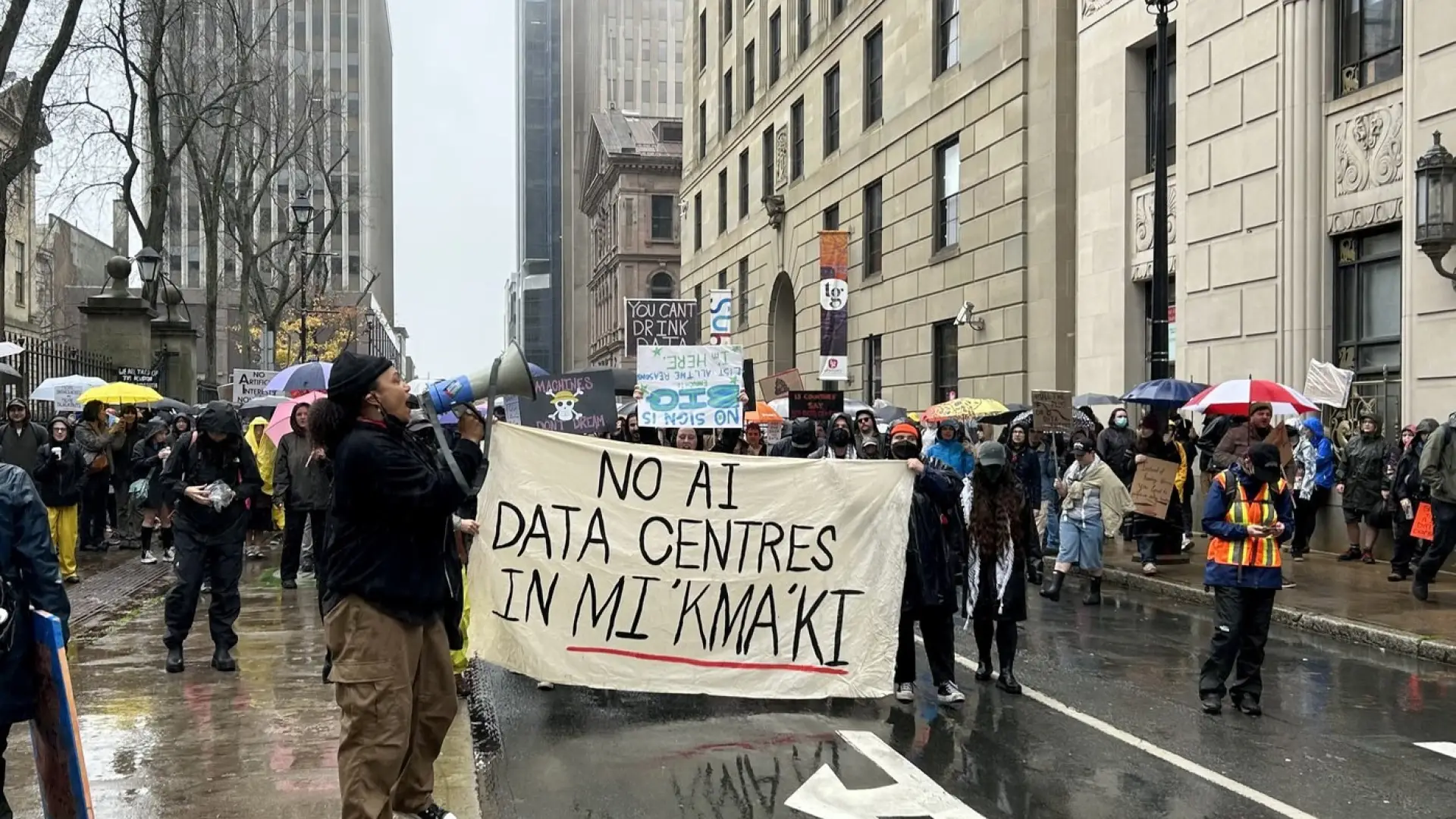
Nearly 1,000 residents gathered in downtown Halifax on Saturday, November 7, 2026, as protests spread across Nova Scotia, with demonstrators demanding a halt to proposed large-scale artificial intelligence (AI) data centre developments in the province.
The demonstrations targeted a proposed $10-billion data centre project in Point Tupper, southern Cape Breton, which has attracted growing criticism over its potential environmental impact, electricity consumption and pressure on local water supplies.
Protesters gathered outside the provincial legislature before marching through Halifax’s downtown streets despite heavy rain. Organisers said the demonstration was one of at least seven protests held simultaneously in communities across Nova Scotia.

The protesters are calling on the provincial government to introduce a moratorium on all large-scale AI data centre proposals until stronger environmental protections, regulations and public consultation procedures are established.
The controversy intensified after energy infrastructure company Everwind Fuels announced plans to lease its proposed data centre facility in Point Tupper to American artificial intelligence company Anthropic, which develops the AI assistant Claude.
Under the agreement, Anthropic has signed a 20-year lease for the 18,600-square-metre facility.
The project is expected to begin operations in 2027, initially requiring approximately 95 megawatts of electricity. A planned expansion in mid-2028 would add another 325 megawatts, bringing total electricity demand to 420 megawatts.
However, residents and environmental advocates fear the development could place additional pressure on essential resources.
One major concern involves water consumption. The facility is expected to use approximately 100,000 litres of water daily during its first phase, potentially increasing to 500,000 litres per day following expansion.
Some residents are particularly concerned because the water would come from nearby Landry Lake, which also supplies drinking water to Port Hawkesbury.
Demonstrators have also questioned the project’s approval process, arguing that communities were not adequately consulted before the development was announced.
Everwind has maintained that its cooling system will operate as a closed-loop system, with cooling fluid recycled or disposed of off-site. The company has also said it will cover the cost of electricity infrastructure associated with the project.
Meanwhile, Premier Tim Houston’s office said the development would only proceed if it complied with provincial and federal requirements protecting water resources, the environment and electricity affordability.
The government also indicated that it remained open to introducing legislative changes if necessary.
Despite these assurances, protesters insist that stronger safeguards and greater transparency are needed before Nova Scotia commits to major AI infrastructure developments.
Swifteradio.com