
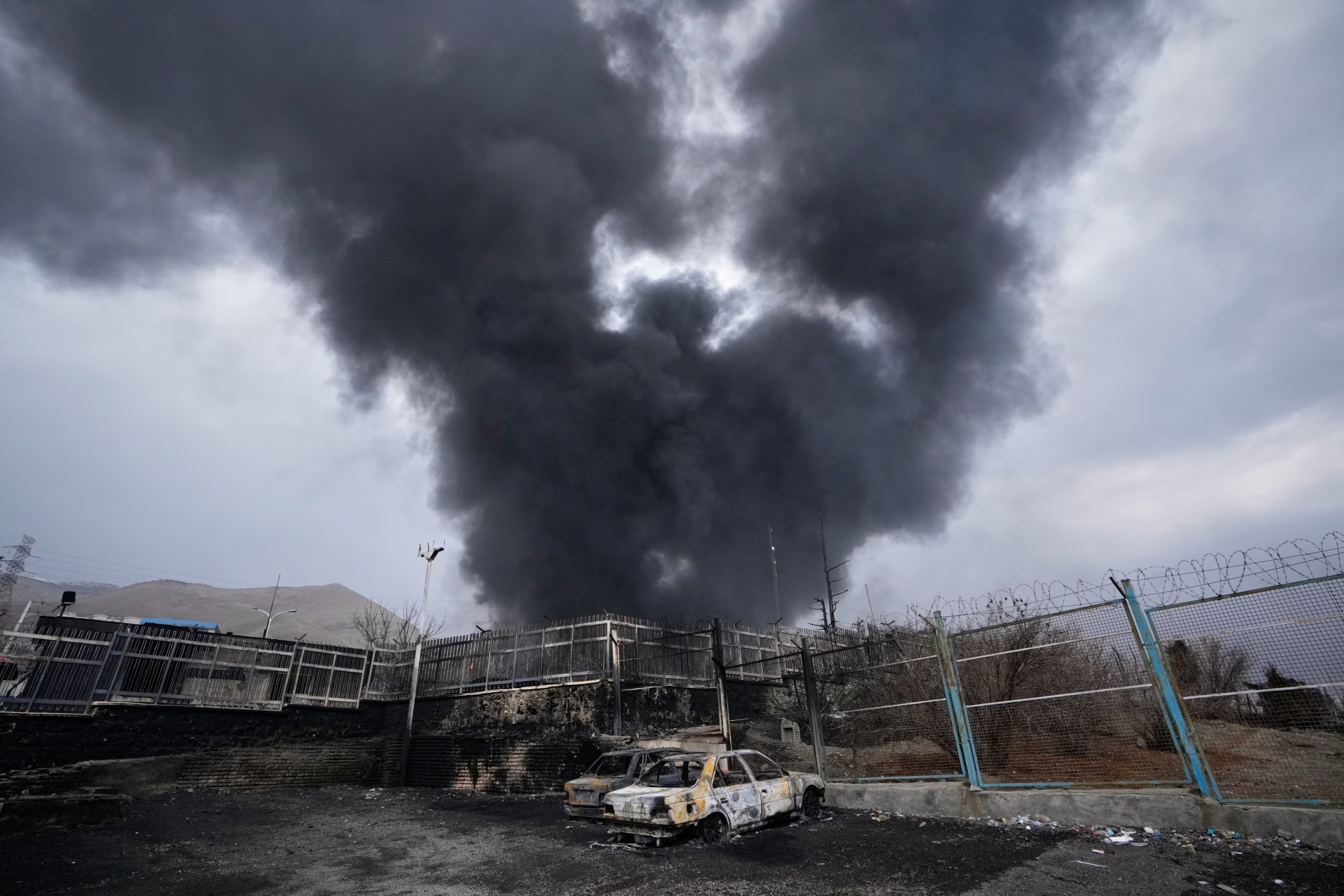
Iran launched a new wave of missile and drone attacks Tuesday targeting Israel and several Gulf Arab nations, intensifying a widening regional war that has rattled global markets and disrupted vital energy supplies.
Air raid sirens sounded across multiple locations, including Dubai in the United Arab Emirates and across Bahrain, while Saudi Arabia said it intercepted two drones over its oil-rich eastern region. Kuwait’s National Guard reported shooting down six drones over Kuwait.
In Israel, sirens also sounded in Jerusalem as explosions were heard over Tel Aviv while the Israel Defense Forces activated air defenses to intercept incoming missiles.
Iran’s parliament speaker Mohammad Bagher Qalibaf said Tehran had no interest in halting the conflict.

“We are definitely not looking for a ceasefire,” Qalibaf wrote on social media, saying the aggressor must be punished to prevent future attacks on Iran.
Beyond missile strikes, Iran has also targeted energy infrastructure across the region and tightened pressure around the strategic Strait of Hormuz, the key shipping route between the Persian Gulf and the Gulf of Oman through which roughly 20 percent of the world’s oil supply moves.
The disruption has shaken global energy markets. Brent crude oil briefly surged close to $120 per barrel before retreating, though it remained around $90 on Tuesday, roughly 24 percent higher than when the war began on Feb. 28.
Donald Trump said he expects the conflict to be relatively brief, describing it as a “short-term excursion,” even as analysts warn the war could last weeks or longer.
Meanwhile, Benjamin Netanyahu vowed Israel would continue its military campaign against Iran.
“Our aim is to bring the Iranian people to cast off the yoke of tyranny,” the Israeli prime minister said, adding that Israel’s strikes were weakening the Iranian leadership.
The conflict has severely disrupted global shipping. Iran has effectively halted many tanker movements through the Strait of Hormuz, while attacks on merchant vessels near the passage have killed at least seven sailors, according to the International Maritime Organization.
Energy executives warn the impact could worsen if shipments from the region remain constrained. Amin Nasser, CEO of Saudi Aramco, said global oil inventories could shrink rapidly as supply disruptions persist.
“If shipments are curtailed from the region, inventories may be drawn down faster,” Nasser said following the company’s latest earnings report.
The war is also triggering humanitarian and political ripple effects. Five players from Iran’s national women’s soccer team who were competing in Australia when the war began have been granted asylum by the government of Australia, according to Home Affairs Minister Tony Burke.
Elsewhere in the region, the fighting has spread to Iraq, where an airstrike hit the 40th Brigade of the Popular Mobilization Forces in the city of Kirkuk, killing at least five militiamen. Officials said it was not immediately clear who carried out the strike.
Israel has also expanded operations against Hezbollah in Lebanon, including strikes on the group’s financial network, particularly the institution Al‑Qard Al‑Hasan.
Since the war erupted, officials say at least 1,230 people have been killed in Iran, 397 in Lebanon and 11 in Israel. Seven U.S. service members have also died.
Despite the violence, financial markets in Asia opened with modest gains Tuesday, suggesting cautious optimism among investors even as the conflict continues to threaten global energy supplies and regional stability.
