Tag: SR

  • (VIDEO) Update on Borno Suicide Bomb Attacks

    Medical personnel are currently battling to save the lives of victims of the multiple suicide bomb attacks in Nigeria’s Northeast Borno State.

    On Saturday, terrorists allegedly attacked a wedding party in Gwoza town using a person-borne improvised explosive device.
    Swifteradio.com gathered that the exact number of people killed and injured remains unknown, but it appears that at least 23 people have been killed and over 100 seriously injured.
    Medical personnel at the hospital and administrators at Gwoza Local Government Area have spoken on the current state of things.

    FATIMA MUSA- Secretary, Gwoza Local Government Area
    YAKUBU MABBA-ALI – Secretary, State Specialist Hospital, Maiduguri
    Dr BABASHEHU MOHAMMED – Medical Director, State Specialist Hospital, Maiduguri
    Video Credit: News Central

  • WHO’s Report on Climate Change Implications for Global Health

    Climate Change: A Fundamental Threat to Human Health

    Overview: Climate change presents a fundamental threat to human health, impacting the physical environment and all aspects of natural and human systems, including social, economic conditions, and health system functioning. It acts as a threat multiplier, potentially reversing decades of health progress by increasing the frequency and intensity of extreme weather events such as storms, heatwaves, floods, droughts, and wildfires. These events directly and indirectly increase the risk of deaths, noncommunicable diseases, the spread of infectious diseases, and health emergencies.

    Health Workforce and Infrastructure Impact: Climate change affects health infrastructure and the capacity to provide universal health coverage (UHC). Environmental and social determinants of health, such as clean air, water, soil, food systems, and livelihoods, are degraded by climate shocks and stresses, including changing temperature patterns, droughts, floods, and rising sea levels.

    IPCC’s Sixth Assessment Report: The Intergovernmental Panel on Climate Change’s (IPCC) Sixth Assessment Report (AR6) reveals that climate risks are accelerating and becoming more severe. It highlights that 3.6 billion people live in areas highly susceptible to climate change, with low-income countries and small island developing states (SIDS) bearing the harshest health impacts despite minimal contributions to global emissions. Vulnerable regions have seen a death rate from extreme weather events 15 times higher than less vulnerable areas.

    Health Impacts of Climate Change:

    • Direct Health Impacts: Death and illness from extreme weather events like heatwaves, storms, and floods.
    • Indirect Health Impacts: Disruption of food systems, increased zoonoses, and food-, water-, and vector-borne diseases. Mental health issues due to displacement and social disruption.
    • Social Determinants: Livelihoods, equality, and access to healthcare and social support are undermined.

    Vulnerable Populations: Climate-sensitive health risks disproportionately affect the most vulnerable and disadvantaged, including women, children, ethnic minorities, poor communities, migrants, older populations, and those with underlying health conditions.

    Scientific Advances: While it is challenging to estimate the full scale of climate-sensitive health risks, scientific advances allow for better attribution of morbidity and mortality to global warming. WHO data indicates that 2 billion people lack safe drinking water, and 600 million suffer from foodborne illnesses annually. Climate change exacerbates waterborne and foodborne disease risks, hunger, and the spread of vector-borne diseases.

    Projected Health Impacts: Recent research attributes 37% of heat-related deaths to human-induced climate change, with a significant increase in heat-related deaths among those over 65. The WHO projects 250,000 additional yearly deaths by the 2030s due to climate change impacts on diseases like malaria and coastal flooding.

    Economic and Social Consequences: Climate change threatens to undo 50 years of progress in development, global health, and poverty reduction, exacerbating health inequalities. Health shocks already push around 100 million people into poverty annually, a trend worsened by climate change.

    WHO’s Response: WHO’s response centers around three main objectives:

    1. Leadership and Raising Awareness: Emphasizing the health implications of climate change and centralizing health in climate policies.
    2. Evidence and Monitoring: Contributing global evidence, assisting nations in assessments, and monitoring progress.
    3. Capacity Building and Country Support: Supporting ministries of health through collaboration, guidance, training, and project execution.

    Global Commitment: To prevent catastrophic health impacts and millions of climate-related deaths, the world must limit the temperature rise to 1.5°C. Every additional tenth of a degree of warming will severely impact people’s lives and health. WHO aims for carbon neutrality by 2030 and leads the Alliance for Transformative Action on Climate and Health (ATACH) to support climate-resilient and low-carbon health systems.

    Related Resources:

    • News
    • Fact sheets
    • Feature stories

    Source: WHO

  • Essential Mexico Travel Tips: Official Advice from GOV.UK

    a man riding a motorcycle down a street next to parked cars

    We use some essential cookies to make this website work. We’d like to set additional cookies to understand how you use GOV.UK, remember your settings, and improve government services. We also use cookies set by other sites to help us deliver content from their services. You can change your cookie settings at any time.

    Important Travel Advisories

    • Voting Reminder: Bring photo ID to vote. Check what photo ID you’ll need to vote in person in the General Election on 4 July.
    • Travel Insurance Warning: Your travel insurance could be invalidated if you travel against advice from the Foreign, Commonwealth and Development Office (FCDO).

    Specific Travel Warnings from the FCDO:

    • Baja California: All but essential travel to the city of Tijuana and the city of Tecate, including roads between Tijuana and Tecate.
    • Chihuahua: All but essential travel.
    • Sinaloa: All but essential travel.
    • Tamaulipas: All but essential travel.
    • Zacatecas: All but essential travel.
    • Areas South-West of Road 45D: All but essential travel.
    • Michoacán: All but essential travel, except the areas south and south-west of Lake Chapala to the border with Colima.
    • Northern Municipalities: All but essential travel.
    • Colima: All but essential travel, except the city of Manzanillo accessed by sea or air via the Manzanillo-Costalegre International Airport, and direct travel via road 200 from the airport to Manzanillo.
    • Guerrero: All but essential travel, except the town of Zihuatanejo/Ixtapa accessed by air.
    • Guatemalan Border: All but essential travel within 40km of the Guatemalan border between the Pacific Coast up to and including the border crossing at Gracias a Dios.
    • Federal Highway 199: All but essential travel on Federal Highway 199 between Rancho Nuevo and the Chancalá junction just outside Palenque.

    Travel Tips and FCDO Resources:

    • Research and Insurance: If you choose to travel, research your destinations and get appropriate travel insurance. Ensure your insurance covers your itinerary, planned activities, and emergency expenses.
    • Stay Informed: FCDO provides advice about risks of travel to help British nationals make informed decisions. Follow and contact FCDO travel on Twitter, Facebook, and Instagram. You can also sign up to get email notifications when travel advice is updated.

    Source: GOV.UK

  • Record-Breaking July Travel Predicted by AAA News

    person riding airplane photography

    AAA Newsroom
    Automotive, Travel, and Traffic Safety Information
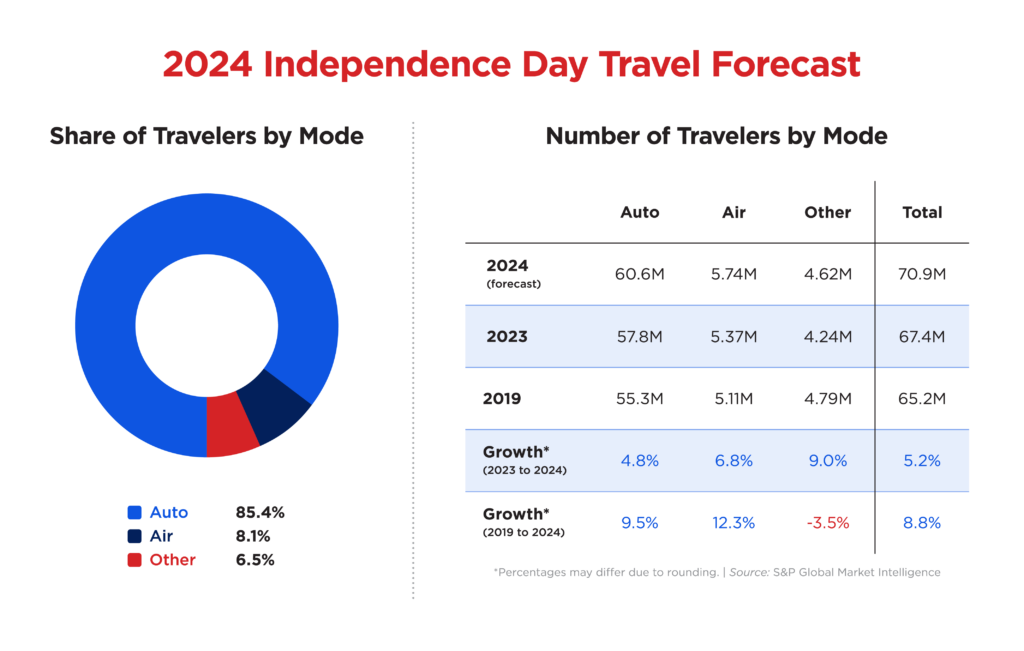
    WASHINGTON, DC (June 20, 2024) – AAA projects 70.9 million travelers will head 50 miles or more from home over the Independence Day holiday travel period*. For the first time, AAA looked at the entire July 4th week, plus the Saturday before and the Sunday after the holiday. This year’s projected number of travelers for that time period is a 5% increase compared to 2023 and an 8% increase over 2019.
    “With summer vacations in full swing and the flexibility of remote work, more Americans are taking extended trips around Independence Day,” said Paula Twidale, Senior Vice President of AAA Travel. “We anticipate this July 4th week will be the busiest ever with an additional 5.7 million people traveling compared to 2019.”  
    Share of Travelers by Mode pie chart and Number of Travelers by Mode table
    AAA projects a record 60.6 million people will travel by car over Independence Day week – that’s an additional 2.8 million travelers compared to last year. This year’s number also surpasses 2019 when 55.3 million people traveled by car over July 4th week. AAA car rental partner Hertz says Dallas, Denver, Salt Lake City, Los Angeles, and San Francisco are the cities displaying the highest rental demand during the holiday week. The busiest pick-up days are projected to be Friday, June 28, Saturday, June 29, and Wednesday, July 3.  
    Gas prices are lower than last year when the national average was $3.53. Pump prices will likely continue going down leading up to Independence Day.  At that point, they will likely level off and remain relatively stable until after Labor Day, similar to last year.  An important caveat is hurricane season – underway now – which could affect gas prices should a storm negatively impact Gulf Coast oil production and refining centers. 
    The number of air travelers is also expected to set a new record. AAA projects 5.74 million people will fly to their July 4th destinations. That’s an increase of nearly 7% compared to last year and a 12% increase over 2019. AAA booking data shows domestic airfare is 2% cheaper this Independence Day week compared to last year, and the average price for a domestic roundtrip ticket is $800. Airports will be packed throughout the week. AAA recommends arriving 2 hours early, reserving parking ahead of time, and traveling with carry-on luggage versus checked bags to save time and money.  
    More than 4.6 million people are expected to travel by other modes of transportation, including buses, cruises, and trains. This category is seeing an increase of 9% compared to last year, but this year’s number is shy of 2019’s figure of 4.79 million. Cruising continues its remarkable post-pandemic comeback. This time of year, Alaska cruises are in high demand, making Seattle and Anchorage top domestic destinations. Cruise travelers are also finding deals this summer. With new ships coming onto the market – and going for a premium – some cruise lines have been offering targeted discounts to fill older inventory for remaining cabins. 

    Best/Worst Times to Drive and Peak Congestion by Metro 
    INRIX, a provider of transportation data and insights, says the worst times to travel by car before and on July 4th are between 2pm and 7pm. Drivers should hit the road in the morning, and travelers returning on Monday, July 8th should avoid rush hour traffic in the morning and afternoon. 
    “Drivers in large metro areas can expect the worst traffic delays on Wednesday, July 3rd, as they leave town, and Sunday, July 7th, as they return,” said Bob Pishue, transportation analyst at INRIX. “Road trips over the holiday week could take up to 67% longer than normal. Travelers should monitor 511 services, local news stations, and traffic apps for up-to-the-minute road conditions.” 

    Source: INRIX 

    Welcome to the AAA Newsroom: July 4th Travel Expected to Set New Record

    Are you ready for the holiday weekend? We have exciting news to share with you – July 4th travel is expected to reach new heights this year! The American Automobile Association (AAA) has released their latest report, predicting record-breaking numbers of individuals hitting the road for Independence Day.

    Here are some key highlights of what to expect for this year’s July 4th travel:

    • Higher than Ever Before: AAA anticipates that a staggering number of Americans will be traveling this holiday weekend. With COVID-19 restrictions easing and more people feeling comfortable to venture out, the roads are expected to be busier than ever.
    • Popular Destinations: From beach getaways to mountain retreats, travelers are flocking to various destinations across the country. Whether you prefer a relaxing beach day or an adventurous hike, there’s something for everyone to enjoy this July 4th.
    • Increased Safety Measures: As travel picks up, AAA reminds travelers to prioritize safety. Be sure to follow all local guidelines, pack essentials like hand sanitizer and masks, and practice social distancing whenever possible.

    As we gear up for the holiday weekend, it’s essential to plan ahead and stay informed. Keep an eye on our AAA Newsroom for updated information and tips to make your July 4th travel experience as smooth as possible.

    source: AAA Newsroom

  • Brit barred from Tui flight due to ‘slight mark’ on passport forced to pay £1200

    black and yellow bus seats

    A holidaymaker was forced to shell out £1,200 for a same-day British Airways flight to Cancun after she was blocked from boarding her original Tui plane because of a “slight mark” on her passport.

    Laila March, 25, a private tutor from Croydon in south London, thought she was getting a “cheap deal” with Tui for less than £1,000 per person when she booked a week’s holiday to the tropical beach destination with her sister Kaemarnie, 21, to celebrate her graduating from university.

    When the pair arrived at Gatwick Airport on June 7, Laila was told she could not board the plane because her passport was damaged – even though she uses it to travel regularly for work and had just flown back from Morocco the day before.

    As a last-ditch attempt, Laila, who is studying to become a French and Spanish teacher, decided to try her luck with British Airways (BA) and was shocked to learn they had “no issue” with her passport and would happily let her fly.

    Not wanting her sister to travel alone, Laila purchased a last-minute ticket for £1,200 and had no problem clearing customs after arriving in Mexico only a few hours later than expected.

    But having to shell out an extra £1,200 put a dent in Laila’s savings.

    She complained in the hope of getting refunded for the pricey ticket and, after initially being told Tui had closed her case, more than two weeks later the company has now agreed to reimburse her.

    “I think it’s just insane that Tui can say my passport is damaged and not allow me to board for fear I’m not going to be allowed into Mexico by passport control, and then for another airline to have no issue with the same passport, let me fly to Mexico and then I get through passport control,” Laila told PA Real Life.

    “I’m studying to become a teacher, I start in September, and that money was money that I had saved up towards getting myself set up for university.”

    According to the UK Passport Office’s website, a passport is considered damaged if “you cannot read any of your details, any of the pages are ripped, cut or missing, there are holes, cuts or rips in the cover, the cover is coming away or there are stains on the pages, for example ink or water damage.”

    “It was a very small mark, almost like a little scratch on the right-hand side of the page but you would have to look very carefully to see it – I hadn’t even noticed until they pointed it out,” said Laila.

    Laila wanted to book a holiday to celebrate her little sister graduating from the University of Keele with a law degree.

    They found “a really cheap deal” on the Tui website, a one-week holiday at the Azul Beach Resort Riviera in Cancun, Mexico, for under £1,000 per person, flights included.

    “It was the first time we were going on holiday just the two of us,” added Laila.

    The pair were due to depart from Gatwick Airport on June 7, a day after Laila arrived back in the UK from Morocco, where she had been working as a private tutor.

    They arrived at the North Terminal Tui check-in desk two hours early, expecting to collect their tickets with plenty of time to relax before their flight.

    Laila said the check-in assistant scanned their passports and was about to hand over their boarding passes when she spotted a small stain in the top right of her picture page.

    “She was like, ‘What’s happened to your passport? What’s this mark on it?’,” Laila said.

    “Apparently there was a slight mark on the photo page, but it wasn’t over any of the details and you could still read everything.

    “She called someone who took my passport and disappeared for half an hour, even though I explained, I flew into this airport yesterday and have travelled many times in the past year.”

    After waiting 45 minutes, Laila was informed she could not board the plane.

    “They said Mexico has really strict passport control so I might not be let into the country,” said Laila.

    “According to them, my passport was damaged so they couldn’t allow me to fly with Tui because if I get to Mexico and they send me back, it’s going to be a charge for them.”

    Laila said she was given three options: to apply for an emergency passport and travel a few days later, to change the name on her booking so someone else could travel in her place, or to see if another airline would accept her passport.

    “They told me British Airways was flying out from the South Terminal this afternoon: ‘Maybe you could try with them?’,” explained Laila.

    “But you’ve just said that my passport was damaged, how can you recommend I use another airline?”

    Laila did not want to ruin her sister’s graduation holiday but at the same time was concerned because she had never been traveling alone.

    “Ultimately, I had to find a way,” she said.

    With no time to spare, Laila headed for the South Terminal to plead her case.

    “I spoke to someone who works at Gatwick and showed them my passport,” she said.

    “I told them what Tui had said and he was like ‘that’s not damaged, go speak to British Airways and see what they say’.

    “‘I don’t see why they wouldn’t let you board’.”

    The BA desk examined her passport and confirmed she could purchase a fresh ticket for £1,200 and fly out that very afternoon.

    “They were able to scan my passport and print out my boarding pass, just like the lady at Tui,” said Laila.

    “There was absolutely no issue, I just had to pay an extra £1,200.”

    Upon arrival, Laila was still apprehensive, thinking Mexican border control could still turn her away but again, they examined her passport and waved her through.

    “I gave them my passport and they looked at the mark,” said Laila.

    “I understood what they were saying because I speak Spanish.

    “They were saying her passport isn’t damaged because no pages have been ripped out, you can still scan it and everything is clear, readable and you can see her face.”

    Laila raised a complaint with Tui in the hope of getting a full or partial refund for her BA flight, which cost more than the holiday.

    She was told Tui would investigate the matter, but on June 16 she received an email saying her case had been closed.

    Then last week, on June 21, she received another message to say the company would be refunding the cost of the BA ticket in the next two weeks.

    After arriving at the hotel, Laila said it was a “good holiday” but that the whole experience was tarnished by her having to pay so much money.

    Laila has another holiday booked with Tui to Jamaica in September this year and fearing she will be turned away again, has applied for a new passport.

    “This whole experience with Tui has just left a sour taste in my mouth and I just want to avoid it happening again.”

    A Tui UK & Ireland spokesperson said: “We’re sorry to hear Ms March was unable to travel with Tui as planned due to the damage on her passport.

    “Customers are informed by email, and on our website, at the time of booking and prior to travel that UK Government’s passport requirements must be followed.

    “We strongly advise that customers check their passports are damage-free as if there is any concern a passenger could be denied entry to their destination, they will be denied travel at the discretion of our check-in team.

    “Details of passport validity can be found here: www.gov.uk/renew-adult-passport/replace“

    Join thought-provoking conversations, follow other Independent readers, and see their replies.

    Laila said the whole experience with Tui has left a sour taste in her mouth.

    Laila March, 25, from Croydon, was blocked from boarding her original Tui flight because staff deemed her passport was damaged.

    Laila (left) and her sister Kaemarnie, 21, booked a holiday to Cancun, Mexico, with Tui.

    Laila shelled out £1,200 for a same-day British Airways flight to Cancun after she was refused boarding.


    Source: bbc.com

  • West Maui Reopens to Tourists Two Months After Devastating Wildfires

    people walking on sidewalk during daytime

    West Maui Reopens to Tourists Two Months After Devastating Wildfires

    Tourists were officially welcomed back to West Maui on Sunday, two months after wildfires displaced thousands of residents, killed 98 people, and destroyed hundreds of buildings. Historic Lahaina Town remains unrecognizable, with cleanup of debris just beginning.

    Hawaii Gov. Josh Green announced on Sept. 8 that unaffected areas north of the fire would reopen to travelers to help the region recover economically. To kick off the reopening, five hotels and eight timeshare condos in West Maui began accepting guests, covering 3 miles of the northwestern coast.

    The island’s reopening has been met with mixed reactions. Some residents worry it’s too soon, fearing the government will prioritize tourism dollars over urgent needs like education and housing. Others see it as necessary for economic recovery. Maui County Mayor Richard Bissen emphasized the need to balance grief with economic necessity, stating that many in the community are ready to return to work to support their families.

    Peter Fuleky, an economics professor at the University of Hawaii at Manoa, highlighted the importance of tourism to Maui, noting that while the island accounts for 12% of the state’s jobs, it makes up one-third of the visitor spending statewide. Visitor arrivals on Maui in August dipped more than 60% compared to July, according to the Hawaii Tourism Authority.

    The reopening of West Maui, home to over half of the island’s accommodations, is controversial. Some residents welcome respectful visitors who support local businesses and volunteer, while others prefer more time to heal. Prior to reopening, the state and county urged tourists to be respectful and avoid taking inappropriate photos.

    In a phased reopening, all travel restrictions to Kaanapali, Napili, Honokowai, and Kapalua have been lifted, with hotels opening in groups. The Hawaii Tourism Authority encourages support for local businesses and workers reliant on tourism. Lahaina remains closed to the public “until further notice out of respect to the town’s residents.” Residents have begun to visit their properties in protective gear due to toxic ash.

    Tourism recovery is expected to be slow, with an 80% recovery of pre-fire visitor levels not expected until the end of 2024, according to Carl Bonham, a professor of economics at the University of Hawaii at Manoa.

    Merriman’s Kapalua, a restaurant in West Maui, has been delivering free meals and providing free Wi-Fi to residents since the fires. Owner Peter Merriman supports the reopening, saying many employees want to return to work despite potential financial losses.

    Jesse Imbach, who lost his Lahaina restaurants to the fire, supports a phased reopening but worries about the impact on resources and the presence of tourists interested in seeing the aftermath.

    Officials have launched online resources for visitors to donate, volunteer, and plan their trips to Maui. Some residents, like Blake Ramelb, feel the reopening timeline is too rushed, impacting mental health and recovery.

    The Maui City Council voted unanimously to delay the reopening, citing the need for a trauma-informed approach. Jan Jones, a lecturer in hospitality and tourism management at the University of New Haven, highlighted the challenge of balancing community protection with economic needs.

    Small businesses, already hit hard by the pandemic, need tourists for survival. Jerry Agrusa, a hospitality and tourism management professor at the University of Hawaii at Manoa, advised tourists to support local businesses to aid recovery.

    For more information on supporting Maui’s recovery, visit the Maui Strong website and the Hawaii Tourism Authority website. A list of local businesses to support can be found at Maui Nui First.

    Kathleen Wong is a travel reporter for USA TODAY based in Hawaii. Bailey Schulz is a general assignment money reporter based in Las Vegas. Contributing: The Associated Press.

    source: usatoday.com

  • Zurich Acquires AIG’s Travel Insurance Business for $600 Million – Insurance Journal

    black DSLR camera near passport

    Zurich announced early Wednesday that it is acquiring the global personal travel insurance business of American International Group (AIG) for $600 million. An additional payment may be made if specific targets are met after the sale, which is anticipated to close by the end of 2024.

    Zurich emphasized that travel insurance is a “priority” and stated that AIG’s Travel Guard business will strengthen its U.S. presence through Zurich’s travel insurance provider, Cover-More Group, positioning it as a leading travel insurance provider.

    “This transaction is a great strategic fit, enhancing Zurich’s existing capabilities and establishing us as a leading travel insurance provider across all regions,” said Cara Morton, CEO of Zurich Global Ventures. “The acquisition broadens our retail customer base and aligns with our goal to continuously enhance our offerings, providing world-class protection throughout our customers’ travels.”

    Cover-More’s capabilities will be bolstered by AIG’s global IT platform, and the deal includes AIG’s global service centers. However, the transaction excludes travel coverages offered through AIG’s Accident & Health (A&H) business.

    AIG CEO Peter Zaffino described the sale as “another important strategic step in positioning AIG for the future.” He assured that AIG will work closely with Zurich to ensure a seamless transition for employees, customers, and global distribution partners.

    Zurich expects this acquisition to generate annual gross written premiums of about $2 billion for the new Cover-More Group. Bank of America analysts noted that Zurich appears to have made a “sensible acquisition” that could increase earnings per share by 1-2% post-integration.


    source: insurancejournal.com

  • Hunton Andrews Kurth LLP: Pioneering Environmental Law and Advocacy

    book lot on black wooden shelf

    At Hunton Andrews Kurth LLP, our lawyers are on the front lines of emerging environmental issues, safeguarding and advancing our clients’ interests in state and federal courts across the country, before regulatory agencies, and within the halls of Congress. Whether you are facing an enforcement action, navigating new regulations, or seeking assistance with permitting or environmental due diligence for an acquisition, our environmental team will partner with you to develop and implement comprehensive, business-focused solutions.

    Our Expertise and Experience

    With over 50 environmental lawyers situated nationwide—including in California, Texas, and Washington, DC—we possess the deep knowledge and extensive experience necessary to handle a wide range of environmental matters. We help you manage day-to-day issues and respond swiftly and effectively in crisis situations.

    Our environmental team has been at the forefront of the field for the last 50 years. Established in 1970, we helped clients navigate the enactment and initial implementation of the first modern federal and state environmental statutes. Having participated in more than 40 US Supreme Court cases and hundreds of cases in the US Courts of Appeals, we continue to be thought leaders on emerging environmental issues.

    Comprehensive Environmental Practice

    Our rich knowledge and deep bench of lawyers—with experience in industry as well as at EPA, DOJ, DOI, DOE, Capitol Hill, and the White House—enable us to tackle problems and build durable solutions. Our air practice has been involved in significant rulemakings since the enactment of the Clean Air Act. Our climate change lawyers have litigated precedent-setting greenhouse gas public nuisance suits. Our water practice has been part of crucial rulemakings under the Clean Water Act since its inception in the 1970s. Additionally, we represent industry-leading clients in regulatory compliance, enforcement defense, and policy advice within the chemicals sector and related to waste control and storage.

    Industry Expertise

    Strengthened by extensive experience in the energy, automobile, chemical, manufacturing, semiconductor, primary steel, specialty industrial gas, commercial real estate development, petroleum product terminaling, and mineral extractive industries, and with federal, state, and local regulatory authorities, our firm counsels clients on diverse and evolving environmental legal and regulatory challenges. We maintain a keen focus on your strategic business goals while providing expert legal services at all stages of the regulatory process—from initial legislative and policy developments, through rulemaking and implementation, to defense against enforcement actions and litigation of complex cases.

    Recognized Excellence

    Our rankings speak volumes. Hunton Andrews Kurth was named the 2017 and 2021 Chambers USA Environmental Law Firm of the Year. Our environmental practice and many of our lawyers are ranked Band 1 nationally by Chambers USA and Chambers Global. We maintain the top national ranking for environmental law and water law—and regionally in each state where our team lawyers are based—in US News-Best Lawyers. We are top-ranked by Legal 500, Benchmark Litigation, and since 2012, we have been designated an Environmental Group of the Year by Law360 eleven times.

    Specialized Practices

    Hunton Andrews Kurth LLP successfully guides clients through all stages of incident response. We offer the first centralized source for tracking state applications for primacy over Class VI permitting programs, as well as the status of Class VI permit applications nationwide. Our PFAS practice is interdisciplinary, with experience in state and federal regulatory, litigation, and technical issues related to PFAS.


    source: huntonak.com

  • The Global Sanitation Crisis: Urgent Action Needed to Meet 2030 Goals

    The Global Sanitation Crisis: Urgent Action Needed to Meet 2030 Goals

    The world is alarmingly off-track to deliver sanitation for all by 2030. Despite progress in global sanitation coverage in recent years, over half the world’s population—4.2 billion people—use sanitation services that leave human waste untreated, threatening both human and environmental health. This report presents the state of sanitation in the world today, aiming to increase awareness of the progress made towards achieving the Sustainable Development Goal (SDG) targets for sanitation, and to identify opportunities to meet the remaining challenges. It calls on the Member States of the United Nations system and partners to urgently meet these challenges as part of the Global Acceleration Framework for SDG 6.

    Current State of man wearing surgical suit near mirror

    Despite improvements, the global sanitation crisis remains severe. Many communities, particularly in low-income countries, still lack access to basic sanitation facilities. This lack of access results in the widespread practice of open defecation, which contaminates water sources and contributes to the spread of diseases such as cholera, diarrhea, and dysentery. These conditions disproportionately affect children, leading to high rates of child mortality and stunting due to repeated infections.

    Progress and Challenges

    In the past decade, efforts to improve sanitation have led to increased access to improved facilities for millions of people. However, these gains are unevenly distributed, with significant disparities between urban and rural areas, and among different socio-economic groups. For instance, while urban areas in some countries have seen marked improvements, rural regions often remain neglected. The poorest and most marginalized communities are the hardest hit, lacking the resources and infrastructure necessary for safe sanitation.

    The Role of Governments and International Organizations

    Governments and international organizations play a crucial role in addressing the sanitation crisis. Investments in infrastructure, education, and technology are essential to expanding access to safe sanitation. Policies must prioritize the most vulnerable populations, ensuring that no one is left behind. Public health campaigns and community-led initiatives can also drive behavior change, promoting the use of toilets and the importance of hygiene.

    The Global Acceleration Framework

    The Global Acceleration Framework for SDG 6 calls for coordinated efforts to achieve universal access to sanitation. This includes increasing financial investments, leveraging innovative technologies, and fostering partnerships across sectors. By working together, stakeholders can develop sustainable solutions that address the root causes of poor sanitation and ensure long-term benefits for all communities.

    COVID-19 and Sanitation

    The COVID-19 pandemic has highlighted the critical importance of sanitation and hygiene in preventing the spread of infectious diseases. It has also exacerbated existing inequalities, with marginalized communities facing greater difficulties in accessing sanitation services. As countries recover from the pandemic, there is an urgent need to integrate sanitation into broader public health and development strategies, ensuring resilient and inclusive systems.

    Call to Action

    The report urges immediate and sustained action to close the sanitation gap by 2030. This involves:

    1. Increased Investment: Allocating more financial resources to build and maintain sanitation infrastructure.
    2. Policy Reform: Implementing policies that promote equitable access to sanitation services.
    3. Community Engagement: Empowering communities to take ownership of sanitation projects through education and participation.
    4. Innovation: Leveraging new technologies and practices to provide affordable and sustainable sanitation solutions.
    5. Monitoring and Accountability: Strengthening data collection and monitoring systems to track progress and hold stakeholders accountable.

    Achieving universal access to sanitation is a fundamental human right and a key component of sustainable development. The challenges are significant, but with concerted global effort, it is possible to make substantial progress. The Member States of the United Nations system and their partners must prioritize sanitation as a critical issue, investing in the health, dignity, and well-being of billions of people worldwide.

    For More Information

    Please contact: pubdoc@unicef.org Get the latest data, research, and analysis on the issues affecting children around the world. Discover our latest reports and explore by topic, with a special focus on COVID-19.

    Community health workers are at the heart of UNICEF’s work to reach every child with lifesaving vaccines. Universal access for all and leaving no one behind is the guiding principle that will drive efforts to achieve sanitation for all by 2030.

    Source: UNICEF

  • Exploring Environmental Science & Water Quality with Marquette’s Outreach Program

    a row of bottles filled with liquid sitting on a shelf

    Project Water Expands Science Career Possibilities for Milwaukee Public School Students

    For two weeks this fall semester, Christina Lim and Sophie Bridwell carefully gathered their microbiology lab equipment, placed it securely in their vehicles, and drove to Milwaukee Public Schools’ Audubon Technology and Communication High School. Their mission: to educate students about the importance of water quality and introduce them to the world of science. This initiative is part of “Project Water,” an educational outreach program aimed at high schools in the Milwaukee Public School (MPS) system that lack sufficient lab equipment or dedicated science rooms.

    Christina Lim, a lab manager in Marquette’s Department of Biological Sciences, and Sophie Bridwell, a Ph.D. candidate in microbiology, see this experience as a way to inspire a new generation about the importance of clean water and environmental microbiology. With only a few chairs and tables provided, Lim and Bridwell set up the same lab equipment they use in their Ph.D. and graduate programs to conduct labs for the high school students. Twice a week, they teach three classes a day to around 80 students.

    “By teaching them basic microbiology and water quality testing, it introduces the students to new areas that they didn’t know anything about but may have great interest in,” Bridwell says.

    In the labs, students tested water quality, including taking local water samples and testing for lead contamination. They also attended field trips to Jones Island Water Reclamation Plant and the University of Wisconsin-Milwaukee’s School of Freshwater Sciences. At Jones Island, students learned about waste management, engineering, and plumbing. At the School of Freshwater Sciences, they explored natural systems and an academic research environment.

    “We were able to show the students that this profession is very much in the realm of possibility if that’s what they choose to pursue down the road,” Lim says.

    Although the program focuses on educating high school students about water quality issues, the larger aim is to expose students to science lab work and the opportunities available to them after graduation.

    “It’s important for people to see that science doesn’t happen in a white ivory tower — you don’t need to be from a certain background or from a certain demographic,” Lim says. “Scientists come in different types and it’s important for them to see that science is accessible to them.”

    Project Water began in 2015 with funding secured by Kiana Yang, a postdoctoral researcher in the Opus College of Engineering, and Dr. Krassi Hristova, a professor of biological sciences in the Klingler College of Arts and Sciences. In 2019, Dr. Chris Marshall, an assistant professor of applied and environmental microbiology, joined the effort until the pandemic paused the program in 2020.

    Last fall, Marshall helped revive the program with Hristova and new funding from the Milwaukee Metropolitan Sewerage District. In 2023, Marshall took over the program, which is now organized and based out of his lab.

    “Project Water doesn’t just focus on water quality issues,” Marshall says. “It’s also trying to expose the students to the world of STEM (science, technology, engineering, and math) and the possibility of a career within it.”

    source: today.marquette.edu