
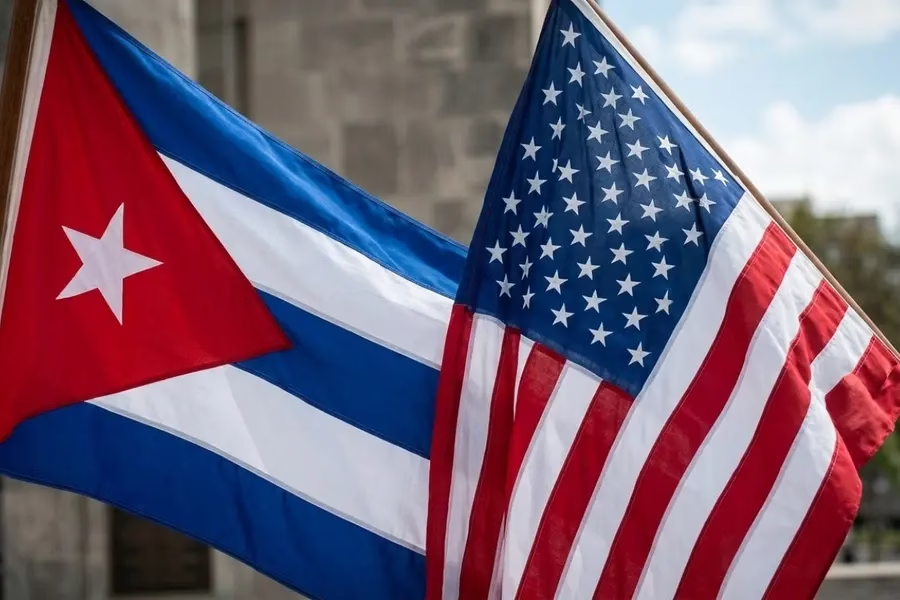
Miguel Díaz-Canel has confirmed that Cuba recently held talks with the United States, marking the first official acknowledgement by the Cuban government that discussions between the two countries have taken place.
Speaking on Friday, Díaz-Canel said the conversations were intended to address longstanding disputes between the two nations and explore possible areas of cooperation.
“The talks were aimed at finding solutions through dialogue to the bilateral differences between our two nations,” the Cuban president said, adding that “international factors” had helped facilitate the exchanges. He did not provide further details about the discussions or the circumstances surrounding them.
The confirmation comes as Cuba faces a worsening energy crisis. Díaz-Canel said the island has not received any petroleum shipments in the past three months, blaming what he described as a U.S. energy blockade for the disruption.

A major blackout struck western Cuba last week, leaving millions of people without electricity. The outage was reportedly triggered by a failure at a thermoelectric plant that forced the shutdown of the national power grid.
Cuba produces roughly 40 percent of its petroleum domestically, but Díaz-Canel said that supply has not been sufficient to meet the country’s energy demands.
“The impact is tremendous,” he said, noting that power shortages have disrupted communications, education and transportation while forcing the postponement of tens of thousands of surgeries.
Authorities have resorted to emergency measures to cope with the energy shortage. More than 115 bakeries across the island have reportedly been converted to operate using firewood or coal instead of electricity.
The government has also begun expanding renewable energy efforts. According to Díaz-Canel, 955 solar panel systems have been installed in rural homes and social centers, with additional installations expected to bring about 100 megawatts of power to the national grid before the end of March.
“Even with everything we’re putting together, we still need oil,” the president said.
Economic activity has also been affected by the crisis, with Díaz-Canel warning that falling energy supplies have reduced industrial output and forced adjustments in employment across the country.
Cuba’s energy problems worsened after critical oil shipments from Venezuela were halted following U.S. military action that led to the arrest of Venezuelan President Nicolás Maduro.
Officials say many of Cuba’s aging thermoelectric plants have been operating for more than 30 years and have received minimal maintenance because of the high costs involved. Cuban authorities also argue that U.S. sanctions have limited the country’s ability to purchase replacement equipment and specialized parts.
During the press session following his speech, Díaz-Canel also addressed a recent maritime incident involving a Florida-flagged vessel in Cuban waters. Cuban authorities said four of ten people aboard the boat were killed after troops accused the group of opening fire on security forces. A fifth suspect later died from injuries.
The Cuban leader said investigators from the Federal Bureau of Investigation are expected to travel to Cuba soon as both countries continue to share information about the case. Five remaining suspects have been detained and face terrorism-related charges.
Díaz-Canel’s remarks came a day after the Ministry of Foreign Affairs of Cuba announced plans to release 51 prisoners, a move the government described as a gesture of goodwill linked to the country’s relationship with the Vatican.
“It is a sovereign practice, no one imposes it on us,” Díaz-Canel said. “It responds to our humanistic vocation.”
