
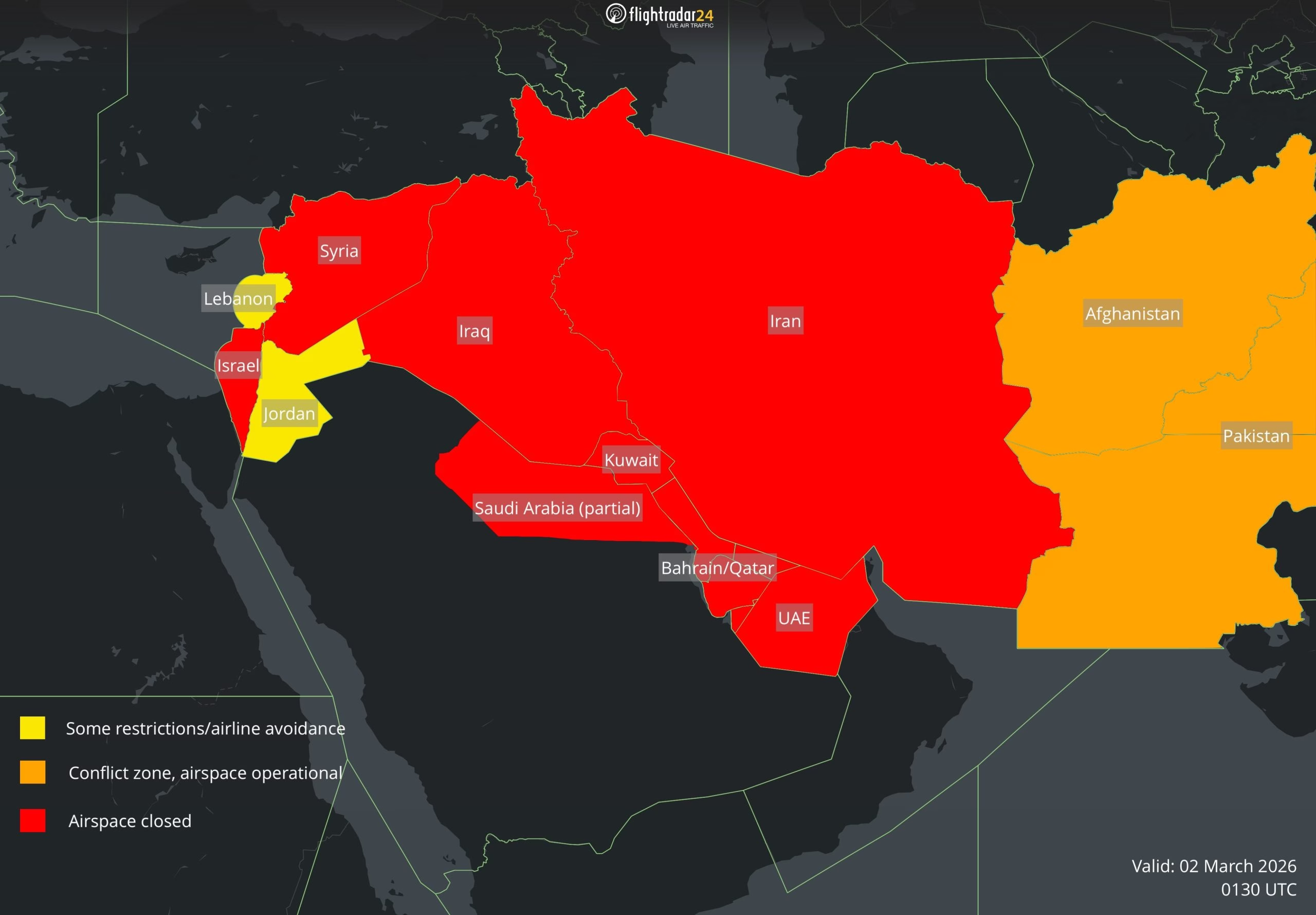
Air travel across the Middle East and beyond was thrown into chaos on Saturday after U.S. and Israeli strikes on Iran forced multiple countries to shut their airspace, stranding hundreds of thousands of passengers and shutting down three of the world’s most important aviation hubs linking Europe, Africa and Asia.
Countries including Israel, Qatar, Syria, Iran, Iraq, Kuwait and Bahrain closed their airspace, while the United Arab Emirates announced a “temporary and partial closure,” according to FlightRadar24. The closures halted flight activity over major transit routes and led to the shutdown of airports in Dubai, Abu Dhabi and Doha.
More than 1,000 flights were cancelled by leading Middle Eastern airlines, including Emirates, Qatar Airways and Etihad Airways. Aviation analytics firm Cirium estimates these carriers normally handle around 90,000 passengers daily through the three hubs.
Officials in the UAE reported that Dubai International Airport recorded four injuries, while Zayed International Airport said one person was killed and seven others wounded in a drone strike. Kuwait International Airport also reported strike-related incidents.

Although Iran did not publicly claim responsibility, Gulf states said the scope of retaliatory attacks extended beyond U.S. military bases that Tehran had previously warned it would target.
“For travellers, there’s no way to sugarcoat this,” said airline analyst Henry Harteveldt of Atmosphere Research Group. “You should prepare for delays or cancellations for the next few days as these attacks evolve and hopefully end.”
Airlines were forced to reroute flights south over Saudi Arabia, adding hours of flying time and increasing fuel costs. This could push ticket prices higher if the conflict continues. Air traffic controllers in Saudi Arabia are also expected to face heavy pressure as rerouted flights converge on limited corridors.
Former U.S. air traffic official Mike McCormick said partial airspace reopenings may occur within 24 to 36 hours once military flight paths become clearer and missile threats diminish. However, the duration of disruption remains uncertain. A similar U.S.-Israel operation against Iran in June 2025 lasted 12 days.
At least 145 aircraft bound for cities such as Tel Aviv and Dubai were diverted to Athens, Istanbul or Rome, according to FlightAware. One flight from Philadelphia spent nearly 15 hours in the air before returning to its departure airport.
Airlines around the world issued cancellations and travel waivers. India designated much of the Middle East, including Jordan, Saudi Arabia and Lebanon, as a high-security risk zone. Air India cancelled all Middle East services, while Turkish Airlines suspended flights to Lebanon, Syria, Iraq, Iran and Jordan, and halted services to Qatar, Kuwait, Bahrain, the UAE and Oman.
U.S.-based Delta Air Lines and United Airlines suspended flights to Tel Aviv. European carriers including Lufthansa and Air France cancelled flights to Lebanon, while KLM had already halted Tel Aviv services earlier in the week. British Airways suspended flights to Tel Aviv and Bahrain, and cancelled services to Amman. Virgin Atlantic said it would avoid Iraqi airspace, lengthening some routes to India and the Gulf. American Airlines suspended flights from Philadelphia to Doha.
Passengers were urged to check flight status before heading to airports. Some airlines offered free rebooking waivers.
Jonathan Escott, whose Emirates flight from Newcastle to Dubai was cancelled, said uncertainty dominated the situation. “No one really knows what’s going on with the conflict. Not Emirates. No one has a clue,” he said.
Aviation experts warned travellers to expect prolonged disruption. “If you haven’t left home, chances are you won’t be leaving home if you’re supposed to travel to or through these destinations for at least several days,” Harteveldt said. “And if you are returning home, you will have to be very creative about how you get home.”
