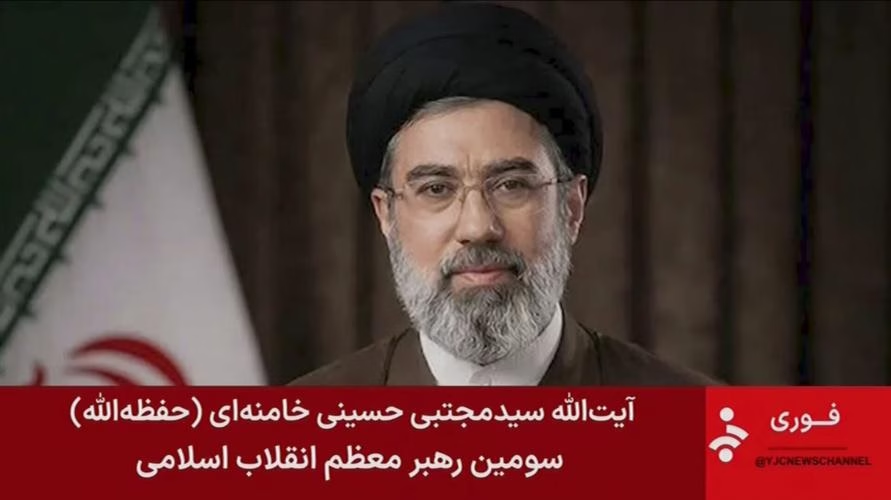
Global oil markets surged sharply after Iran announced that Mojtaba Khamenei has been appointed as the country’s new supreme leader, succeeding his father Ali Khamenei amid an intensifying regional conflict.
The leadership change comes during a widening confrontation involving Iran, Israel, and the United States, sending shockwaves through global energy markets and raising fears of prolonged instability in the Middle East.
Oil Prices Surge Above $100
Oil prices spiked dramatically following the announcement, with major crude benchmarks climbing above $100 per barrel for the first time in years. Brent crude briefly reached nearly $120 per barrel before easing slightly, reflecting market anxiety over potential disruptions to global energy supply.

Analysts say the surge is largely driven by concerns that escalating military tensions could disrupt shipments through the Strait of Hormuz — a strategic waterway through which roughly a fifth of the world’s oil supply passes.
The conflict has already affected energy infrastructure and shipping routes across the Gulf region, further fueling volatility in commodity markets.
Leadership Change During Wartime
The appointment of Mojtaba Khamenei was confirmed by Iran’s powerful clerical body known as the Assembly of Experts. The 56-year-old cleric, widely viewed as a hard-line figure with close ties to the Islamic Revolutionary Guard Corps, now holds the highest political and religious authority in the Islamic Republic.
His rise to power follows the death of his father, Ali Khamenei, during the early stages of the ongoing war involving Israeli and U.S. military operations in Iran.
Observers say the succession signals continuity in Iran’s political and military posture rather than a shift toward de-escalation.
Global Economic Concerns
The rapid rise in oil prices is raising alarm among economists and policymakers worldwide. Higher crude prices could drive up fuel costs, transportation expenses, and inflation in many countries already dealing with economic uncertainty.
Financial markets have also reacted nervously, with stocks falling in several regions as investors assess the potential long-term impact of a wider Middle East conflict. Energy analysts warn that further disruptions could push prices even higher if the war expands or shipping routes remain threatened.
Growing Geopolitical Tensions
The leadership transition and the ongoing conflict have heightened fears that the crisis could evolve into a broader regional war involving multiple countries. Military exchanges and attacks on energy infrastructure have already been reported across several Middle Eastern states.
With Iran’s new leadership taking charge during one of the most volatile periods in the region’s history, global attention remains focused on how the conflict and energy markets will develop in the coming weeks.
Swifteradio.com
