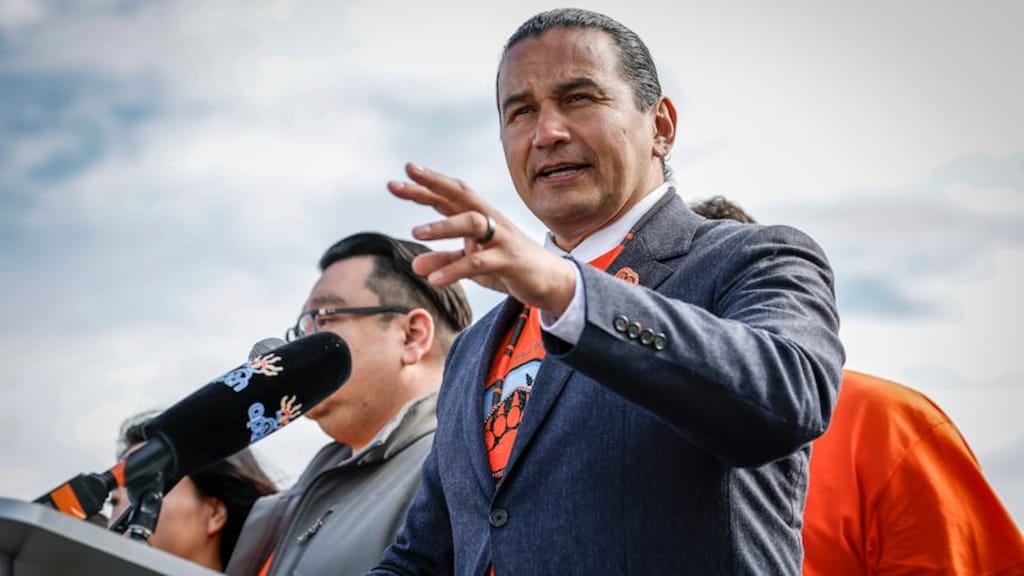
Manitoba Premier Wab Kinew is facing criticism over his position that denying or downplaying the history of Canada’s residential school system should not be made a criminal offence, prompting renewed debate about Indigenous rights, historical accountability and reconciliation.
Speaking to CBC Manitoba on October 9, 2026, Kinew described residential school denialism as detestable but argued that criminalizing it was not the right approach. Instead, he said governments should focus on education and combating misinformation.
His comments contrast with calls from Indigenous leaders and advocates who want stronger legal protections for residential school Survivors and their families against hateful statements that deny or minimize the system’s documented harms.

Debate Over Proposed Federal Legislation
The controversy centres partly on Bill C-254, introduced by Manitoba New Democratic Party MP Leah Gazan. The proposed legislation seeks to amend Canada’s Criminal Code to address the promotion of hatred against Indigenous people by criminalizing public statements that condone, deny, justify or minimize the residential school system.
Gazan first introduced the bill in October 2024, but it did not proceed after Parliament was dissolved ahead of the 2025 federal election. She reintroduced it in October 2025.
Gazan has argued that denying the experiences of residential school Survivors causes further harm and undermines reconciliation. The bill has not yet completed the parliamentary process required to become law.
The Assembly of First Nations has also called for residential school denialism to be criminalized. In July 2026, the national organization passed an emergency resolution supporting legal action against denialism, reflecting concerns among First Nations leaders about the spread of misinformation.
Residential Schools and Their Lasting Impact
For more than 150 years, residential schools operated across Canada, separating First Nations, Inuit and Métis children from their families and communities. The institutions, largely funded by the federal government and operated by religious organizations, were designed to assimilate Indigenous children into Euro-Canadian society.
An estimated 150,000 Indigenous children attended residential schools. The Truth and Reconciliation Commission documented more than 4,000 student deaths, while research and community investigations into missing children and burial sites continue.
Indigenous leaders say denialism can deepen the trauma experienced by Survivors and their families by dismissing documented history and lived experiences. The federal government has similarly warned that denying or minimizing residential schools’ harms damages Survivors, Indigenous communities and reconciliation efforts.
Kinew Emphasizes Education and Reconciliation
Kinew said education should extend beyond schools into workplaces, churches, sports organizations and other community settings. He argued that Canadians need a stronger understanding of residential school history to prevent misinformation from becoming more widespread.
The premier also pointed to recent efforts to preserve the history of the Brandon Residential School, including Manitoba’s partnership with the City of Brandon to purchase former school property containing a historic cemetery.
The disagreement highlights an ongoing national question: whether education and public awareness are sufficient to counter residential school denialism or whether additional legal measures are necessary.
Swifteradio.com
