
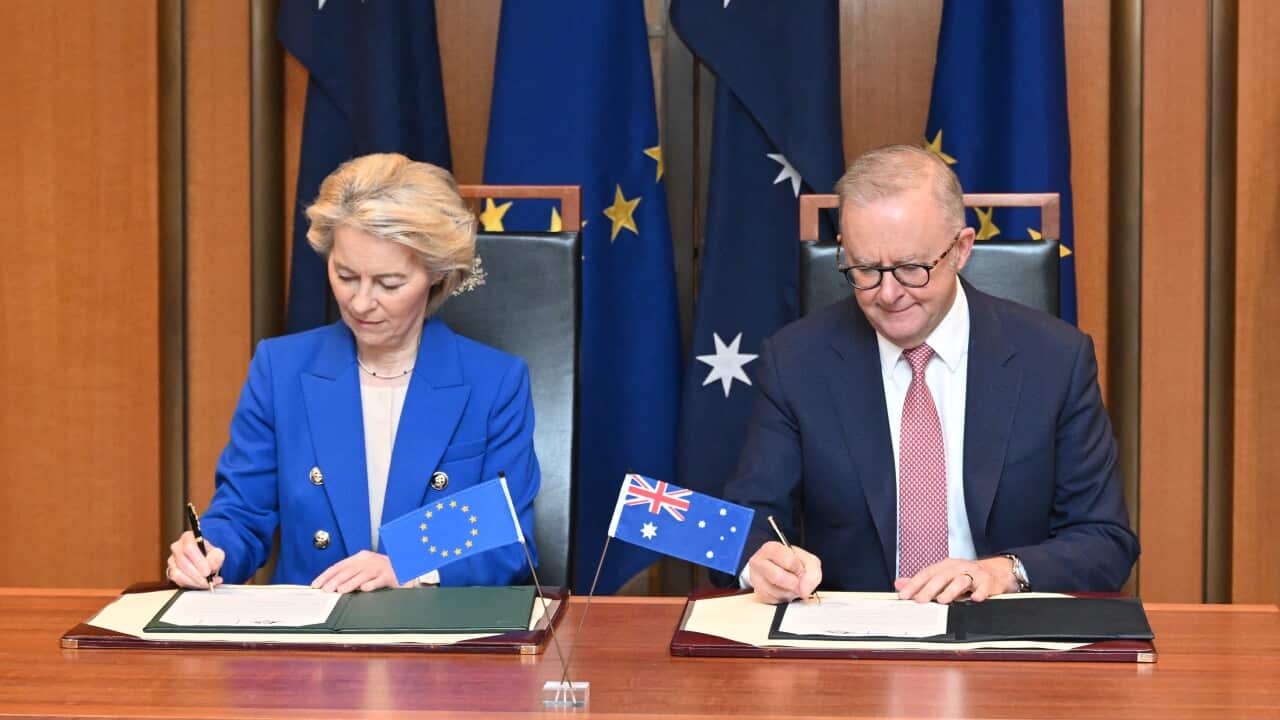
Australia and the European Union have signed a sweeping free trade agreement worth about A$10 billion (US$7 billion), ending eight years of negotiations and opening a new chapter in economic and security cooperation between the two partners.
The deal was finalized Tuesday, with Australian Prime Minister Anthony Albanese and European Commission President Ursula von der Leyen describing the agreement as a mutual “win-win” that will deepen trade ties while strengthening cooperation in a rapidly changing global landscape.
Under the agreement, almost all tariffs on trade between Australia and the EU will be removed. The deal also includes expanded collaboration on defence, critical minerals and strategic industries.
Von der Leyen said the partnership reflects a growing need for trusted economic relationships as global tensions reshape trade patterns.

“We are living in a world that is deeply changing,” she said, warning that major powers are increasingly using tariffs and supply chains as tools of geopolitical leverage.
She added that Australia and the European Union share a long-term relationship based on trust and cooperation rather than short-term transactions.
The agreement will significantly benefit Australian exporters by removing EU tariffs on a wide range of agricultural products, including wine, seafood, fruit and vegetables, olive oil, wheat, barley and most dairy products.
The Australian government said the tariff removal alone will save the country’s wine industry around A$37 million annually.
Australian consumers are also expected to benefit from lower prices on imported European goods such as wine, spirits, chocolates, biscuits and pasta.
One of the more sensitive issues during negotiations involved the use of traditional European food names. Under the deal, Australian producers will still be allowed to sell Italian-style sparkling wine domestically under the name prosecco, although the label will be phased out over a 10-year period for exports.
Australian producers will also retain the right to use names such as parmesan, while the use of feta will gradually be restricted through extended transition periods.
Albanese highlighted the cultural connections behind many of these food traditions, noting that Australia’s modern culinary landscape has been shaped by generations of European migrants.
“Whether it’s Greeks coming here and creating feta, or Italians doing parmesan, or people from Eastern Europe producing kransky sausages, it reflects our strong connection with Europe,” he said.
While many sectors welcomed the deal, some industry groups expressed disappointment over limits on beef exports.
Andrew McDonald of Meat and Livestock Australia said the agreement allows Australian producers to export about 30,000 tonnes of beef annually to the EU, up from 3,389 tonnes but short of the 50,000-tonne quota the industry had sought.
“This is unquestionably a missed opportunity for Australia’s red meat producers, processors and exporters,” he said.
Beyond trade, the agreement also includes a new security and defence partnership aimed at strengthening cooperation in areas such as counterterrorism, maritime security, space and defence industries.
The EU and Australia also announced expanded collaboration on critical minerals projects, including the development of lithium and tungsten supply chains, which are considered vital for clean energy technologies and advanced manufacturing.
