
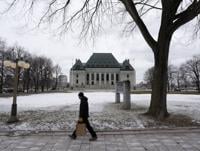
Canada’s highest court is set to hear a landmark challenge to Quebec’s controversial secularism law, commonly known as Bill 21, in a case that could redefine the use of the Constitution’s notwithstanding clause.
The legislation, formally titled Bill 21, prohibits certain public sector workers—including teachers, police officers, and judges—from wearing religious symbols while on duty.
A Defining Legal Battle
The case before the Supreme Court of Canada is widely seen as one of the most significant constitutional challenges in recent years.

At the center of the dispute is the law’s use of the Notwithstanding Clause, which allows governments to override certain Charter rights for a limited period.
Quebec invoked this clause to shield Bill 21 from legal challenges based on freedom of religion and expression.
Supporters Defend Secularism
Proponents of Bill 21 argue that the legislation is necessary to preserve state neutrality and reinforce secular values in public institutions.
They maintain that public officials in positions of authority should present a neutral image, free from visible religious affiliation.
Critics Raise Rights Concerns
Opponents, however, argue that the law disproportionately affects religious minorities, particularly Muslim women who wear hijabs, as well as Sikhs and other faith groups.
Civil liberties organizations and advocacy groups contend that the legislation violates fundamental freedoms guaranteed under the Charter.
The case has sparked widespread debate across Canada, with many viewing it as a test of how far governments can go in limiting individual rights.
Notwithstanding Clause in Focus
The Supreme Court’s review is expected to closely examine the scope and limits of the Notwithstanding Clause.
Legal experts say the ruling could set a precedent for how provinces and the federal government use the clause in future legislation.
National Implications
Beyond Quebec, the outcome of the case could have far-reaching implications for constitutional law and civil rights across Canada.
It may influence how governments balance collective values with individual freedoms, particularly in a multicultural society.
Awaiting a Historic Decision
As arguments begin, the nation is watching closely.
The Supreme Court’s eventual ruling on Bill 21 could reshape the legal landscape and redefine the boundaries of constitutional power in Canada.
Swifteradio.com
