
Canadian border authorities say they have cancelled at least 239 travel visas over concerns that the holders may be connected to leadership within Iran, as part of an ongoing security crackdown.
The figures were released by the Canada Border Services Agency (CBSA), which said the numbers are current as of March 5. Canadian officials first introduced measures in November 2022 declaring senior Iranian government officials, as well as members of the country’s security and intelligence apparatus, inadmissible to Canada.
According to the CBSA, those individuals are barred from entering Canada for alleged involvement in terrorism and systemic human rights violations.
So far, 32 individuals have been formally reported inadmissible due to their status as senior officials within the Iranian regime.

“Canada’s strong response to suspected senior officials in the Iranian regime remains in place and the CBSA continues to take action to stop them from seeking or finding safe haven in Canada,” the agency said in a statement.
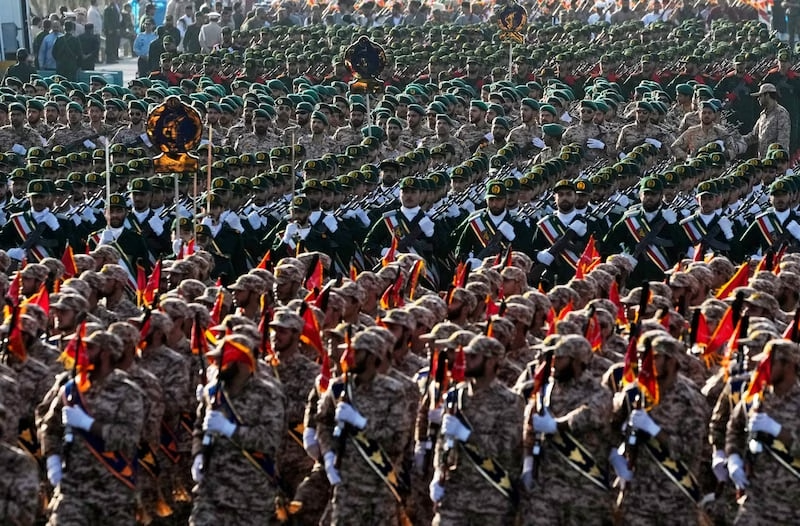
In 2024, the Canadian government formally designated the Islamic Revolutionary Guard Corps (IRGC) as a terrorist organization. The paramilitary force, which answers directly to Iran’s supreme leader, has been accused by Ottawa of carrying out terrorist activities and cooperating with groups such as Hezbollah and Hamas.
Canadian immigration officials say all Iranian citizens must apply for visas before travelling to Canada. If officers at Immigration, Refugees and Citizenship Canada (IRCC) identify potential admissibility concerns during the application process, the case can be referred to the CBSA for deeper security screening.
Authorities say roughly 17,800 visa applications have been reviewed so far for possible links to the Iranian government or security services.
At the same time, Canada has been assisting its citizens and residents stranded in the Middle East amid the ongoing conflict involving the United States, Israel and Iran.
According to Global Affairs Canada, more than 110,000 Canadians have registered their presence in the region. Since February 28, when the conflict escalated with U.S. and Israeli strikes, nearly 8,000 Canadians, permanent residents and family members have returned to Canada.
The government says it has also helped close to 1,000 Canadians and permanent residents reach safe third countries while assisting foreign nationals from countries including Jordan, Kuwait, Australia, Ireland, Egypt, Denmark and New Zealand in leaving affected areas.
Officials say calls for emergency assistance have recently declined. The Emergency Watch and Response Centre reported receiving just over 400 calls recently, compared with nearly 1,400 calls per day at the peak of the crisis.
