
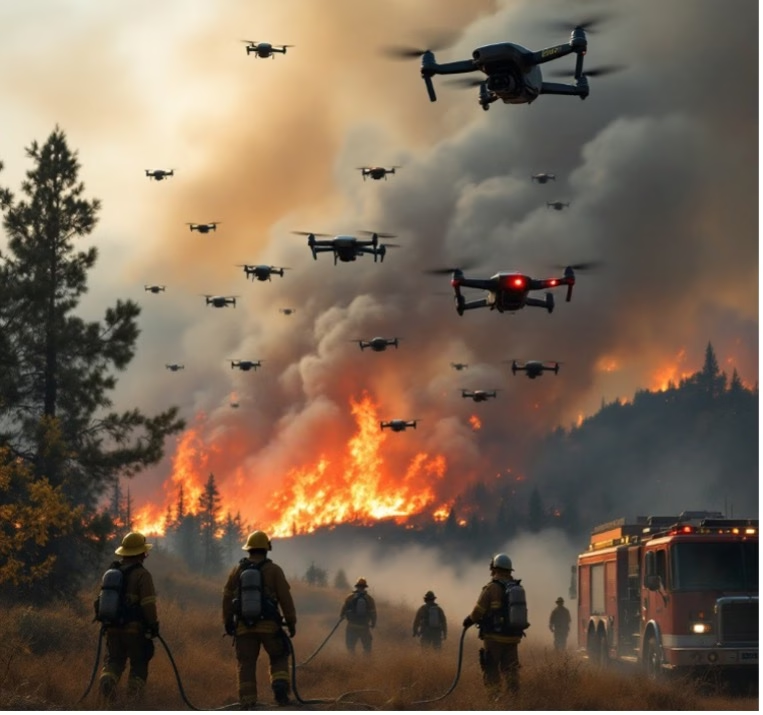
The devastating wildfires that swept across British Columbia in 2023 have inspired a new Canadian startup aiming to revolutionize wildfire suppression using swarms of ultra-heavy-lift drones, with growing interest from defence organizations including NATO.
Alex Deslauriers watched flames descend on his community near Gun Lake, about 200 kilometres north of Vancouver, as aircraft grounded for the night left fires to advance unchecked. Trees were uprooted by a fire tornado and hurled across the landscape. That experience became the catalyst for FireSwarm, a Squamish-based company building drone swarms capable of carrying hundreds of litres of water to fight wildfires day and night.
Deslauriers, an aerospace engineer with more than 25 years of experience on military jets and commercial aircraft, including a decade at Boeing, co-founded FireSwarm with David Thanh and Melanie Bitner. Their goal is to modernize wildfire response by deploying autonomous drones that can operate continuously, including in dangerous night-time conditions when crewed aircraft must stand down.
Bitner’s family lost a multi-generational property during the 2023 fires, destroying historic buildings and leaving her father displaced years later. She said the lack of aerial support overnight highlighted a critical gap in wildfire response.

Thanh, FireSwarm’s chief operating officer and a former wildfire and emergency management professional, initially doubted that drones could be effective. Conventional heavy-lift drones carry less than 25 kilograms, far too little for major blazes. That changed when the team partnered with Swedish manufacturer ACC Innovations, whose ThunderWasp drone can carry up to 300 litres of water.
FireSwarm integrates proprietary mission software, fire-behaviour modelling and autonomous flight control to allow a single operator to manage multiple drones in coordinated suppression missions. The company plans to combine satellite data and onboard sensors to analyze fire conditions and improve drop effectiveness, with the long-term goal of fully autonomous early-response firefighting units stationed across high-risk regions.
While wildfire suppression remains the company’s core mission, defence applications have rapidly emerged. FireSwarm has been selected for NATO DIANA, a program that fast-tracks dual-use technologies for military adoption. Out of more than 3,400 applicants worldwide, FireSwarm was among 150 chosen.
Participation will give the company access to test facilities in 32 countries and include an operational exercise in Latvia with the Canadian Armed Forces, where drone swarms will be evaluated for logistics delivery and casualty evacuation in hostile environments.
Thanh said modern battlefields have made evacuation increasingly dangerous, creating demand for unmanned extraction systems that reduce risk to pilots and medical crews. FireSwarm envisions drones equipped with rescue lines capable of retrieving injured personnel from contested zones.
Deslauriers said defence partnerships provide a pathway to accelerate research and validation while supporting civilian wildfire missions. He noted that much of aviation’s innovation historically comes from military research and development, and that dual-use technology allows faster testing and deployment.
Interest from provincial governments and wildfire agencies in Canada is growing, particularly in British Columbia communities such as Kelowna. However, procurement and funding cycles remain slow, pushing the company to rely on defence programs for early operational trials.
All three founders live in Squamish, an area increasingly threatened by wildfires. Thanh has faced multiple evacuation alerts, including one after a lightning strike ignited a fire less than a kilometre from his home.
As climate change expands wildfire risk and urban development pushes deeper into forested zones, FireSwarm believes autonomous drone swarms can reshape both disaster response and military logistics. From B.C.’s burning forests to NATO test ranges in Europe, the company is betting that coordinated unmanned aircraft will become a new frontline tool against fire and conflict alike.
