Tag: stock market

  • Oil Prices Rise More Than 2% as Global Shares Mostly Decline Amid Market Uncertainty

    Oil Prices Rise More Than 2% as Global Shares Mostly Decline Amid Market Uncertainty

    Oil prices climbed more than 2% while global stock markets largely moved lower, as investors assessed growing geopolitical risks and concerns about the impact of higher energy costs on the global economy.

    The rise in crude prices reflected renewed uncertainty in international energy markets, with traders closely watching developments in the Middle East and their potential effect on oil production and supply routes.

    Higher oil prices can provide a boost to energy companies but often create pressure for other parts of the economy. Rising fuel and transportation costs can increase expenses for manufacturers, airlines, logistics companies and consumers, potentially adding to inflationary pressures.

    Meanwhile, major stock markets around the world were mostly lower as investors remained cautious. Market sentiment has been affected by geopolitical uncertainty, economic concerns and expectations surrounding interest rates.

    Analysts said investors are likely to remain sensitive to further movements in crude oil prices. A sustained increase could influence inflation forecasts and complicate decisions by central banks as they assess the outlook for borrowing costs.

    Energy markets have remained particularly volatile as traders weigh supply risks against global demand. Any disruption involving major oil-producing regions or strategically important shipping routes could push prices higher and increase market volatility.

    The latest movements highlight the close connection between geopolitical developments, commodity prices and global financial markets. Investors are expected to continue monitoring economic data and international developments for signs of where markets could move next.

    Swifteradio.com

  • Global Markets Trade Mixed as Brent Crude Oil Extends Rally Amid Iran Conflict

    Global Markets Trade Mixed as Brent Crude Oil Extends Rally Amid Iran Conflict

    Global stock markets delivered mixed performances as Brent crude oil prices continued to climb, driven by escalating fighting involving Iran and growing concerns over potential disruptions to global energy supplies.

    Investors remained cautious as geopolitical tensions in the Middle East fueled uncertainty across international financial markets. While some major indexes posted modest gains, others declined as traders weighed the economic implications of sustained conflict and rising commodity prices.

    Brent crude, the international benchmark for oil prices, extended its upward trend amid fears that prolonged hostilities could threaten production and shipping routes in one of the world’s most strategically important energy-producing regions. Analysts noted that any disruption to oil exports could place additional pressure on global fuel prices and inflation.

    Financial markets have been closely monitoring developments in the Middle East, where continued military exchanges have heightened concerns about the stability of global energy markets. Higher oil prices have boosted shares of energy companies while increasing pressure on sectors that rely heavily on fuel and transportation costs.

    Market analysts said investor sentiment remains fragile as geopolitical risks combine with broader concerns over inflation, interest rates, and global economic growth. Rising energy costs could complicate monetary policy decisions for central banks already navigating uncertain economic conditions.

    Despite the volatility, some investors viewed energy stocks as beneficiaries of the stronger oil market, while defensive sectors attracted increased demand as traders sought safer investment opportunities.

    Economists warn that a prolonged increase in crude oil prices could affect consumer spending, transportation costs, manufacturing, and global supply chains if geopolitical tensions continue to escalate.

    With the conflict showing little sign of easing, investors are expected to remain focused on developments in the Middle East and their potential impact on financial markets and the global economy.

    Swifteradio.com

  • Oil Prices Climb and Global Stocks Slide After Trump Declares Iran Ceasefire ‘Over’

    Oil Prices Climb and Global Stocks Slide After Trump Declares Iran Ceasefire ‘Over’

    Global financial markets came under renewed pressure after Donald Trump declared that the ceasefire between the United States and Iran was “over,” triggering a sharp rise in oil prices and a broad decline in stock markets worldwide.

    Investors reacted swiftly to Trump’s remarks, fearing that renewed hostilities in the Middle East could threaten global energy supplies and further destabilize an already volatile geopolitical landscape.

    Oil prices climbed as traders priced in the possibility of supply disruptions, particularly if tensions escalate around key shipping routes such as the Strait of Hormuz, through which a significant portion of the world’s crude oil exports passes.

    Meanwhile, major stock markets in Asia, Europe, and North America recorded losses as investors shifted toward safer assets amid growing uncertainty over the geopolitical situation.

    Market analysts said the combination of rising energy prices and increased geopolitical risk weighed heavily on investor confidence, with energy stocks outperforming while sectors sensitive to economic uncertainty experienced declines.

    Trump’s comments followed a period of heightened tensions between Washington and Tehran, raising concerns that diplomatic efforts to reduce hostilities may have stalled.

    Financial experts warned that prolonged instability in the Middle East could contribute to higher fuel costs, increased inflationary pressures, and greater volatility across global financial markets.

    Governments and international organizations continue urging restraint, calling for renewed diplomatic engagement to prevent further escalation and protect regional stability.

    Economists noted that while markets often react sharply to geopolitical developments, the long-term impact will depend on whether tensions continue to rise or diplomatic negotiations resume.

    Energy analysts are also closely monitoring developments involving oil production, shipping security, and regional military activity that could influence crude oil supply in the coming weeks.

    As investors assess the evolving situation, global markets are expected to remain sensitive to political statements, military developments, and any renewed efforts to restore dialogue between the United States and Iran.

    The latest market reaction highlights the significant influence geopolitical conflicts continue to have on global energy prices, investor sentiment, and economic stability.

    Swifteradio.com

  • Stock Market Update: S&P 500, Nasdaq Dip as Inflation Progress Falters

    Stock Market Update: S&P 500, Nasdaq Dip as Inflation Progress Falters

    US stock markets faced a setback on Wednesday, with key indices retreating after fresh data suggested inflation remains stubbornly high, challenging the Federal Reserve’s efforts to hit its 2% target.

    The S&P 500 (^GSPC) dropped 0.4%, while the Dow Jones Industrial Average (^DJI) slid 0.3%. The Nasdaq Composite (^IXIC), led by losses in tech stocks, declined by 0.6%. This follows Tuesday’s record highs, dampening investor sentiment ahead of the Thanksgiving holiday, when markets will close Thursday and have shortened trading hours on Friday.

    Inflation Data Raises Concerns

    The Federal Reserve’s preferred inflation gauge, the Core Personal Consumption Expenditures (PCE) index, showed modest growth in October. Core PCE, which excludes volatile food and energy prices, rose 0.3% month-over-month, aligning with Wall Street expectations. Annually, core prices increased by 2.8%, slightly above September’s 2.7%.

    This flat progress in inflation control has raised questions about the Fed’s next move. Current market forecasts, based on the CME FedWatch Tool, indicate a 34% probability that the Fed will hold interest rates steady at its upcoming meeting—a notable increase from 24% a month earlier.

    Broader Economic Indicators

    Additional economic reports released Wednesday painted a mixed picture. The second estimate for third-quarter GDP remained unchanged, showing a 2.8% annualized growth rate. Meanwhile, the labor market showed resilience, with weekly jobless claims dropping to 213,000 from the prior week’s 215,000—indicating continued strength in employment.

    Corporate and Trade Developments

    In corporate news, Dell Technologies (DELL) shares plunged over 12% after quarterly revenue missed expectations, reflecting weak PC demand. Similarly, HP (HPQ) suffered an 11% loss post-earnings, compounding concerns in the tech hardware sector.

    On the trade front, President-elect Donald Trump appointed Jamieson Greer as the new US Trade Representative. Greer, a key figure in Trump’s first-term China tariff policies, has sparked speculation about the administration’s approach to future trade agreements and tariffs on top US trading partners.

    Outlook

    As markets enter a holiday-shortened week, investors are cautiously navigating a mix of economic signals and corporate challenges. Persistent inflation and trade policy uncertainties remain key themes that could shape market direction in the coming weeks.

    For updates on the stock market and economic trends, stay tuned to our blog.

    Source : Swifteradio.com

  • Asian Stock Markets Mixed Following Wall Street’s New Record Highs – The Associated Press

    Asian Stock Markets Mixed Following Wall Street’s New Record Highs – The Associated Press

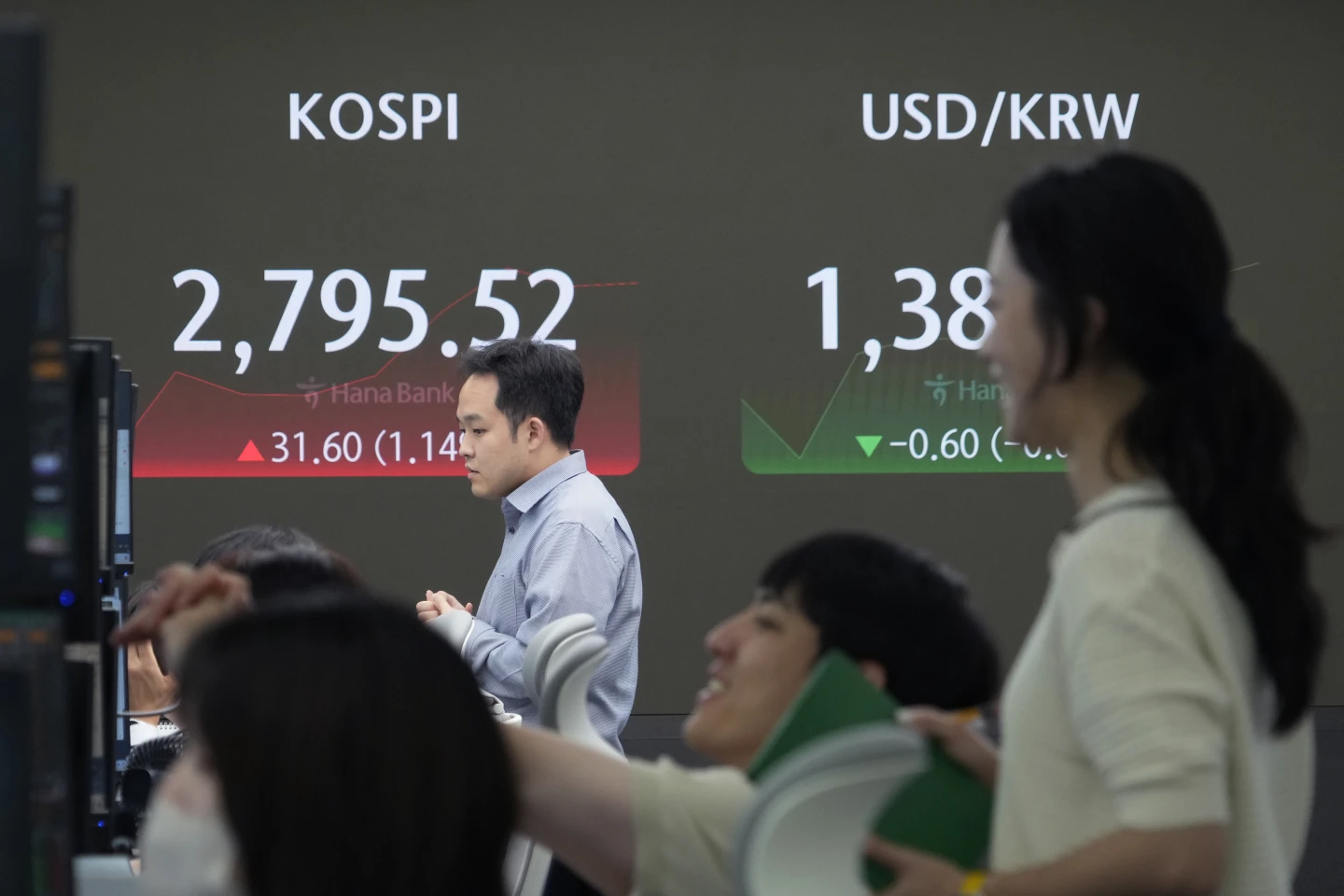
    Currency traders pass by a screen displaying the Korea Composite Stock Price Index (KOSPI) and the exchange rate between the U.S. dollar and South Korean won at the KEB Hana Bank headquarters’ foreign exchange dealing room in Seoul, South Korea, on Wednesday, June 19, 2024. (AP Photo/Ahn Young-joon)

    Currency traders monitor screens near a display showing the KOSPI and the exchange rate between the U.S. dollar and South Korean won at the KEB Hana Bank headquarters’ foreign exchange dealing room in Seoul, South Korea, on Wednesday, June 19, 2024. (AP Photo/Ahn Young-joon)

    The New York Stock Exchange is seen on Tuesday, June 18, 2024, in New York. Shares mostly rose in Europe and Asia after U.S. stocks hit new records, driven by gains in technology companies. (AP Photo/Peter Morgan)

    Asian markets were mixed on Wednesday following U.S. benchmarks setting more records amid signs of a slowing U.S. economy that hasn’t yet fallen into recession. U.S. futures were mixed, and oil prices remained steady.

    In Tokyo, the Nikkei 225 index increased by 0.2% to 38,575.54, as Japan’s May trade data showed a 13.5% rise in exports and a 9.5% increase in imports compared to the previous year, driven by higher prices and a weaker yen. Minutes from the Bank of Japan’s latest policy meeting revealed discussions about whether the yen’s weakness could drive inflation higher, with Governor Kazuo Ueda hinting at a potential rate hike depending on economic data.

    The Hang Seng in Hong Kong rose 2% to 18,264.51, while the Shanghai Composite index fell 0.3% to 3,020.03 after China’s securities regulator announced plans to enhance oversight of financial activities to mitigate risks. In Sydney, the S&P/ASX 200 dipped 0.2% to 7,764.30. South Korea’s Kospi surged 1% to 2,792.14. Taiwan’s Taiex climbed 1.8%, while Bangkok’s SET decreased by 0.1%.

    On Tuesday, the S&P 500 gained 0.3% to 5,487.03, marking its 31st record high this year. The Nasdaq composite rose by less than 0.1% to 17,862.23, and the Dow Jones Industrial Average increased by 0.2% to 38,834.86.

    Nvidia continued to be a standout performer, with its shares rising 3.5%, contributing significantly to the S&P 500’s gains. Nvidia’s chips are key in AI development, with demand skyrocketing, leading to tripling revenues each quarter and soaring profits. Its stock has surged nearly 174% this year, accounting for almost a third of the S&P 500’s gains through May. However, the heavy reliance on a few top performers could indicate a fragile market.

    Retail sales in May rose by 0.1%, below expectations, with April sales revised downward by 0.2%. March and February saw rises of 0.6% and 0.9%, respectively, while January sales fell by 1.1% due to adverse weather. The weaker data might suggest cracks in household spending, the main driver of the U.S. economy, as inflation remains high, particularly affecting lower-income households.

    Despite this, a Bank of America survey showed global fund managers’ optimism at its highest since autumn 2021, with significant stock allocations and less cash hoarding, and fewer predictions of a severe recession.

    In early Wednesday trading, U.S. benchmark crude oil remained steady at $80.71 per barrel, while Brent crude rose slightly to $85.35 per barrel. The dollar strengthened to 157.87 Japanese yen from 156.87 yen, and the euro slightly declined to $1.0737 from $1.0740.

    AP Business Writer Stan Choe contributed to this report.

    source: apnews.com