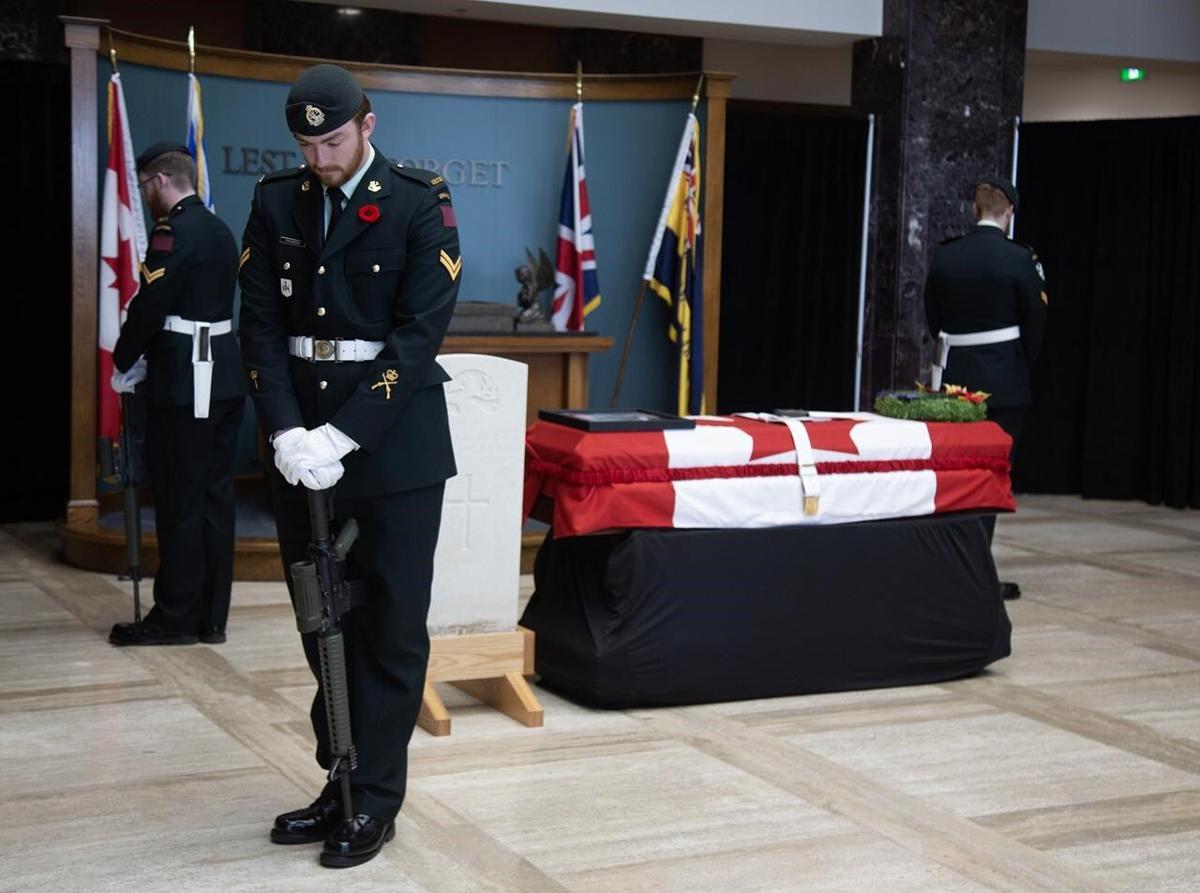
ST. JOHN’S, N.L. – Hundreds of people filled the downtown streets of Newfoundland and Labrador’s capital city on Monday to pay their respects to a soldier from the First World War who died on the battlefields of France and has finally returned home.
The unknown Newfoundland soldier was laid to rest in a black granite tomb at around 11 a.m. local time at the National War Memorial in St. John’s. Despite a grey and wet morning, the rain stopped for the soldier’s reinterment, which was marked by a powerful performance of the “Ode to Newfoundland.” As members of the Royal Canadian Armed Forces gently placed a temporary cover over the soldier’s final resting place, the skies opened up again.
“We therefore commit this body to the ground,” Canadian Armed Forces chaplain Lt.-Col. Shawn Samson recited while standing at the head of the soldier’s tomb. The crowd included Prime Minister Justin Trudeau and Gov. Gen. Mary Simon. “Earth to earth. Ashes to ashes. Dust to dust.”
July 1 is Memorial Day in Canada’s easternmost province, Newfoundland and Labrador, honoring those who have been killed in battle, especially the hundreds of young men from the Newfoundland Regiment who died during the disastrous fight at Beaumont-Hamel in northern France during the First World War. On the morning of July 1, 1916, about 800 members of the Royal Newfoundland Regiment charged over the top of the trenches with rifles and bayonets toward the Germans’ machine-gun fire; only 68 made it to roll call the next morning. The rest were killed, wounded, or declared missing.
Approximately 12,000 men from Newfoundland enlisted to fight in the First World War, and more than 3,500 were wounded or killed, according to Heritage Newfoundland and Labrador. The island, not yet a part of Canada, had a population of about 240,000 at the time. The staggering number of casualties impacted the small population deeply and is still felt today.
For some who watched Monday’s ceremony, whether in person in St. John’s or on television in smaller communities, the Unknown Soldier may have stood in the trenches beside their grandfathers or great uncles. The ceremony coincided with the 100th anniversary of the unveiling of the National War Memorial in St. John’s. The soldier’s tomb will represent deceased Newfoundlanders and Labradorians from all branches of service who have no known grave, and thus the soldier’s identity will not be investigated.
Newfoundland and Labrador Premier Andrew Furey acted as the unknown soldier’s next of kin and walked behind the casket as it was carried up the steps toward the national monument. The monument features a statue of a woman holding a flaming torch high into the sky with her left hand and a sword pointed toward the ground in her right.
Before the temporary cover was placed over the Unknown Soldier’s tomb, it was sprinkled with 820 blue forget-me-nots, representing the 820 Newfoundland soldiers who fought in the First World War and have no known grave.
“Today we welcome home one of ours,” said veteran Perry Grandy, who co-led Monday’s ceremony.
Source: