Tag: Missile Defense

  • Russian Missile Strike on Kyiv Kills One, Highlights Gaps in Ukraine’s Air Defenses

    Russian Missile Strike on Kyiv Kills One, Highlights Gaps in Ukraine’s Air Defenses

    A Russian missile attack on Kyiv has left one person dead while exposing vulnerabilities in Ukraine’s air defense systems, as the conflict between Moscow and Kyiv continues with renewed intensity.

    Ukrainian authorities confirmed that the missile strike targeted areas in and around the capital, causing casualties and damage to civilian infrastructure. Emergency services were quickly deployed to extinguish fires, rescue survivors, and assess the extent of the destruction.

    Officials said the attack demonstrated that despite Ukraine’s extensive air defense network, some incoming missiles were able to evade interception and reach their intended targets. The incident has renewed concerns about the country’s ability to defend major cities against increasingly sophisticated aerial attacks.

    The latest strike comes as Russia continues its campaign of missile and drone attacks on Ukrainian cities, while Ukraine has repeatedly appealed to its international partners for additional advanced air defense systems to strengthen protection for civilians and critical infrastructure.

    Military analysts say sustained attacks are placing significant pressure on Ukraine’s defensive capabilities, even as Western allies continue providing military assistance and air defense equipment.

    Residents of Kyiv described hearing explosions overnight as air raid sirens sounded across the city. Authorities urged citizens to remain vigilant and follow safety instructions during future missile alerts.

    The Ukrainian government condemned the attack, accusing Russia of deliberately targeting civilian areas and undermining regional security. Moscow has maintained that its military operations are directed at strategic objectives.

    International leaders have once again called for restraint and emphasized the need to protect civilians while diplomatic efforts to end the conflict remain stalled.

    As investigations into the latest strike continue, emergency crews remain on the ground clearing debris and assisting affected residents, while security officials assess further risks to the capital.

    Swifteradio.com

  • Zelenskyy to Meet European Leaders in Paris to Strengthen Ukraine’s Air Defenses and Secure Continued Support

    Zelenskyy to Meet European Leaders in Paris to Strengthen Ukraine’s Air Defenses and Secure Continued Support

    Ukrainian President Volodymyr Zelenskyy is set to meet with European leaders in Paris to discuss strengthening military support for Ukraine, with a particular focus on enhancing the country’s air defense capabilities amid continued Russian attacks.

    The high-level summit, known as the Coalition of the Willing, will bring together leaders from approximately 25 countries to coordinate additional military assistance, expand sanctions against Russia, and reinforce Europe’s long-term commitment to Ukraine’s security.

    One of the meeting’s top priorities will be securing additional air defense systems and interceptor missiles for Ukraine as Russian ballistic missile and drone attacks continue to target cities and critical infrastructure. Leaders are also expected to discuss expanding joint production of air defense technologies, including European-backed anti-ballistic missile projects.

    French President Emmanuel Macron will host the summit, where discussions are also expected to cover new bilateral military assistance packages, expanded defense industry cooperation, and plans for multinational military exercises aimed at strengthening European security.

    The gathering comes as Ukraine continues to request greater military support from its allies while intensifying long-range drone operations targeting Russian military infrastructure. European leaders are also expected to consider additional measures to tighten sanctions against Russia, including efforts to further restrict Moscow’s energy revenues.

    In addition to defense cooperation, participants will discuss Ukraine’s long-term security guarantees and continued coordination with NATO partners as the war enters its fifth year. Leaders have repeatedly reaffirmed their commitment to supporting Ukraine’s sovereignty and territorial integrity while pursuing a just and lasting peace.

    Security analysts say the Paris meeting represents another significant step in Europe’s effort to increase defense cooperation and reduce Ukraine’s dependence on external military supplies through expanded domestic and regional production.

    The outcome of the summit is expected to shape future military assistance, air defense cooperation, and Europe’s broader strategy for supporting Ukraine against continued Russian aggression.

    Swifteradio.com

  • As Threats from North Korea and China Escalate, US Strengthens Defense Partnerships with Asian Allies

    As North Korean and Chinese threats escalate, the United States is intensifying efforts to solidify defense partnerships with its Asian allies. Recently, the U.S. concluded its inaugural multidomain exercise with Japan and South Korea in the East China Sea, marking a significant step in strengthening these key security relationships. The exercise, named Freedom Edge, represents Washington’s commitment to enhancing joint defense capabilities in the face of increasing regional threats.

    Held over three days, Freedom Edge included sophisticated air and naval drills designed to improve joint ballistic-missile defense, anti-submarine warfare, and surveillance operations. This exercise aimed to refine the ability of the three nations to share missile warnings—a critical capability as North Korea continues to develop and test advanced missile systems.

    Japan and South Korea, aside from Australia, are the only U.S. allies in the region with the advanced military capabilities necessary for integrated operations with American forces. This interoperability is crucial in potential conflict scenarios, enabling, for example, rapid response coordination if South Korea detects a missile target. According to Ridzwan Rahmat, an analyst with defense intelligence firm Janes, such exercises foster the development of a cohesive fighting force among the three nations.

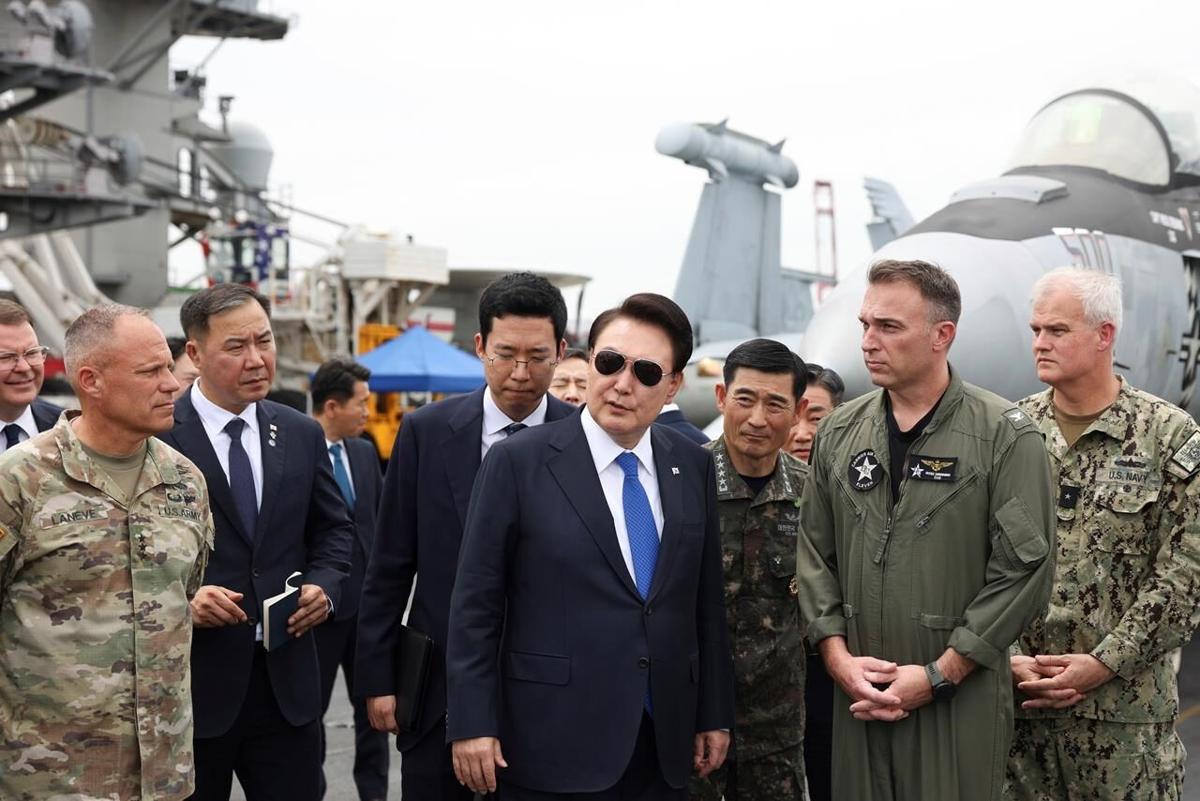
    However, these exercises are not without risk. They often heighten regional tensions, as China routinely criticizes military drills conducted within what it considers its sphere of influence. Additionally, North Korea has condemned the arrival of the USS Theodore Roosevelt carrier group in Busan, South Korea, for Freedom Edge, labeling it as “provocative” and “dangerous.” Following South Korean President Yoon Suk Yeol’s visit to the Roosevelt, North Korea tested what it claimed was a multiwarhead missile, although South Korean and U.S. authorities later assessed that the launch failed.

    The trilateral defense cooperation involving Japan and South Korea also presents political challenges due to historical animosities stemming from Japan’s occupation of Korea before and during World War II. Despite these challenges, both countries have significantly bolstered their military capabilities and host approximately 80,000 American troops. Japan’s Prime Minister Fumio Kishida has increased defense spending and cooperation with South Korea, actions generally well-received by the Japanese public but controversial within his party’s right wing. Similarly, President Yoon’s efforts to improve relations with Japan have faced domestic opposition but remain crucial for regional security.

    Both leaders are working to strengthen their defense ties with the U.S. in anticipation of a potential new American administration. South Korean officials have expressed hopes of signing a formal security framework agreement with the U.S. and Japan this year, aiming to establish a unified response strategy to potential North Korean threats.