Tag: Japan

  • China Imposes Export Controls on 40 Japanese Entities as Tensions With Tokyo Escalate

    China Imposes Export Controls on 40 Japanese Entities as Tensions With Tokyo Escalate

    China has imposed new export control measures on 40 Japanese entities, marking a significant escalation in trade and diplomatic tensions between Beijing and Japan.

    Chinese authorities announced that the affected Japanese organizations would be subject to tighter export restrictions under national security regulations, a move that could impact trade, technology transfers, and commercial cooperation between the two Asian economies.

    According to officials, the measures are intended to safeguard China’s national interests and security. However, detailed information regarding the specific entities affected and the scope of the restrictions has not been fully disclosed.

    The latest action comes amid increasingly strained relations between Beijing and Tokyo over a range of political, economic, and security issues.

    China and Japan have recently exchanged criticism over regional security, military activities, trade policies, and territorial disputes, contributing to growing diplomatic friction between the neighboring countries.

    Trade analysts say the new export controls could affect businesses involved in technology, manufacturing, electronics, industrial equipment, and other sectors that rely on cross-border supply chains.

    The restrictions may also create additional uncertainty for multinational companies operating across East Asia, where China and Japan remain two of the world’s largest economies and major trading partners.

    Japanese officials have expressed concern over the development and are expected to review the implications for affected businesses while considering possible diplomatic and economic responses.

    Business organizations in both countries are closely monitoring the situation, warning that prolonged trade tensions could disrupt investment, production, and regional economic stability.

    Economic experts note that export controls have increasingly become a tool used by governments to address national security concerns while influencing international trade relationships.

    The latest measures also reflect broader geopolitical competition across the Indo-Pacific region, where strategic rivalry, technology policy, and economic security continue to shape government decisions.

    Despite ongoing disagreements, China and Japan maintain extensive commercial ties, with bilateral trade remaining an important pillar of economic activity for both nations.

    Diplomatic observers believe continued dialogue will be essential to preventing further deterioration in relations, particularly given the importance of cooperation on regional stability and global economic growth.

    As both governments assess their next steps, the newly announced export controls underscore the increasingly complex intersection of international trade, national security, and geopolitical competition in East Asia.

    The coming weeks will likely determine whether the latest restrictions lead to further retaliatory measures or renewed diplomatic efforts to stabilize one of Asia’s most significant bilateral relationships.

    Swifteradio.com

  • From Temporary Teacher to Craft Brewer: The 32-Year Journey of an American in Japan

    In 1992, Dave Prucha embarked on a journey from California to Japan, expecting to stay for only six months. Little did he know that this temporary assignment would transform into a lifelong adventure spanning over three decades.

    Initially, Prucha, who had never set foot in Japan, was drawn to the country by an opportunity to teach English at a Tokyo high school. “I didn’t know anything about Japan,” he recalls. “I thought it would be a brief stint to take some time off and earn some money.”

    However, the allure of Japanese culture and society quickly captivated him. Reflecting on his first impressions, Prucha describes Japan as a place of remarkable harmony and detail. “The society was focused on cohesiveness, and everybody seemed to know exactly what to do,” he says. “I couldn’t stop observing just how amazing and different it was.”

    As the years passed, Prucha not only made Japan his home but also built a fulfilling life there. He got married, welcomed three children, and launched a successful American craft beer company in Yamanashi Prefecture. “Even after 32 years, I still feel like, ‘Wow, I really like living here,’” he shares.

    A Life-Changing Decision

    Prucha’s interest in Japan was sparked during his studies in International Business at San Francisco State University. In search of a deeper understanding of a country that was then a major rival economy to the U.S., he seized the chance to move to Japan. He arrived with little more than an open mind and the desire to learn the language, which he quickly found challenging.

    Despite initial difficulties navigating the language and cultural nuances, Prucha adapted and embraced the values of Japanese society, such as politeness and attention to detail. His perseverance paid off, allowing him to build connections and integrate into his new environment.

    Embracing Change

    After several years in Japan, Prucha decided to shift gears and pursue his passion for craft beer. “I’ve always loved craft beer,” he explains. Recognizing Japan’s growing interest in the craft beer scene, he saw an opportunity to establish his brewery.

    After two years of converting a vacant building into Obina Brewing, Prucha obtained his brewing license and began creating beers that combined American craft brewing techniques with Japanese ingredients. “It’s coming together,” he remarks, noting the positive response from locals and visitors alike.

    Building Community

    At 61, Prucha reflects on his journey with gratitude. “I have always found the country full of opportunity, especially if one works hard,” he states. He acknowledges that while he misses certain aspects of life in the U.S., such as open spaces and individual expression, he cherishes the community he has built in Japan.

    Prucha’s story serves as a testament to the transformative power of following one’s passion and embracing new experiences. “It’s never too late to change your life,” he concludes, inspired to continue crafting exceptional brews for years to come.

    Source: Swifteradio.com

  • Visitors Uncover Black Brazilian Past of Sao Paulo’s Japanese Neighborhood

    woman standing near brown pole

    São Paulo’s Liberdade neighborhood is renowned for its Asian-style architecture, restaurants, and public lighting resembling paper lanterns. Home to the largest Japanese community outside Japan, thousands of tourists flock to enjoy the area’s cuisine and culture, often unaware of its Black history.

    The name “Liberdade” (liberty in English) is linked to Chaguinhas, a formerly enslaved Black soldier sentenced to death in 1821 after leading a protest for better wages. Spectators at his execution called for his “liberty.”

    “When people see the neighborhood, there is another history being told,” said Debora Pinheiro, a guide on a tour attended by Reuters. “The Japanese arrived in the early 20th century and started a process of gentrification. But the Black presence is still huge.”

    Afrotourism, focusing on Black history, is growing in Brazil. Guia Negro, founded in 2018, disseminates overlooked history and offers tours in 22 cities, including Salvador, Rio de Janeiro, and São Paulo. In 2023, the tourism agency began promoting businesses in addition to tourism. Pequena Africa (Little Africa) in Rio had more visitors than Christ the Redeemer or Sugar Loaf Mountain, according to the Rio mayor’s office.

    Despite not being known as the “Blackest city outside of Africa” like Salvador or Little Africa in Rio, São Paulo has the largest population of Black people in Brazil in absolute numbers. Black American tourists frequently choose Brazil for its welcoming atmosphere. “Brazil made me feel like a Black queen,” said Dr. Chanel Adrian Clifton, a tour participant.

    Guilherme Soares Dias, founder of Guia Negro, created the organization after experiencing frequent racial profiling abroad. “I wanted to create a platform to encourage more Black people to travel and for everyone to learn more about Black history and culture,” he said. Guia Negro emphasizes history education to combat prejudice.

    In October 2020, police officers, alerted by social media posts about a “Black march,” questioned, filmed, and followed the organizers for three hours, suspecting the paid tour was a protest. In April 2024, a judge ordered São Paulo State to pay 750 thousand reais ($138 thousand) to Guia Negro for “moral collective damage and discriminatory action, with clear outlines of institutional racism.

    Source: reuters

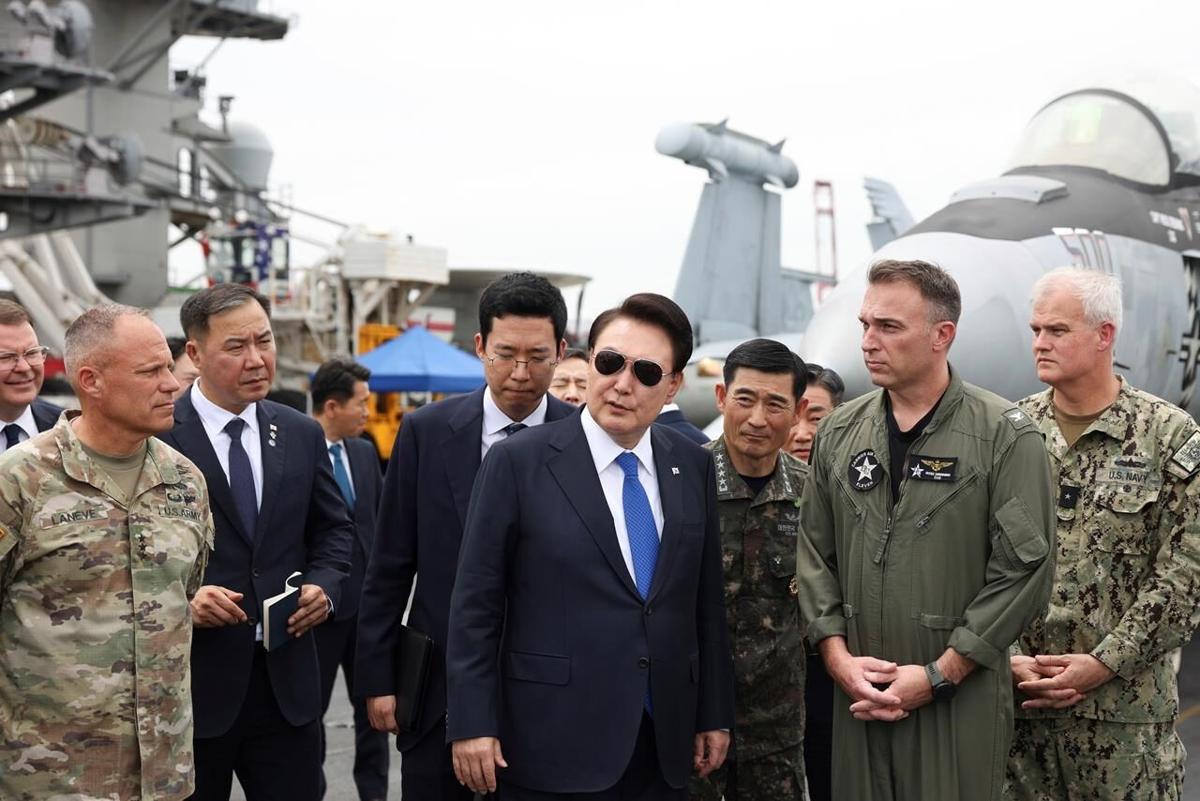
  • As Threats from North Korea and China Escalate, US Strengthens Defense Partnerships with Asian Allies

    As North Korean and Chinese threats escalate, the United States is intensifying efforts to solidify defense partnerships with its Asian allies. Recently, the U.S. concluded its inaugural multidomain exercise with Japan and South Korea in the East China Sea, marking a significant step in strengthening these key security relationships. The exercise, named Freedom Edge, represents Washington’s commitment to enhancing joint defense capabilities in the face of increasing regional threats.

    Held over three days, Freedom Edge included sophisticated air and naval drills designed to improve joint ballistic-missile defense, anti-submarine warfare, and surveillance operations. This exercise aimed to refine the ability of the three nations to share missile warnings—a critical capability as North Korea continues to develop and test advanced missile systems.

    Japan and South Korea, aside from Australia, are the only U.S. allies in the region with the advanced military capabilities necessary for integrated operations with American forces. This interoperability is crucial in potential conflict scenarios, enabling, for example, rapid response coordination if South Korea detects a missile target. According to Ridzwan Rahmat, an analyst with defense intelligence firm Janes, such exercises foster the development of a cohesive fighting force among the three nations.

    However, these exercises are not without risk. They often heighten regional tensions, as China routinely criticizes military drills conducted within what it considers its sphere of influence. Additionally, North Korea has condemned the arrival of the USS Theodore Roosevelt carrier group in Busan, South Korea, for Freedom Edge, labeling it as “provocative” and “dangerous.” Following South Korean President Yoon Suk Yeol’s visit to the Roosevelt, North Korea tested what it claimed was a multiwarhead missile, although South Korean and U.S. authorities later assessed that the launch failed.

    The trilateral defense cooperation involving Japan and South Korea also presents political challenges due to historical animosities stemming from Japan’s occupation of Korea before and during World War II. Despite these challenges, both countries have significantly bolstered their military capabilities and host approximately 80,000 American troops. Japan’s Prime Minister Fumio Kishida has increased defense spending and cooperation with South Korea, actions generally well-received by the Japanese public but controversial within his party’s right wing. Similarly, President Yoon’s efforts to improve relations with Japan have faced domestic opposition but remain crucial for regional security.

    Both leaders are working to strengthen their defense ties with the U.S. in anticipation of a potential new American administration. South Korean officials have expressed hopes of signing a formal security framework agreement with the U.S. and Japan this year, aiming to establish a unified response strategy to potential North Korean threats.