Tag: Geopolitical Tensions

  • Armenian PM Nikol Pashinyan Claims Election Victory in Vote Seen as Test of Russia’s Influence

    Armenian PM Nikol Pashinyan Claims Election Victory in Vote Seen as Test of Russia’s Influence

    Armenian Prime Minister Nikol Pashinyan has declared victory in the country’s parliamentary election after preliminary results showed his ruling Civil Contract party securing nearly half of all votes cast, strengthening his mandate to pursue closer ties with the West and reduce Armenia’s dependence on Russia.

    According to preliminary figures released by Armenia’s Central Election Commission, Civil Contract won 49.82% of the vote, comfortably ahead of the Strong Armenia bloc led by businessman Samvel Karapetyan, which received 23.28%.

    The election was widely viewed as a referendum on Armenia’s geopolitical future, with voters effectively choosing between Pashinyan’s pro-Western agenda and opposition groups advocating stronger relations with Moscow.

    Speaking after casting his ballot, Pashinyan reaffirmed his commitment to deeper cooperation with Europe.

    “The European Union is our main partner in democratic reform implementation, and we will continue that path,” he said.

    The result is expected to allow Pashinyan’s party to govern without coalition partners. Preliminary projections indicate Civil Contract will hold 61 seats in Armenia’s 101-member National Assembly, enough to form a government, approve legislation, and pass the state budget independently.

    Political analyst Richard Giragosian described the vote as a defining moment for the South Caucasus nation.

    “This election stands as a referendum on the future of the country,” he said, adding that it provides a renewed mandate for diplomatic engagement, normalization with neighboring states, and diversification of Armenia’s security partnerships.

    The election took place amid escalating tensions between Armenia and Russia. In recent weeks, Moscow imposed a series of restrictions on Armenian exports, including flowers, wine, cognac, potatoes, and fish. While Russian authorities cited regulatory concerns, European officials characterized the measures as economic pressure aimed at influencing Armenian politics.

    Russian President Vladimir Putin has repeatedly emphasized Armenia’s dependence on Russian energy supplies and infrastructure, while Russian officials have warned against Yerevan following a path similar to Ukraine’s growing alignment with the West.

    Pashinyan’s main rival, Karapetyan, campaigned while under house arrest after being charged with advocating the overthrow of the government. He has denied the allegations and described them as politically motivated. His Strong Armenia bloc has accused Pashinyan of risking confrontation with the Kremlin.

    Adding to the controversy, Armenian authorities issued arrest warrants for several Strong Armenia members shortly before the election, alleging vote-buying activities.

    The opposition will still maintain a presence in parliament. The Hayastan bloc, led by former Armenian President Robert Kocharyan, secured 9.93% of the vote and is expected to win parliamentary seats. Meanwhile, the Prosperous Armenia party, headed by businessman Gagik Tsarukyan, hovered around the threshold required for parliamentary representation.

    Voter turnout reached 58.94%, reflecting strong public engagement in what many viewed as one of Armenia’s most consequential elections in recent years.

    Beyond relations with Russia, the election also carried major implications for regional peace efforts. Pashinyan has continued to push for normalization with neighboring Azerbaijan following decades of conflict over the Karabakh region.

    In August, Pashinyan and Azerbaijani President Ilham Aliyev initialed a framework for a peace agreement during a meeting at the White House alongside U.S. President Donald Trump.

    Pashinyan said Armenia intends to move toward formalizing that agreement and ratifying plans for a major transit corridor crossing Armenian territory, a project expected to enhance regional trade and connectivity.

    European leaders quickly welcomed the election outcome. Ursula von der Leyen congratulated Pashinyan, stating that Armenia’s growing partnership with Europe would continue to deepen.

    European Council President Antonio Costa also praised the strengthening relationship, highlighting cooperation in energy, trade, and digital development.

    Russia responded cautiously. Russian Foreign Ministry spokesperson Maria Zakharova claimed the election took place amid Western interference and said Moscow would evaluate future relations based on the actions of Armenia’s leadership.

    The result marks another significant step in Armenia’s evolving foreign policy direction and could reshape the geopolitical balance in the South Caucasus as the country increasingly seeks closer integration with Western institutions while managing its complex relationship with Russia.


  • U.S. Allies Urge Global Unity, Warning That Division Undermines Deterrence Against Emerging Threats

    U.S. Allies Urge Global Unity, Warning That Division Undermines Deterrence Against Emerging Threats

    Key allies of the United States are calling for greater international unity, warning that political divisions among democratic nations could weaken collective deterrence and embolden adversaries amid a rapidly changing global security landscape.

    During recent security and diplomatic discussions, allied leaders emphasized that cooperation among partner nations remains essential to addressing emerging threats ranging from military conflicts and cyberattacks to economic coercion and geopolitical instability.

    Officials argued that maintaining a united front is critical for preserving global stability and preventing potential aggressors from exploiting divisions between allies.

    The warnings come as governments around the world confront a growing number of challenges, including regional conflicts, strategic competition between major powers, cybersecurity risks, and threats to international trade routes.

    Security experts say deterrence relies not only on military strength but also on political cohesion, diplomatic coordination, and the credibility of alliances.

    Members of NATO and other partner nations have repeatedly stressed the importance of collective action in responding to security concerns across Europe, the Indo-Pacific, and other strategically important regions.

    Allied leaders noted that divisions within international coalitions can create uncertainty and potentially weaken responses to crises, making cooperation more important than ever.

    The call for unity comes amid ongoing global tensions involving Russia, China, and conflicts affecting multiple regions of the world.

    Diplomats argue that strong partnerships allow countries to coordinate sanctions, intelligence sharing, defense planning, and humanitarian responses more effectively.

    Analysts say the international security environment has become increasingly complex, requiring broader collaboration among governments, international organizations, and regional alliances.

    Several leaders emphasized that emerging threats are often interconnected, with developments in one region capable of influencing stability elsewhere.

    The discussions also highlighted the need for continued investment in defense capabilities, technological innovation, and strategic partnerships to address future challenges.

    While policy differences remain among some allies, officials stressed that shared interests and common security goals should remain the foundation of international cooperation.

    Observers note that the appeal for unity reflects growing concerns about geopolitical fragmentation and the long-term impact of global rivalries on international stability.

    As security challenges continue to evolve, allied nations are expected to deepen cooperation efforts aimed at strengthening deterrence, resilience, and collective defense.

    Swifteradio.com

  • US Defense Chief Pete Hegseth Urges Asian Allies to Increase Military Spending Amid China Concerns

    US Defense Chief Pete Hegseth Urges Asian Allies to Increase Military Spending Amid China Concerns

    U.S. Defense Secretary Pete Hegseth has called on Asian allies to significantly increase defense spending in response to China’s expanding military capabilities, warning that the region faces growing security challenges if Beijing’s influence continues to rise unchecked.

    Speaking at the prestigious Shangri-La Dialogue in Singapore, Hegseth stressed that a stronger and more self-reliant alliance network is crucial to maintaining stability and preserving the balance of power across the Indo-Pacific region.

    “There is rightful alarm regarding China’s historic military buildup and the expansion of its military activities in the region and beyond,” Hegseth told defense leaders, military officials, and diplomats gathered at Asia’s leading security forum.

    The Pentagon chief warned that any attempt by China to dominate the Pacific region could undermine regional security and economic prosperity. He emphasized that the United States remains committed to preventing any single power from establishing hegemony over the region.

    Hegseth revealed that Washington expects its Asian allies and partners to increase defense spending to approximately 3.5% of their gross domestic product while the United States moves forward with a planned $1.5 trillion investment in its own military capabilities.

    While highlighting concerns about China’s military expansion, Hegseth also adopted a measured tone regarding relations with China. He noted that military-to-military communication between Washington and Beijing has improved and remains an important tool for managing tensions between the two global powers.

    According to Hegseth, U.S.-China relations are currently in a more stable position than they have been in recent years, with both sides maintaining open channels of communication.

    Chinese delegate Zhou Bo, a senior fellow at Tsinghua University and former People’s Liberation Army colonel, described relations between the two countries as complicated but acknowledged that the tone of discussions had improved compared to previous years.

    The defense secretary also echoed President Donald Trump’s long-standing position that allies should shoulder a greater share of their own defense responsibilities.

    “The era of the United States subsidizing the defense of wealthy nations is over,” Hegseth said, adding that strong alliances require equal commitment from all participating nations.

    He praised defense contributions from allies including South Korea, Philippines, Australia, Singapore, Malaysia, Thailand and Japan, noting that Tokyo has taken significant steps to strengthen its military capabilities in recent years.

    Addressing tensions in the Middle East, Hegseth stated that the United States remains prepared to resume military strikes against Iran if diplomatic efforts fail to produce a satisfactory agreement regarding Tehran’s nuclear ambitions. However, he said the Trump administration continues to pursue a diplomatic solution.

    Hegseth also reaffirmed Washington’s commitment to supporting Taiwan, while noting that any future arms sales decisions would ultimately be determined by President Trump. Reports indicate Taiwan is awaiting approval for a potential U.S. weapons package valued at up to $14 billion.

    Despite ongoing conflicts in the Middle East, Hegseth rejected suggestions that U.S. attention toward Asia would diminish, insisting that Washington remains capable of addressing multiple global security challenges simultaneously.

  • Xi Jinping Welcomes Vladimir Putin to China as Russia Faces Growing Pressure Over Ukraine War

    Xi Jinping Welcomes Vladimir Putin to China as Russia Faces Growing Pressure Over Ukraine War

    Chinese President Xi Jinping welcomed Russian President Vladimir Putin to Beijing this week in a high-profile diplomatic visit aimed at reinforcing the strategic alliance between China and Russia amid mounting global tensions and increasing pressure on Moscow over the war in Ukraine.

    Putin’s two-day visit to China, his 25th as Russian president, comes just days after U.S. President Donald Trump completed a state visit to Beijing focused on improving relations between the world’s two largest economies. While Trump’s trip centered on stabilizing U.S.-China ties, Putin’s visit is widely viewed as an effort to reassure one of China’s closest geopolitical partners during a difficult period for the Kremlin.

    Ahead of the visit, Putin described Russia-China relations as having reached an “unprecedented level” and pledged that both countries would continue working “hand in hand” to deepen their strategic partnership and strengthen long-standing ties.

    Chinese and Russian officials confirmed that the leaders would discuss economic cooperation, regional security, and major international issues, including the ongoing war in Ukraine and growing tensions involving Taiwan and the United States.

    The visit also marks the 25th anniversary of the Sino-Russian Treaty of Friendship, with Xi expected to host Putin at the Great Hall of the People and later attend a gala reception celebrating the milestone partnership.

    Analysts say Beijing is eager to project stability and maintain strong ties with Moscow, even as relations with Washington appear to be improving following Trump’s visit. During Trump’s stay in Beijing, Xi emphasized that the United States and China should be “partners, not rivals,” while both sides agreed to pursue what they described as a “constructive relationship of strategic stability.”

    Despite signs of warmer U.S.-China diplomacy, experts believe Beijing does not want Russia to feel isolated or abandoned. Observers say maintaining a strong alliance with Moscow remains strategically important for China as global power competition intensifies.

    Putin arrives in China at a difficult time domestically and militarily. Ukraine has intensified drone strikes deep inside Russian territory, including attacks near Moscow, while peace negotiations remain stalled. Reports also suggest growing public frustration in Russia over the economic and social impact of the prolonged war.

    Recent polling by Russian state agencies reportedly showed Putin’s approval rating dropping to its lowest level since the full-scale invasion of Ukraine began in 2022, signaling rare signs of internal political pressure on the Kremlin.

    China has continued to support Russia economically and diplomatically throughout the conflict, becoming Moscow’s largest trading partner and a major buyer of Russian oil and gas. Russian officials said energy exports to China rose significantly during the first quarter of the year, helping offset the impact of Western sanctions.

    At the same time, analysts note that Beijing may benefit strategically from a weakened Russia that remains dependent on Chinese trade and investment. China has also expanded its economic interests in the Arctic and other resource-rich regions traditionally dominated by Moscow.

    Taiwan is also expected to feature prominently in discussions between Xi and Putin. China considers Taiwan part of its territory, while the self-governing island continues to rely heavily on U.S. military and diplomatic support.

    Recent comments by Trump suggesting that a proposed U.S. arms package for Taiwan could become part of broader negotiations with China have sparked concern among supporters of Taiwan and raised questions about future American commitments in the Indo-Pacific region.

    The Putin-Xi summit highlights the increasingly close alignment between China and Russia as both countries seek to counter Western influence and reshape the global balance of power during a period of heightened geopolitical uncertainty.

  • Xi Jinping Warns Trump Taiwan Conflict Could Threaten U.S.-China Relations During Beijing Summit

    Xi Jinping Warns Trump Taiwan Conflict Could Threaten U.S.-China Relations During Beijing Summit

    Chinese President Xi Jinping warned President Donald Trump that tensions over Taiwan could trigger “clashes and even conflicts” between China and the United States as both leaders held high-stakes talks in Beijing focused on trade, global security and the ongoing Iran war.

    The warning came during the opening day of a major two-day summit at Beijing’s Great Hall of the People, where Xi and Trump met face-to-face amid rising geopolitical tensions and efforts to stabilize relations between the world’s two largest economies.

    According to China’s foreign ministry, Xi told Trump that Taiwan remains the most sensitive issue in U.S.-China relations and warned that mishandling the matter could seriously damage ties between both nations.

    “If the issue is handled properly, the relationship can remain generally stable,” Xi reportedly said. “Otherwise, the two countries will have clashes and even conflicts, putting the entire relationship in great jeopardy.”

    Taiwan has remained a major source of friction between Washington and Beijing, with China continuing to claim the self-governing island as part of its territory and refusing to rule out the use of force to take control. The Trump administration has repeatedly stated that America’s Taiwan policy remains unchanged despite concerns from lawmakers about possible concessions during the summit.

    While China’s official summary of the meeting highlighted Taiwan extensively, the White House focused more on economic cooperation and the Iran conflict in its own account of the talks. U.S. officials described the meeting as productive and aimed at strengthening bilateral ties following months of trade tensions.

    Secretary of State Marco Rubio said Trump did not request assistance from China regarding Iran, despite Beijing’s close ties with Tehran. However, Trump later revealed that Xi expressed interest in helping resolve tensions in the Middle East and maintaining stability in the Strait of Hormuz, a critical global oil shipping route.

    The summit also featured discussions on trade relations, with Xi reiterating that “trade wars have no winner” while welcoming progress made during recent economic negotiations between both countries.

    Trump praised his relationship with Xi during opening remarks, calling the Chinese leader “a great leader” and emphasizing the importance of cooperation between Washington and Beijing.

    “We’ve gotten along when there were difficulties, we worked it out,” Trump said.

    Xi also stressed the global importance of U.S.-China relations, saying both nations must avoid falling into the “Thucydides Trap,” a theory describing conflict between rising and existing global powers.

    The Beijing summit included elaborate ceremonies, a visit to the historic Temple of Heaven and a lavish state banquet attended by top American business leaders, including Tesla CEO Elon Musk, Apple CEO Tim Cook and Nvidia CEO Jensen Huang.

    Trump formally invited Xi to visit the United States in September as both leaders pledged continued dialogue despite growing strategic competition over Taiwan, trade and global security issues.

  • Canada Expels Indian High Commissioner Amid Escalating Diplomatic Rift Over Sikh Activist’s Murder

    Canada Expels Indian High Commissioner Amid Escalating Diplomatic Rift Over Sikh Activist’s Murder

    Relations between Canada and India have further deteriorated as Canada expelled India’s High Commissioner Sanjay Kumar Verma and five other diplomats. The diplomatic fallout follows allegations linking Indian officials to the 2023 murder of a Sikh activist, deepening the rift between the two nations.

    India Denounces Expulsions as Politically Motivated

    India’s Ministry of External Affairs announced on Monday that Verma, along with other diplomats, was designated a “person of interest” by Canadian authorities in an ongoing investigation into the killing of Hardeep Singh Nijjar, a Sikh separatist leader. In its statement, the ministry dismissed the accusations as “preposterous” and politically driven.

    Hinting at possible retaliatory measures, the ministry warned, “India reserves the right to take further steps in response to these latest efforts by the Canadian government to concoct allegations against Indian diplomats.” So far, the Canadian High Commission in New Delhi has not issued any official comment on the matter.

    Backdrop of the Diplomatic Dispute

    While the Indian government did not specify the investigation in its statement, the developments appear connected to Canadian Prime Minister Justin Trudeau’s explosive allegations in September 2023. Trudeau publicly accused Indian agents of orchestrating Nijjar’s assassination in British Columbia, a claim vehemently denied by New Delhi. Nijjar, a Canadian citizen, was a prominent advocate for Khalistan, a separatist movement seeking an independent Sikh state.

    The murder allegations have led to a sharp decline in bilateral relations. Following Trudeau’s statements, India expelled dozens of Canadian diplomats and imposed travel restrictions. The fresh expulsions of Indian diplomats by Canada suggest that tensions are unlikely to ease soon.

    Broader Implications and Parallel Investigations

    The diplomatic dispute has garnered international attention, as similar cases have surfaced beyond Canada. In a separate investigation, U.S. authorities accused an Indian government operative of planning an assassination attempt on Gurpatwant Singh Pannun, a Sikh separatist and U.S. citizen. Although the plot was foiled, the case has heightened scrutiny on India’s activities abroad.

    As Canadian law enforcement continues to investigate Nijjar’s murder, officials have already charged multiple Indian nationals in connection with the killing. The ongoing tensions have raised concerns about the future of diplomatic, trade, and security cooperation between the two countries.

    With both governments standing firm, the possibility of further retaliatory measures looms, threatening to escalate the conflict. Diplomatic observers warn that prolonged discord between Canada and India could have significant geopolitical ramifications.

    Source : The Canadian Press

  • What’s Next After Nasrallah’s Assassination?: Hezbollah’s Future in Jeopardy

    What’s Next After Nasrallah’s Assassination?: Hezbollah’s Future in Jeopardy

    The recent assassination of Hassan Nasrallah, the longstanding leader of Hezbollah, marks a significant escalation in the ongoing conflict between Israel and the Lebanese militant group. This pivotal event raises critical questions about the potential for a broader and more devastating conflict involving Iran and the United States.

    What’s Next for Hezbollah?

    Hezbollah is currently grappling with profound losses. With its leadership structure heavily compromised due to the assassination of key commanders and disruptions to its communication systems, the organization is in a precarious position. Mohammed Al-Basha, a Middle East security analyst, notes, “The loss of Hassan Nasrallah will have significant implications, potentially destabilizing the group and altering its political and military strategies in the short term.”

    However, any expectation that Hezbollah will abandon its anti-Israel stance is likely misguided. The group has vowed to continue its struggle and has a significant number of fighters—many seasoned veterans from the Syrian conflict—who are now clamoring for retaliation. Hezbollah possesses a substantial arsenal of long-range, precision-guided missiles capable of striking major Israeli cities like Tel Aviv. With internal pressure mounting to act, the timing of any potential attacks will be crucial.

    Should Hezbollah launch a large-scale assault, Israel’s response would likely be severe, potentially leading to catastrophic consequences for Lebanon’s infrastructure and further escalating regional tensions.

    Iran’s Response

    The assassination of Nasrallah is a blow to Iran as much as it is to Hezbollah. The Iranian government has declared five days of mourning and has taken measures to protect its Supreme Leader, Ayatollah Ali Khamenei, amid fears of further targeted attacks.

    In light of this incident, hardliners within the Iranian regime may feel compelled to retaliate. Iran wields considerable influence over a network of armed militias throughout the Middle East, collectively referred to as the “Axis of Resistance,” which includes groups in Yemen, Syria, and Iraq. Tehran could mobilize these factions to intensify attacks on Israel and U.S. military bases in the region. However, Iran is likely to carefully calibrate its response to avoid escalating the conflict into a full-scale war that it cannot afford.

    Israel’s Military Strategy

    Israel’s military intentions have become unmistakable following the assassination. The Israeli government shows no interest in a ceasefire, as proposed by 12 nations, including the United States. The Israel Defense Forces (IDF) believe Hezbollah is on the defensive and aim to maintain pressure until the missile threat is neutralized.

    A ground invasion seems increasingly probable, especially given the IDF’s recent troop training exercises near the Lebanese border. However, while entering Lebanon might be operationally straightforward, extracting forces could become complicated, potentially mirroring the prolonged conflict in Gaza.

    In Nasrallah’s final public address, he described an Israeli incursion as “a historic opportunity” for Hezbollah, indicating that the group has been preparing for this scenario for years.

    As these tensions unfold, the geopolitical landscape of the Middle East remains uncertain, with implications that could reverberate far beyond Lebanon’s borders. The coming days will be crucial in determining the responses of Hezbollah, Iran, and Israel, shaping the region’s future.

    Source: BBC

  • Massive Fire Continues at Russian Oil Depot After Drone Attack

    Massive Fire Continues at Russian Oil Depot After Drone Attack


    Overview:

    Event: A large fire rages for the third consecutive day at a Russian oil depot, reportedly targeted by a drone strike amid ongoing conflict.

    Story: A Russian oil depot has been engulfed in flames for three days following a drone attack, exacerbating tensions in the region. The attack is part of a series of escalations in the ongoing conflict between Russia and Ukraine, with both sides suffering significant losses.

    Key Points:

    Drone Strike: The fire was ignited by a drone strike, which targeted the depot located in a strategically important area. The attack is believed to be part of Ukraine’s efforts to disrupt Russia’s logistical and energy infrastructure.

    Scale of the Fire: The fire, which has spread across a large area of the depot, has been difficult to control, with emergency services working around the clock to contain the blaze. The thick plumes of smoke and intense heat have made firefighting efforts challenging.

    Impact on the Region: The fire has caused significant damage to the oil depot, resulting in a substantial loss of fuel and other resources. The incident has also raised concerns about potential environmental impacts and the safety of nearby communities.

    Geopolitical Implications: The attack underscores the ongoing conflict between Russia and Ukraine and highlights the use of drones as a key component in modern warfare. The continued targeting of critical infrastructure is likely to escalate tensions further, with potential repercussions for international energy markets.

    International Response: The international community has expressed concern over the escalation, with calls for a ceasefire and renewed efforts to find a peaceful resolution to the conflict. However, both sides appear entrenched, with no immediate end in sight.

    SOURCE: THE GLOBE AND MAIL

  • Pakistani Parliament Slams U.S. Resolution, Calls for Investigation | Government Criticized

    Pakistani Parliament Slams U.S. Resolution, Calls for Investigation | Government Criticized

    The Pakistani parliament has condemned a U.S. congressional resolution that called for an independent investigation into allegations of massive rigging in Pakistan’s recent parliamentary elections. The resolution was introduced by Shaista Malik from the ruling party and passed by the National Assembly despite objections from lawmakers associated with former Prime Minister Imran Khan, who is currently imprisoned.
    Malik, in a televised speech, stated that the U.S. resolution was “completely against the facts” and emphasized that Pakistan would not tolerate such interference in its internal matters. The Foreign Ministry also rejected the resolution, labeling it as based on an “inadequate and erroneous understanding” of Pakistan’s political and electoral processes.

    In response to the resolution, Pakistan announced the replacement of its ambassador to the U.S., with diplomat Rizwan Saeed Sheikh set to succeed Masood Khan. The Foreign Ministry expressed regret over the U.S. resolution, viewing it as unsolicited interference in Pakistan’s domestic affairs.

    This controversy comes shortly after an appeals court in Pakistan upheld the conviction and seven-year prison sentence for Imran Khan and his wife regarding their 2018 marriage, which was deemed unlawful under Pakistani law. Khan’s party, despite winning the most seats in the election, could not secure a majority and accused the Election Commission of converting its victory into a defeat, allowing political rivals to form a coalition government. Prime Minister Shehbaz Sharif has offered dialogue with Khan’s party, which has been rejected on grounds of alleged election fraud.

    Source: thestar.com

  • As Threats from North Korea and China Escalate, US Strengthens Defense Partnerships with Asian Allies

    As North Korean and Chinese threats escalate, the United States is intensifying efforts to solidify defense partnerships with its Asian allies. Recently, the U.S. concluded its inaugural multidomain exercise with Japan and South Korea in the East China Sea, marking a significant step in strengthening these key security relationships. The exercise, named Freedom Edge, represents Washington’s commitment to enhancing joint defense capabilities in the face of increasing regional threats.

    Held over three days, Freedom Edge included sophisticated air and naval drills designed to improve joint ballistic-missile defense, anti-submarine warfare, and surveillance operations. This exercise aimed to refine the ability of the three nations to share missile warnings—a critical capability as North Korea continues to develop and test advanced missile systems.

    Japan and South Korea, aside from Australia, are the only U.S. allies in the region with the advanced military capabilities necessary for integrated operations with American forces. This interoperability is crucial in potential conflict scenarios, enabling, for example, rapid response coordination if South Korea detects a missile target. According to Ridzwan Rahmat, an analyst with defense intelligence firm Janes, such exercises foster the development of a cohesive fighting force among the three nations.

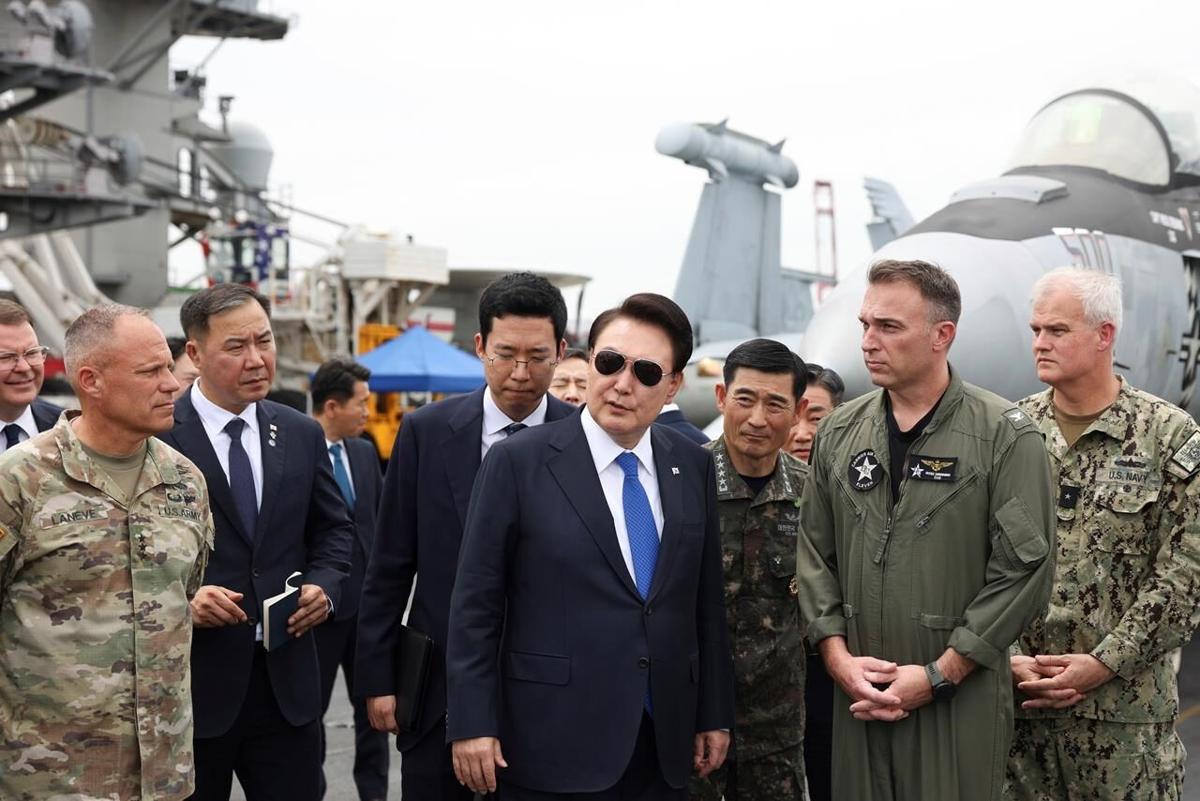
    However, these exercises are not without risk. They often heighten regional tensions, as China routinely criticizes military drills conducted within what it considers its sphere of influence. Additionally, North Korea has condemned the arrival of the USS Theodore Roosevelt carrier group in Busan, South Korea, for Freedom Edge, labeling it as “provocative” and “dangerous.” Following South Korean President Yoon Suk Yeol’s visit to the Roosevelt, North Korea tested what it claimed was a multiwarhead missile, although South Korean and U.S. authorities later assessed that the launch failed.

    The trilateral defense cooperation involving Japan and South Korea also presents political challenges due to historical animosities stemming from Japan’s occupation of Korea before and during World War II. Despite these challenges, both countries have significantly bolstered their military capabilities and host approximately 80,000 American troops. Japan’s Prime Minister Fumio Kishida has increased defense spending and cooperation with South Korea, actions generally well-received by the Japanese public but controversial within his party’s right wing. Similarly, President Yoon’s efforts to improve relations with Japan have faced domestic opposition but remain crucial for regional security.

    Both leaders are working to strengthen their defense ties with the U.S. in anticipation of a potential new American administration. South Korean officials have expressed hopes of signing a formal security framework agreement with the U.S. and Japan this year, aiming to establish a unified response strategy to potential North Korean threats.