Tag: Environmental Impact Assessment

  • Canada Moves Forward with High-Speed Rail: A New Era for Travel Between Toronto and Quebec City

    Canada Moves Forward with High-Speed Rail: A New Era for Travel Between Toronto and Quebec City


    In a significant move for Canadian transportation, the federal government is “seriously” considering the construction of the country’s first high-speed rail link connecting Quebec City and Toronto. This announcement was made by Public Services and Procurement Minister Jean-Yves Duclos, highlighting the government’s commitment to enhancing passenger rail services.

    The plan, initially introduced in 2021, proposed a high-frequency rail corridor with stops in key cities including Toronto, Peterborough, Ottawa, Montreal, Trois-Rivières, Laval, and Quebec City. The estimated cost for this ambitious project ranges between $6 billion and $12 billion. As the initiative progresses, three qualified bidders have been identified to compete for the project, with expectations to offer both conventional rail networks reaching speeds of 200 km/h and high-speed alternatives comparable to European models.

    Minister Duclos stated that the successful bidder will be announced soon, along with further details about the project. He emphasized that the models being considered for high-frequency rail are quite similar to those used in high-speed trains, suggesting that achieving faster travel times is a realistic goal. Current VIA Rail services operate at slower speeds of 60 to 120 km/h, sharing tracks with freight trains. The new corridor is expected to feature dedicated tracks, significantly improving travel times for passengers.

    “This would be a transformative project for Canadians,” Duclos noted, indicating that it would unite nearly half of the country’s population. Approximately 18 million residents live within the proposed corridor. However, Duclos also acknowledged that travelers might not be able to purchase tickets until the mid-2030s, as the project will be rolled out in phases and undergo various environmental and regulatory assessments before a final investment decision is made.

    Interestingly, Canada currently stands out as the only G7 nation without a high-speed rail system. Historical commitments made by political leaders during past elections, such as Liberal leader Michael Ignatieff and NDP leader Jack Layton, have highlighted the long-standing interest in high-speed rail development.

    The VIA HFR initiative has shifted its focus towards enhancing both speed and frequency, aiming for an electrified corridor that would reduce carbon emissions and alleviate road congestion. The proposed rail line, which spans over 1,000 kilometers, is also considering expansions to include London and Windsor, further bolstering regional connectivity.

    As Canada embraces the potential of high-speed rail, the journey towards modernized transportation infrastructure continues, aiming to make rail travel a viable and eco-friendly alternative to cars and planes.

    Source: Swifteradio.com
  • Latest Environmental Impact Assessment Update

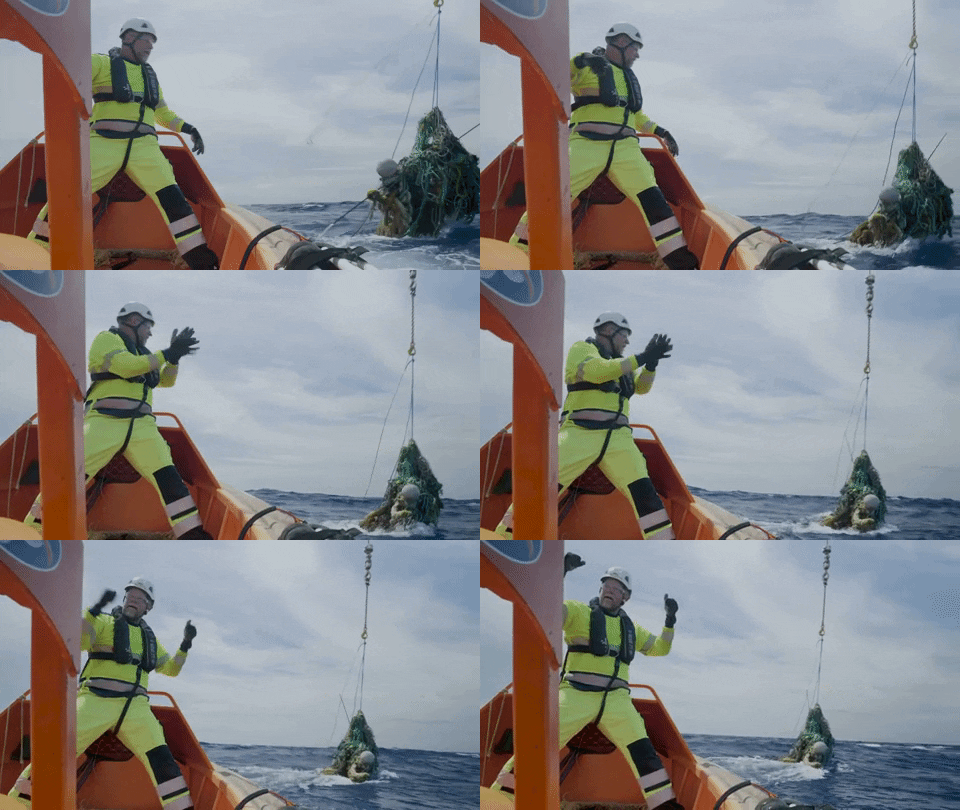
    The Ocean Cleanup has recently completed the Environmental Impact Assessment (EIA) for System 001, a project designed to address the significant issue of ocean plastic pollution in the Great Pacific Garbage Patch. Conducted by the independent environmental consultancy CSA Ocean Sciences, the EIA aims to evaluate the environmental, social, and economic impacts of the project throughout its life cycle.

    The EIA identified potential impacts on marine life, birds, vessels, and protected areas. Although conducted voluntarily, the assessment adheres to the 1999 International Association for Impact Assessment Principles of Environmental Impact Assessment Best Practices. The findings indicate that 29 impact factors were considered, with all but one categorized as “Low” or “Negligible” risks, even before mitigation measures. The single “Medium” risk involved the potential attraction of sea turtles to the cleanup system or ingestion of plastics due to their concentration near the floating screen.

    Mitigation measures have been defined for all identified impacts, and The Ocean Cleanup plans extensive on-site monitoring during the first year of deployment to ensure the system’s environmental safety. Despite not being legally required, this EIA follows significant engagement with regulators, experts, and stakeholders, demonstrating The Ocean Cleanup’s commitment to transparency and environmental responsibility.

    The organization also encourages public engagement, inviting questions and comments via email and offering regular updates through their newsletter.

    SOURCE: theoceancleanup


  • US Supreme Court to Review Dispute Over Agency Environmental Assessments

    The US Supreme Court has granted certiorari in a case that could define whether the National Environmental Policy Act (NEPA) allows federal agencies to consider broader environmental impacts, including climate change, beyond the immediate scope of proposed projects.

    The case, Seven County Infrastructure Coalition v. Eagle County, Colo., centers on the proposed 88-mile Uinta Basin Railway designed to transport oil and minerals from northeast Utah to market. The US Court of Appeals for the DC Circuit invalidated the Surface Transportation Board’s approval of the railway last year.

    Supporters of the project, a coalition of Utah counties, seek Supreme Court intervention to overturn the DC Circuit’s decision and uphold the Surface Transportation Board’s original approval. They argue that the Supreme Court should resolve conflicting interpretations arising from its 2004 ruling in Department of Transportation v. Public Citizen. This case established that NEPA does not obligate federal agencies to assess environmental impacts beyond their regulatory authority.

    Environmental groups opposing the railway project dispute the existence of a circuit split, contending that all courts agree on the limitations outlined in Public Citizen. They argue that the specific issue raised by the coalition is irrelevant to the railway case.

    In its ruling last year, the DC Circuit criticized the Surface Transportation Board’s environmental review of the railway for being too narrow, failing to adequately address potential impacts such as future oil development, rail accidents, wildfires, and water pollution.

    The coalition contends that most circuits interpret Public Citizen as restricting an agency’s NEPA review to impacts within its regulatory jurisdiction, absolving it from broader environmental considerations.

    In contrast, Eagle County and several environmental organizations, including the Sierra Club and the Center for Biological Diversity, argue that the Surface Transportation Board must assess the foreseeable impacts of approving a new rail line, including those beyond its immediate regulatory scope.

    The Sierra Club, which receives funding from Bloomberg Philanthropies, emphasizes the importance of comprehensive environmental review in regulatory decisions.

    The case is titled Seven Cty. Infrastructure Coal. v. Eagle Cty., Colo., U.S., No. 23-975, 6/24/24.

    source: news.bloomberglaw.com