Tag: China

  • China Expels Politburo Member Ma Xingrui Amid Xi Jinping’s Anti-Corruption Campaign

    China Expels Politburo Member Ma Xingrui Amid Xi Jinping’s Anti-Corruption Campaign

    China has expelled Politburo member Ma Xingrui from the Chinese Communist Party as President Xi Jinping’s sweeping anti-corruption campaign continues to target senior government and party officials. The move marks another high-profile development in Beijing’s ongoing efforts to strengthen party discipline and combat corruption at the highest levels of government.

    Chinese authorities announced that Ma Xingrui was expelled following an internal disciplinary investigation. While officials have not released full details of the allegations, the decision reflects the government’s continued emphasis on enforcing party rules and holding senior officials accountable for misconduct.

    President Xi Jinping’s anti-corruption campaign, launched shortly after he took office, has become one of the most extensive political initiatives in modern Chinese history. The campaign has resulted in investigations, disciplinary actions, and prosecutions involving thousands of officials across various levels of government, the military, and state-owned enterprises.

    The removal of a Politburo member is considered a significant political event, as the Politburo is one of the highest decision-making bodies within the Chinese Communist Party. Analysts say the latest action reinforces Xi’s commitment to maintaining strict party discipline and consolidating internal governance.

    The announcement is expected to attract close attention from political observers and international analysts, who continue to monitor the impact of China’s anti-corruption drive on the country’s leadership and policymaking.

    As Beijing presses ahead with its campaign, authorities have reiterated that combating corruption remains a top priority aimed at preserving public trust, strengthening governance, and ensuring long-term political stability.

    Swifteradio.com

  • Uyghur Advocacy Group Urges Canada to Take Stronger Stand on China’s Ethnic Unity Law

    Uyghur Advocacy Group Urges Canada to Take Stronger Stand on China’s Ethnic Unity Law

    A Uyghur advocacy organization is calling on the Canada government to adopt a stronger response to China’s recently enacted ethnic unity law, arguing that Ottawa’s initial reaction was too vague and insufficient to address concerns over human rights.

    The group contends that the legislation could further tighten Beijing’s control over ethnic minority communities, particularly the Uyghur population in China’s Xinjiang Uyghur Autonomous Region. Advocacy organizations have long accused Chinese authorities of implementing policies that restrict cultural, religious, and linguistic freedoms in the region.

    Canada has expressed concern over the new law and reiterated its commitment to defending human rights and promoting respect for international norms. However, Uyghur representatives argue that stronger diplomatic action, clearer public statements, and additional policy measures are needed to demonstrate Canada’s commitment to protecting vulnerable communities.

    The advocacy group is urging Ottawa to coordinate with international allies, increase pressure through diplomatic channels, and continue supporting independent investigations into alleged human rights violations involving Uyghurs and other ethnic minorities.

    The Government of Canada has consistently stated that it supports the protection of fundamental human rights and has previously raised concerns over the treatment of Uyghurs in international forums.

    Chinese authorities have repeatedly rejected allegations of human rights abuses in Xinjiang, maintaining that policies implemented in the region are aimed at combating extremism, promoting stability, and fostering ethnic unity.

    The issue continues to be a source of diplomatic tension between China and several Western countries, including Canada, the United States, and members of the European Union, all of which have called for greater transparency regarding conditions in Xinjiang.

    Foreign policy analysts say Canada’s response reflects the challenge of balancing human rights advocacy with broader diplomatic and economic relations with China.

    Human rights organizations continue to call on governments worldwide to strengthen international efforts to protect ethnic minorities and ensure accountability for alleged abuses.

    As debate over China’s ethnic unity law continues, Canada’s position is expected to remain under close scrutiny from advocacy groups, lawmakers, and international partners seeking a more coordinated global response.

    Swifteradio.com

  • Flooding From Days of Heavy Rain Kills 39 in Southern China

    Flooding From Days of Heavy Rain Kills 39 in Southern China

    At least 39 people have died after days of relentless heavy rainfall triggered widespread flooding across China, with southern provinces bearing the brunt of the disaster, according to Chinese authorities.

    Torrential rain caused rivers to overflow, inundating communities, damaging homes, destroying infrastructure, and forcing thousands of residents to evacuate as emergency services carried out rescue operations in the affected regions.

    Officials said floodwaters swept through towns and villages, cutting off transportation routes and disrupting electricity, communications, and essential public services. Search and rescue teams have been deployed to locate missing persons and assist stranded residents.

    Authorities warned that the death toll could rise as emergency responders continue recovery efforts in areas that remain difficult to access due to damaged roads and ongoing flooding.

    The severe weather has also affected agriculture, with large areas of farmland submerged and significant crop losses expected. Local governments have begun assessing the economic impact while providing emergency shelter and relief supplies to displaced families.

    China’s meteorological agency has warned that additional rainfall is forecast for parts of southern China, raising concerns about renewed flooding, landslides, and flash floods in already saturated areas.

    Emergency management officials have urged residents living in flood-prone communities to remain alert, follow evacuation instructions, and monitor official weather updates as conditions continue to evolve.

    The Chinese government has mobilized disaster response teams and allocated emergency resources to support rescue operations, infrastructure repairs, and humanitarian assistance in the affected provinces.

    Flooding is a recurring challenge during China’s rainy season, particularly in southern regions where prolonged periods of intense rainfall frequently overwhelm rivers and drainage systems.

    Climate experts have noted that increasingly extreme weather events continue to place greater pressure on disaster preparedness and flood management systems across the country.

    Recovery efforts remain underway as authorities work to restore essential services, assist affected communities, and reduce the risk of further casualties from continuing severe weather.

    Swifteradio.com

  • China Imposes Export Controls on 40 Japanese Entities as Tensions With Tokyo Escalate

    China Imposes Export Controls on 40 Japanese Entities as Tensions With Tokyo Escalate

    China has imposed new export control measures on 40 Japanese entities, marking a significant escalation in trade and diplomatic tensions between Beijing and Japan.

    Chinese authorities announced that the affected Japanese organizations would be subject to tighter export restrictions under national security regulations, a move that could impact trade, technology transfers, and commercial cooperation between the two Asian economies.

    According to officials, the measures are intended to safeguard China’s national interests and security. However, detailed information regarding the specific entities affected and the scope of the restrictions has not been fully disclosed.

    The latest action comes amid increasingly strained relations between Beijing and Tokyo over a range of political, economic, and security issues.

    China and Japan have recently exchanged criticism over regional security, military activities, trade policies, and territorial disputes, contributing to growing diplomatic friction between the neighboring countries.

    Trade analysts say the new export controls could affect businesses involved in technology, manufacturing, electronics, industrial equipment, and other sectors that rely on cross-border supply chains.

    The restrictions may also create additional uncertainty for multinational companies operating across East Asia, where China and Japan remain two of the world’s largest economies and major trading partners.

    Japanese officials have expressed concern over the development and are expected to review the implications for affected businesses while considering possible diplomatic and economic responses.

    Business organizations in both countries are closely monitoring the situation, warning that prolonged trade tensions could disrupt investment, production, and regional economic stability.

    Economic experts note that export controls have increasingly become a tool used by governments to address national security concerns while influencing international trade relationships.

    The latest measures also reflect broader geopolitical competition across the Indo-Pacific region, where strategic rivalry, technology policy, and economic security continue to shape government decisions.

    Despite ongoing disagreements, China and Japan maintain extensive commercial ties, with bilateral trade remaining an important pillar of economic activity for both nations.

    Diplomatic observers believe continued dialogue will be essential to preventing further deterioration in relations, particularly given the importance of cooperation on regional stability and global economic growth.

    As both governments assess their next steps, the newly announced export controls underscore the increasingly complex intersection of international trade, national security, and geopolitical competition in East Asia.

    The coming weeks will likely determine whether the latest restrictions lead to further retaliatory measures or renewed diplomatic efforts to stabilize one of Asia’s most significant bilateral relationships.

    Swifteradio.com

  • Satellite Internet Takes Off in China, Pioneering New Horizons for Connectivity

    In a groundbreaking development, China is rapidly advancing its satellite internet capabilities, revolutionizing connectivity across its vast and diverse landscapes. The recent deployment of satellite technology in remote areas, such as the Yulong Naxi Autonomous County in Yunnan Province, showcases a significant leap forward in overcoming connectivity challenges that have long plagued these regions.

    Transforming Connectivity in Remote Areas

    Previously, local power grid staff faced immense difficulties in establishing reliable internet connections. Unstable signals and slow speeds hindered their ability to transmit essential data. However, with the advent of satellite internet, these obstacles are becoming a thing of the past. Now, power inspectors can effortlessly send real-time videos and critical instructions to monitoring centers situated over 500 kilometers away. This technological leap is indicative of the broader potential of satellite internet in enhancing communication, especially in challenging terrains.

    The Rise of Satellite Internet in China

    China’s satellite internet industry is booming, drawing attention for its remarkable advancements. From establishing high-orbit satellite systems to launching the first medium-Earth-orbit communication satellites, the nation is making significant strides in this innovative field. A notable milestone occurred in May when China introduced its space-based technology service in Thailand, further illustrating the global aspirations of its satellite internet endeavors.

    Satellite internet operates by utilizing satellites in orbit as base stations, providing users worldwide with reliable internet access. Unlike traditional connectivity, which is limited by geographical constraints, satellite technology can reach even the most remote locations, from deserts to oceans.

    Expanding Applications and Benefits

    The applications of satellite internet are expanding rapidly. Initially, satellite communication was primarily used for transoceanic TV broadcasts and long-distance calls. Today, personal broadband access is at the forefront, as noted by He Shanbao, a researcher at Beijing Information Science and Technology University. With mobile internet coverage still limited in many areas, satellite connections become crucial during emergencies and natural disasters when traditional infrastructure fails.

    Companies like China Satellite Communications Co., Ltd. are exploring partnerships with airlines to provide in-flight Wi-Fi services, enabling passengers to stream videos and browse the web at speeds comparable to 4G. Meanwhile, Geespace, a technology enterprise under the Chinese automaker Geely, is developing satellite internet services for vehicles. This innovative technology allows users to make satellite calls and send messages even when ground networks are unavailable, ensuring connectivity during emergencies.

    A Vision for the Future

    To integrate satellite internet into the mass consumer market, establishing direct connections between mobile phones and satellites is essential. In 2023, China Telecom launched a direct satellite service for mobile phones, paving the way for smartphone manufacturers like Huawei and OPPO to introduce models with satellite calling capabilities.

    China’s satellite internet ambitions extend beyond its borders. In June, GalaxySpace, a private Chinese company, collaborated with Thailand’s Mahanakorn University of Technology to showcase real-time satellite internet applications, highlighting its potential in telemedicine and remote care.

    Government Support and Economic Impact

    The Chinese government has been a staunch advocate for the satellite internet industry since 2020, incorporating it into national development strategies. Cities like Beijing and Shanghai have introduced policies to foster growth in this emerging sector. Analysts predict that the market size of China’s satellite internet could reach approximately 44.7 billion yuan (around 6.3 billion U.S. dollars) by 2025, fueled by both state and private investments.

    Liu Tun, a senior analyst at the Ministry of Industry and Information Technology, emphasizes that private sector involvement will not only drive economic growth but also enhance the country’s capacity for independent innovation within the industry.

    As satellite internet technology continues to evolve, it holds the promise of transforming connectivity across China and beyond. With its potential to bridge the digital divide in remote areas and provide reliable services during emergencies, the future of satellite internet is bright. This technological revolution is not just about faster internet speeds; it’s about creating new possibilities for communication and connectivity in an increasingly digital world.

    Source: News

  • China Expands Visa-Free Entry to Poland & 11 European Countries

    people at Forbidden City in China during daytime

    China Extends Visa-Free Travel to More Countries to Boost Tourism

    China has extended its visa-free travel scheme to include Poland, Australia, and New Zealand, with the initiative aiming to boost tourism and international exchanges. The new visa-free policy will be in effect until the end of 2025.

    Key Points:

    • New Additions: Polish citizens are now eligible for visa-free entry into China starting from July 1, 2024. This follows earlier extensions to citizens of 11 other European countries and Malaysia.
    • Visa-Free Access: Citizens from Austria, Belgium, France, Germany, Hungary, Ireland, Italy, Luxembourg, the Netherlands, Spain, and Switzerland can also enter China without a visa until the end of next year.
    • Duration: The visa-free entry allows for a stay of up to 15 days as part of a trial program aimed at promoting high-quality exchanges between Chinese and foreign nationals.

    Objective:

    The initiative is part of China’s broader strategy to attract more international visitors for both business and tourism, fostering cultural and economic exchanges. According to Foreign Ministry spokesperson Mao Ning, the goal is to facilitate the “high-quality development of Chinese and foreign personnel exchanges and high-level opening up to the outside world.”

    Impact of Pandemic:

    • Previous Restrictions: China’s strict pandemic measures, which included mandatory quarantines for all arrivals, severely restricted international travel for nearly three years. These restrictions were lifted early last year, but international travel has not yet returned to pre-pandemic levels.
    • Historical Context: Before the pandemic, China allowed visa-free entry for citizens of Brunei, Japan, and Singapore, but this was suspended during the COVID-19 outbreak. Visa-free entry for Brunei and Singapore resumed in July, but Japan remains excluded.

    Tourism Data:

    • Pre-Pandemic vs. Now: In 2023, China recorded 35.5 million entries and exits by foreigners, compared to 97.7 million in 2019. The drop in international visitors highlights the lingering impact of the pandemic on global travel.
    • Interest in China: Data from Trip.com showed a significant increase in interest in China as a tourist destination among Europeans, with a 663% rise in overall bookings from Europe to China in 2023 compared to 2022. There was also a nearly 29% increase in bookings compared to 2019.

    Popular Destinations:

    • Top Cities: Shanghai remains the most popular destination for European visitors, followed by Beijing, Guangzhou, and Shenzhen. Emerging destinations include Sanya, a beachside city on Hainan Island, and Chengdu, the capital of Sichuan province.

    Additional Measures:

    China is further encouraging inbound tourism by promoting cultural and historical attractions in partnership with Trip.com. The country is also investing in tourism infrastructure, including technology enhancements, travel guides, and e-payment systems, to improve the travel experience for international visitors.

    Sources: Euronews

  • As Threats from North Korea and China Escalate, US Strengthens Defense Partnerships with Asian Allies

    As North Korean and Chinese threats escalate, the United States is intensifying efforts to solidify defense partnerships with its Asian allies. Recently, the U.S. concluded its inaugural multidomain exercise with Japan and South Korea in the East China Sea, marking a significant step in strengthening these key security relationships. The exercise, named Freedom Edge, represents Washington’s commitment to enhancing joint defense capabilities in the face of increasing regional threats.

    Held over three days, Freedom Edge included sophisticated air and naval drills designed to improve joint ballistic-missile defense, anti-submarine warfare, and surveillance operations. This exercise aimed to refine the ability of the three nations to share missile warnings—a critical capability as North Korea continues to develop and test advanced missile systems.

    Japan and South Korea, aside from Australia, are the only U.S. allies in the region with the advanced military capabilities necessary for integrated operations with American forces. This interoperability is crucial in potential conflict scenarios, enabling, for example, rapid response coordination if South Korea detects a missile target. According to Ridzwan Rahmat, an analyst with defense intelligence firm Janes, such exercises foster the development of a cohesive fighting force among the three nations.

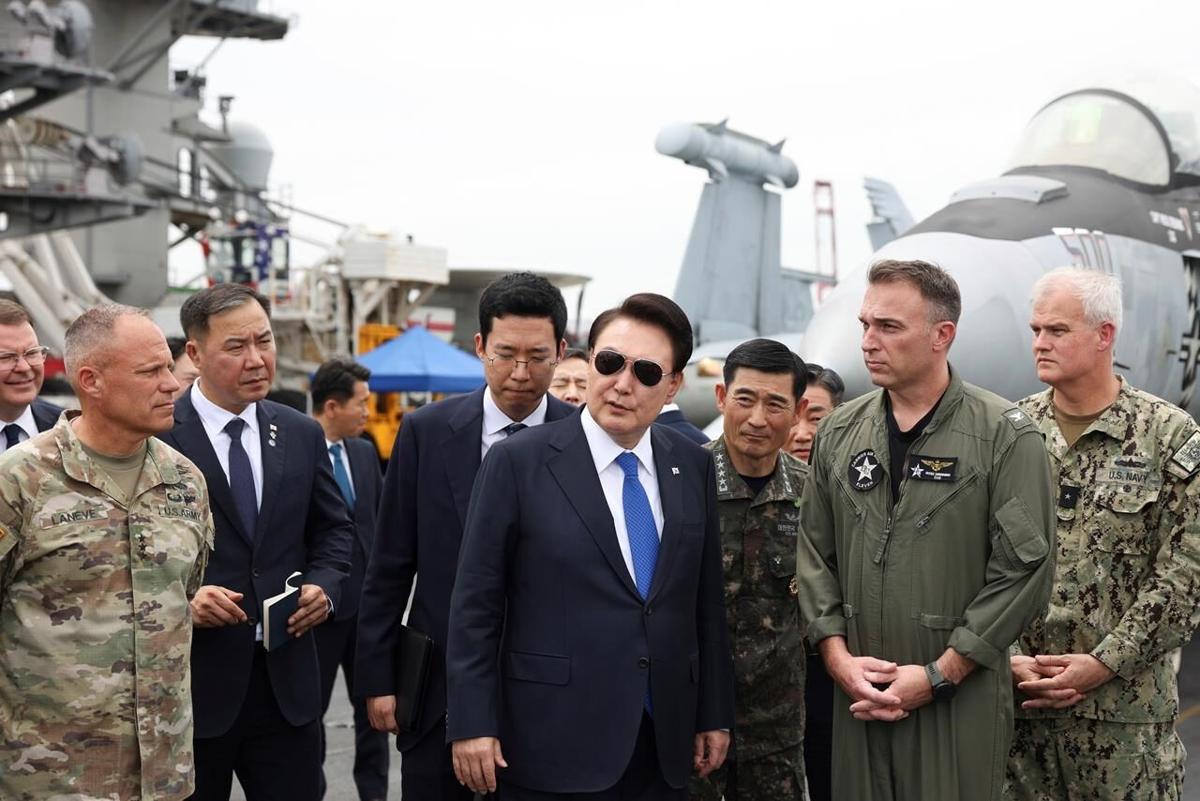
    However, these exercises are not without risk. They often heighten regional tensions, as China routinely criticizes military drills conducted within what it considers its sphere of influence. Additionally, North Korea has condemned the arrival of the USS Theodore Roosevelt carrier group in Busan, South Korea, for Freedom Edge, labeling it as “provocative” and “dangerous.” Following South Korean President Yoon Suk Yeol’s visit to the Roosevelt, North Korea tested what it claimed was a multiwarhead missile, although South Korean and U.S. authorities later assessed that the launch failed.

    The trilateral defense cooperation involving Japan and South Korea also presents political challenges due to historical animosities stemming from Japan’s occupation of Korea before and during World War II. Despite these challenges, both countries have significantly bolstered their military capabilities and host approximately 80,000 American troops. Japan’s Prime Minister Fumio Kishida has increased defense spending and cooperation with South Korea, actions generally well-received by the Japanese public but controversial within his party’s right wing. Similarly, President Yoon’s efforts to improve relations with Japan have faced domestic opposition but remain crucial for regional security.

    Both leaders are working to strengthen their defense ties with the U.S. in anticipation of a potential new American administration. South Korean officials have expressed hopes of signing a formal security framework agreement with the U.S. and Japan this year, aiming to establish a unified response strategy to potential North Korean threats.