
Nvidia has projected that its artificial intelligence chip revenue opportunity could surpass $1 trillion by 2027, as the company intensifies efforts to dominate the rapidly expanding market for real-time AI processing, also known as inference computing.
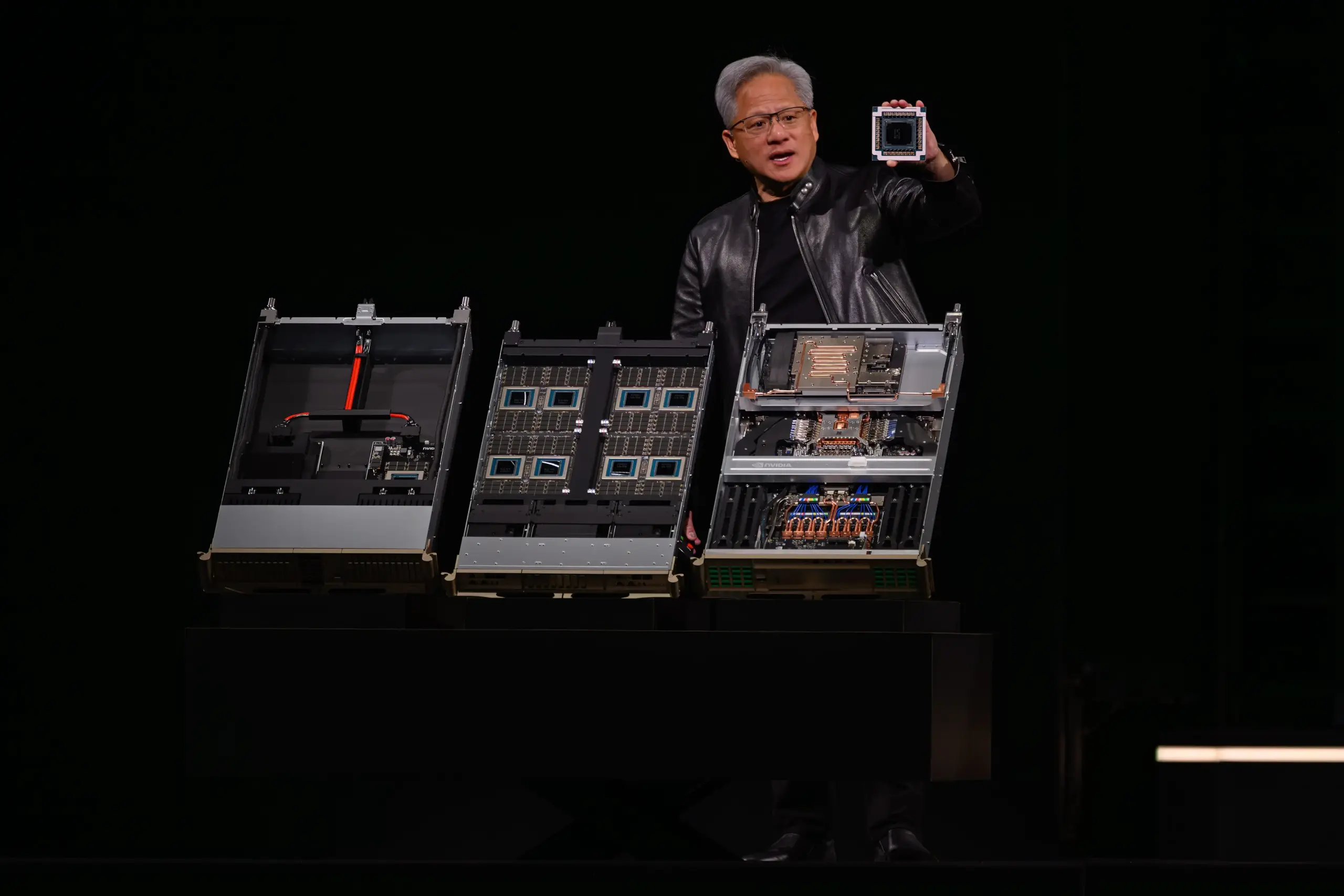
CEO Jensen Huang made the announcement during Nvidia’s annual GTC developer conference in San Jose, California, where he unveiled a new central processing unit and an advanced AI system powered by technology licensed from chip startup Groq in a $17 billion deal completed in December.
The strategy signals Nvidia’s aggressive move to strengthen its position in inference computing, a segment where its graphics processing units face growing competition from central processors and custom-built chips developed by major technology companies such as Google. While Nvidia has long led the AI training market, the focus is now shifting toward deploying AI systems that respond to real-time user queries at scale.
Huang described the current moment as a turning point for the industry, noting that demand for inference capabilities continues to surge. The company’s latest forecast doubles its previous estimate of a $500 billion revenue opportunity through 2026 tied to its Blackwell and Rubin AI chips.

Despite Nvidia’s meteoric rise, including becoming the first company to reach a $5 trillion valuation last year, investor concerns have emerged over the sustainability of its growth and its strategy of reinvesting heavily into the AI ecosystem. However, the updated forecast has helped ease some of those concerns, with analysts pointing to sustained demand for AI infrastructure.
At the conference, Huang outlined how Nvidia plans to capitalize on the inference boom by dividing the process into two stages. Its upcoming Vera Rubin chips will handle the “prefill” phase, converting human language into machine-readable tokens, while Groq-powered systems will manage the “decode” stage, delivering responses back to users.
The shift comes as major AI developers, including OpenAI, Anthropic, and Meta, transition from training models to serving hundreds of millions of users worldwide. This evolution is also boosting demand for CPUs, traditionally dominated by Intel, which are increasingly being used alongside or instead of GPUs for AI deployment.
Nvidia is positioning itself to capture this opportunity with its newly introduced Vera CPU, which Huang said is already on track to become a multi-billion-dollar business. The company also previewed its long-term Feynman architecture roadmap, expected to launch in 2028, featuring a suite of AI and networking chips.
In addition, Nvidia is targeting the emerging market for autonomous AI agents with its NemoClaw platform, designed to integrate with OpenClaw and provide enhanced privacy and safety controls for AI systems capable of executing complex tasks with minimal human input.
The announcements highlight Nvidia’s transformation from a chipmaker into a full-scale AI infrastructure provider, as it expands beyond individual processors to deliver integrated systems designed to power the next generation of artificial intelligence applications.
