
Iran fired missiles at Israel and several Arab states on Monday as the conflict rapidly expanded to include Tehran-backed militias across the Middle East. Hezbollah launched attacks on Israel from Lebanon, prompting heavy Israeli retaliation, while the United States carried out new strikes inside Iran. Iranian security official Ali Larijani declared that Tehran would not negotiate with Washington, even as President Donald Trump signaled openness to dialogue with Iran’s new leadership.
More than 200 people have been killed since the start of the strikes that also claimed the life of Iran’s Supreme Leader Ayatollah Ali Khamenei, according to Iranian officials. Iranian authorities warned that military units were operating independently of centralized command, raising fears of further regional instability.
A bomb-carrying drone boat struck an oil tanker in the Gulf of Oman, killing one crew member from India. Oman confirmed the vessel was attacked off the coast near Muscat, while Iran continued to threaten shipping routes approaching the Strait of Hormuz, a vital corridor for global oil trade.
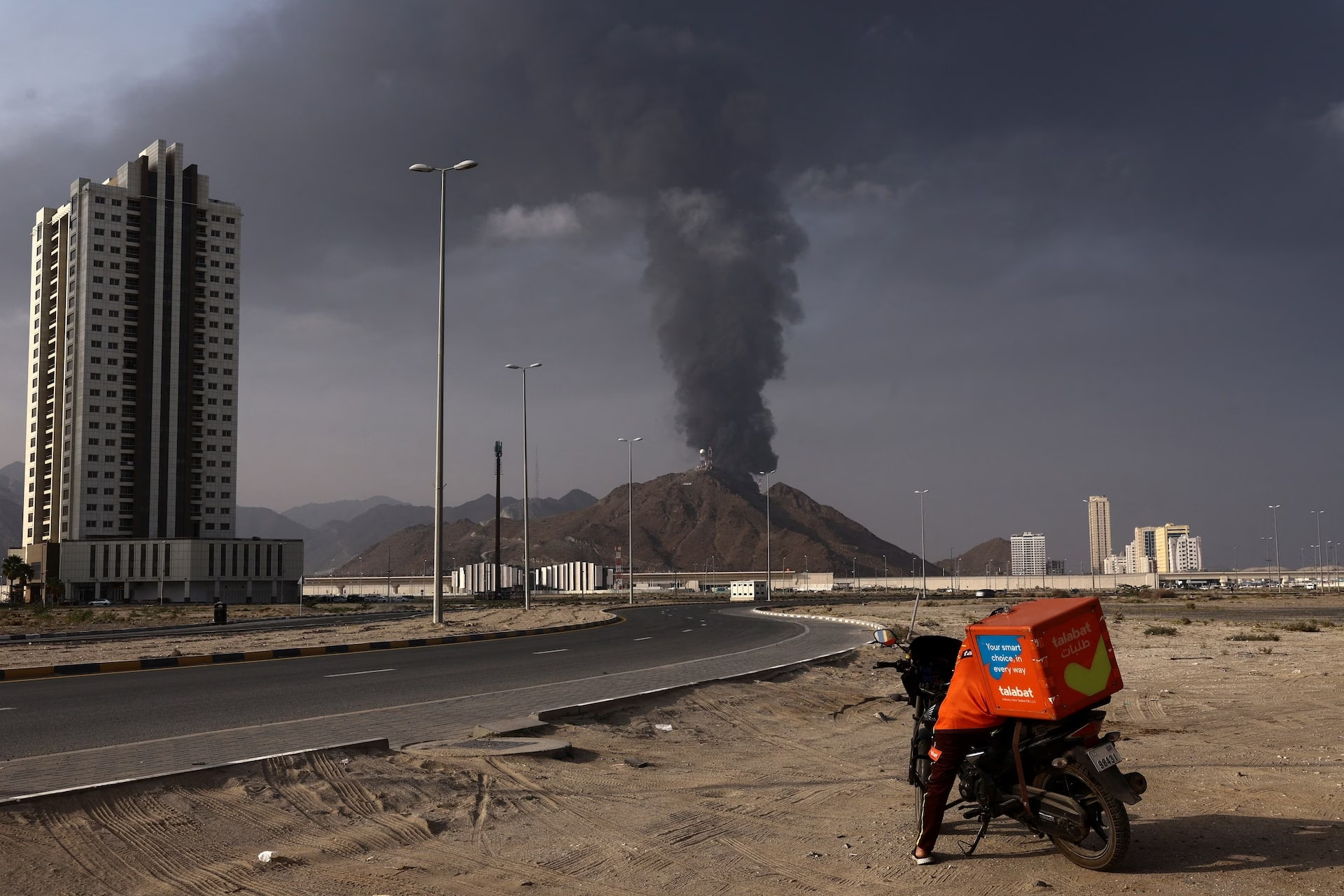
Air defenses in the United Arab Emirates intercepted drones over Abu Dhabi, with debris causing minor damage to industrial facilities. Jordan announced partial airspace closures, and Kuwait reported that several U.S. warplanes crashed after intense Iranian fire, though all pilots survived. Fire and smoke were later seen rising from inside the U.S. Embassy compound in Kuwait following an Iranian strike.

In Lebanon, Israeli warplanes carried out their deadliest barrage in more than a year after Hezbollah fired rockets into Israel. At least 31 people were killed and 149 wounded, according to Lebanon’s Health Ministry. Thousands of displaced families sought shelter in Beirut schools as airstrikes pounded the southern suburbs.
Saudi Arabia temporarily shut down its Ras Tanura oil refinery near Dammam after it was targeted by Iranian drones, marking what analysts described as a significant escalation that puts Gulf energy infrastructure directly in Iran’s sights. The refinery processes more than half a million barrels of crude oil per day.
Iran accused the United States and Israel of targeting its Natanz nuclear enrichment site, while its ambassador to the International Atomic Energy Agency condemned what he called unlawful attacks on peaceful nuclear facilities. However, IAEA chief Rafael Grossi said there was no evidence so far of damage to nuclear installations or elevated radiation levels.
Russia confirmed it remains in contact with Iranian leadership and Gulf countries, expressing disappointment over U.S. and Israeli strikes despite earlier diplomatic progress. Germany said it would not participate in military action but would defend its troops stationed in Jordan and Iraq if attacked.
Across the region, airstrikes and explosions were reported in Tehran, Beirut, Irbil, Dubai and Bahrain. The United Arab Emirates closed its main stock exchanges as uncertainty gripped financial markets, while Turkey temporarily halted short-term border crossings by Iranian visitors.
The World Health Organization called for the protection of civilians and medical facilities, warning that the region’s nuclear plants and dense populations heightened the risk of catastrophic consequences. As missile and drone attacks spread across borders, fears are growing that the war could drag more countries into a wider Middle East conflict.
