
Iran launched a drone attack on the U.S. Embassy in Saudi Arabia’s capital early Tuesday, setting off a limited fire and causing minor damage, according to Saudi Arabia’s Defense Ministry. The strike came as the United States and Israel intensified air operations against Iran, with U.S. President Donald Trump warning that the campaign could last more than a month.
Two drones hit the embassy compound in Riyadh, prompting U.S. officials to urge Americans to avoid the area. The attack followed a similar strike on the U.S. Embassy in Kuwait, which announced it had closed until further notice. The U.S. State Department ordered the evacuation of non-emergency personnel and families from Kuwait, Bahrain, Iraq, Qatar, Jordan and the United Arab Emirates as a precaution.
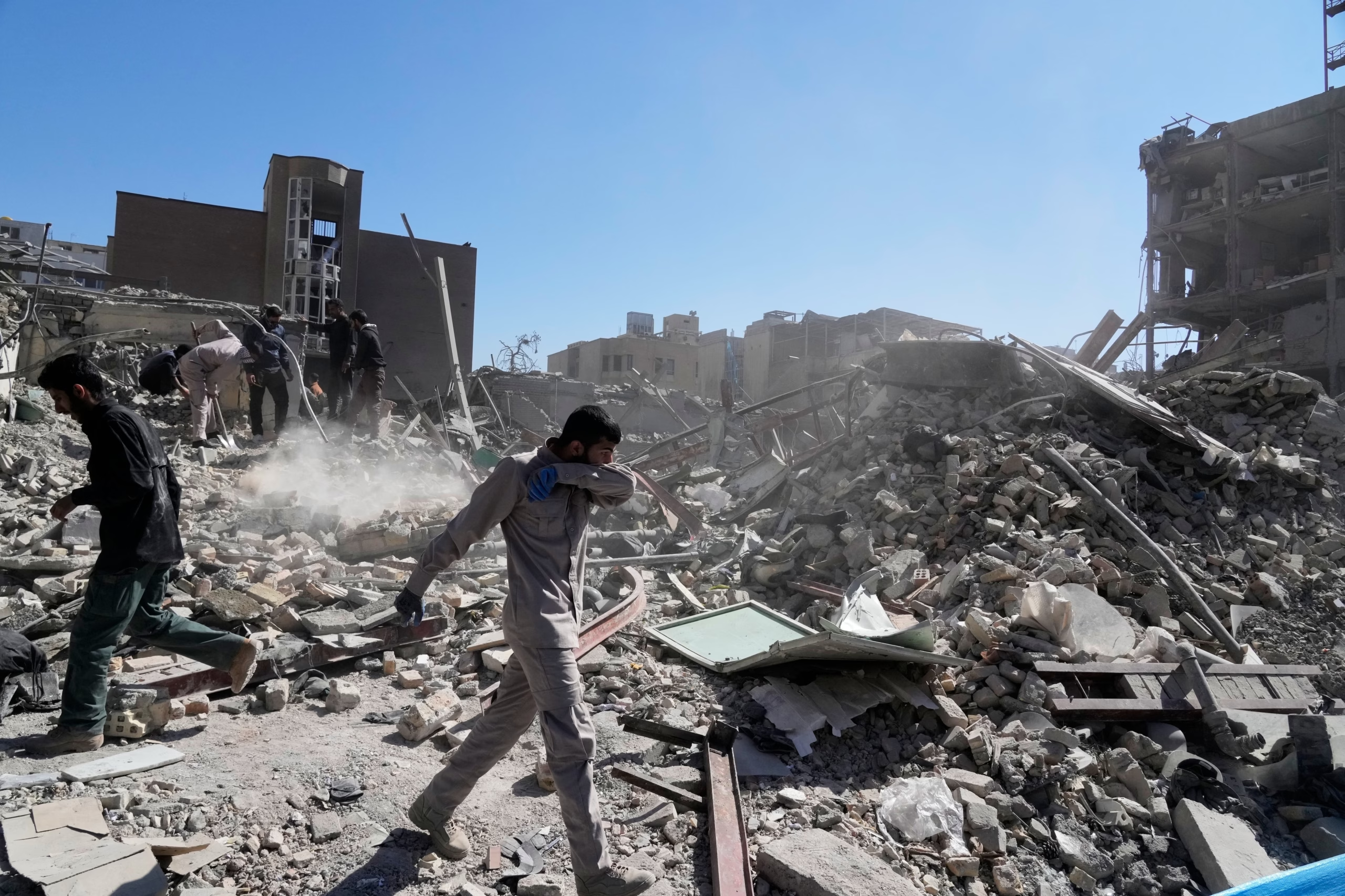
Explosions were reported across Tehran overnight as aircraft were heard overhead. The International Atomic Energy Agency confirmed that Iran’s Natanz nuclear enrichment site sustained recent damage but said no radiological consequences were expected. Natanz had previously been targeted during the brief Iran-Israel war last year.
In Lebanon, Israel expanded strikes on the Iran-backed Hezbollah group, with explosions reported in southern Beirut and along the border. Lebanese authorities said Israeli attacks killed at least 52 people, while Hezbollah claimed it launched drones toward an Israeli air base. The Israeli military said two drones were intercepted and confirmed its troops were operating in southern Lebanon.

Iran’s retaliation has spread across the Gulf region, hitting energy facilities in Qatar and Saudi Arabia and targeting shipping in the Strait of Hormuz, a critical global energy corridor. Iranian Brigadier General Ebrahim Jabbari warned that the strait was effectively closed and threatened to attack any vessel attempting to pass through. The escalation has sent global oil and gas prices sharply higher.
The Iranian Red Crescent Society said at least 787 people have been killed in Iran since the campaign began. In Israel, missile strikes killed 11 people. Thirteen Iranian soldiers were reported killed in Kerman province, while three civilians died in the United Arab Emirates and one each in Kuwait and Bahrain. The U.S. military confirmed six American service members were killed in Kuwait when their logistics unit came under attack.
Chaos intensified when Kuwait mistakenly shot down three U.S. fighter jets during an Iranian barrage of missiles and drones. All six pilots ejected safely, according to U.S. Central Command.
Trump said U.S. operations could last four to five weeks and possibly longer, adding that Washington has a “virtually unlimited supply” of munitions and pre-positioned weapons. He said the objectives were to destroy Iran’s missile capabilities, cripple its navy, prevent it from acquiring nuclear weapons and cut off support for proxy forces such as Hezbollah.
Iranian officials denied pursuing nuclear weapons and said their program remains peaceful. However, Israeli Prime Minister Benjamin Netanyahu claimed Tehran was rebuilding underground facilities to produce atomic bombs, offering no evidence. Satellite imagery reviewed by international analysts suggested limited activity at two nuclear sites as Iran assessed damage from recent strikes.
The conflict has drawn in proxy forces from Iraq and Lebanon, further widening the battlefield. Aid agencies warned that millions of civilians are at risk as displacement grows and essential infrastructure is damaged. With no clear exit strategy and mounting casualties, diplomats fear the crisis is entering a prolonged and highly volatile phase with serious consequences for regional and global security.
