
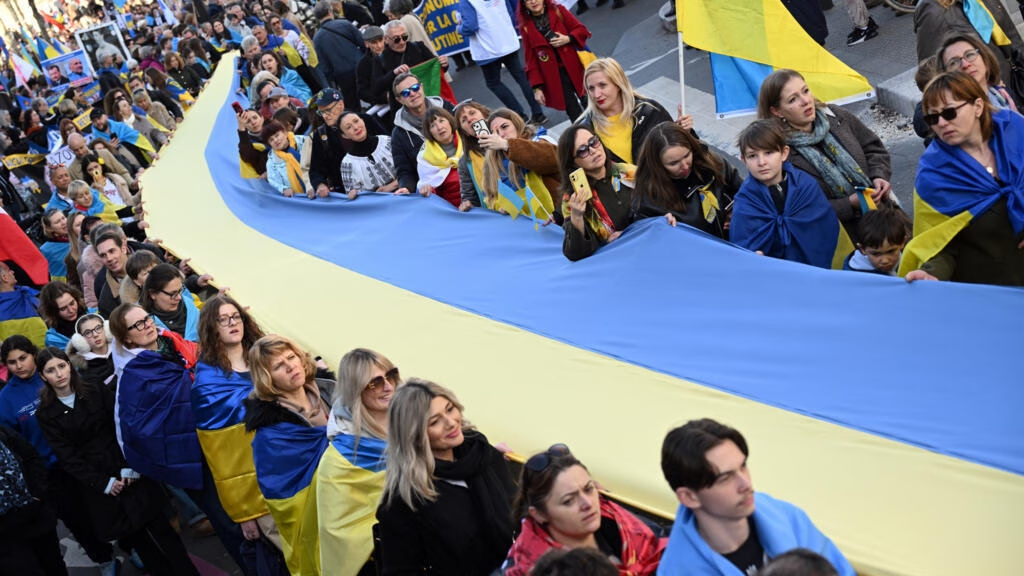
Four years after Russia launched its full-scale invasion, Ukrainians across the country paused to remember the dead from a war that shows no sign of ending.
As the conflict enters its fifth year, Ukraine’s military continues to resist Russian advances, even as casualties rise on both sides and civilians endure near-daily aerial attacks. Speaking on Tuesday, President Volodymyr Zelensky said: “Ukraine never chose this war. We have defended our independence, we have not lost our statehood.”
The Kremlin admitted that its original objectives had not been achieved and signalled it would continue the campaign. Spokesman Dmitry Peskov repeated Moscow’s claim that Western support for Ukraine had turned the conflict into a confrontation between Russia and the West.
Russia now controls just under 20 percent of Ukrainian territory, but Ukrainian forces have prevented it from seizing the entire Donbas region in the east.

At 10:00 a.m., a minute’s silence brought Kyiv to a standstill. In Maidan Square, rows of flags commemorating the fallen stood as people lowered their heads in quiet reflection. At St Sophia’s Cathedral, Zelensky and First Lady Olena Zelenska led a prayer service alongside visiting European leaders, including Finland’s Alexander Stubb, Sweden’s Ulf Kristersson and European Commission President Ursula von der Leyen.
In Bucha, the town that became a symbol of atrocities in the early weeks of the invasion, residents laid flowers on the graves of soldiers. “The war has taken too many lives,” said Valentyn, visiting fallen comrades. “No one thought it would last this long.”
In a video address filmed inside underground corridors of the presidential palace, Zelensky reflected on the early days of the invasion when many believed Kyiv would fall within days. “Ukraine exists not just on the map,” he said. “We have defended our independence and our statehood.”
A virtual meeting of the so-called Coalition of the Willing, led by Britain and France, brought together about 35 countries willing to help guarantee any future ceasefire. UK Prime Minister Keir Starmer said it was wrong to think Russia held the upper hand, noting that Moscow had taken only a small fraction of Ukrainian land over the past year at enormous cost in lives.
French President Emmanuel Macron expressed scepticism about peace in the short term, saying there was no genuine willingness from Russia to secure a lasting settlement.
Russia’s Foreign Intelligence Service accused Britain and France of helping Ukraine pursue a nuclear or “dirty bomb,” a claim dismissed by Downing Street as a distraction with no basis in fact. President Vladimir Putin did not directly address the war in a speech to security officials but echoed accusations against Western powers.
Despite several rounds of US-brokered talks, progress toward peace remains limited. Moscow’s demand that Ukraine surrender territory in the east is widely rejected in Kyiv.
A statement from G7 leaders, including US President Donald Trump, reaffirmed support for Ukraine’s sovereignty and right to exist. It marked the group’s first joint declaration on Ukraine since Trump’s re-election.
Zelensky reiterated that Ukraine needs more US interceptor missiles for its Patriot air defence systems, warning that recent Russian strikes have depleted supplies and left cities and energy infrastructure vulnerable during winter.
Casualty figures continue to rise. The BBC has identified more than 186,000 Russian soldiers killed, though the true toll is believed to be far higher. The UK Ministry of Defence estimates Russia has suffered around 1.25 million casualties overall. Zelensky has said 55,000 Ukrainian soldiers have officially been killed, while other estimates suggest the number could approach 200,000.
Across Ukraine, military cemeteries continue to expand, standing as stark reminders of the human cost of a war that has reshaped the country and the wider world.
