
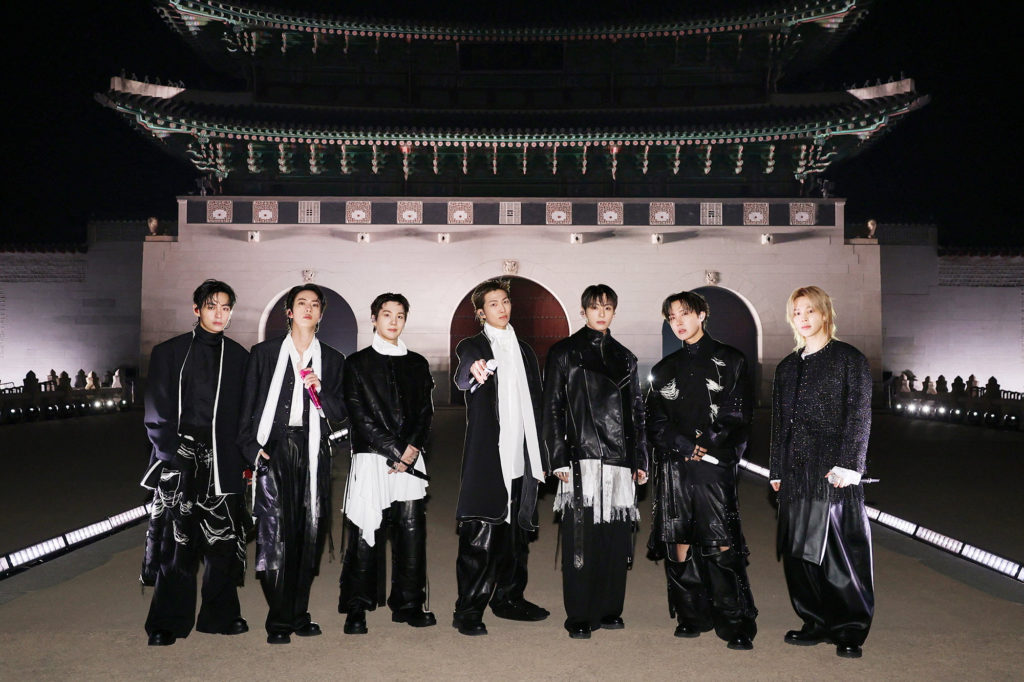
Seoul’s city center turned into a sea of purple on Saturday as fans gathered in massive numbers to welcome back BTS for their first major performance in more than three years following the members’ mandatory military service.
Purple, the band’s signature color, flooded the capital’s landmarks, billboards, high-rise screens and storefronts. Banners reading “Welcome back BTS” decorated shops across the city, while drone lights illuminated the sky above the Han River in celebration of the group’s long-awaited return.
Tens of thousands of fans, known as the “Army,” packed Gwanghwamun Square ahead of the concert, many waving the group’s signature light-sticks and wearing purple outfits. Some had traveled thousands of miles to witness the moment.
Fans Amanda and Veronica, who flew from the United States for the show, said the band’s hiatus had been difficult. “BTS is everything for us,” Veronica said as they waited for the performance to begin.

The seven members — RM, Jin, Suga, J-Hope, Jimin, V and Jung Kook — made their entrance after the resonant toll of the historic Divine Bell of King Seongdeok echoed across the square as part of the intro to “Number 29,” a track from the group’s new album Arirang.
“Annyeonghaseyo… We are back,” leader RM told the crowd in Korean before switching to English.
The group performed on a specially built stage resembling a triumphal arch, set dramatically against the backdrop of the historic Gwanghwamun gate and the surrounding mountains. Their comeback performance began with the album’s opening track “Body to Body,” blending modern pop with elements of Korea’s iconic folk song Arirang.
Although the concert focused on the band’s new material, fans were also treated to beloved global hits including “Butter,” “MIC Drop,” “Dynamite,” and “Mikrokosmos,” which sparked massive sing-alongs throughout the crowd.
Authorities had estimated that up to 250,000 people might attend, though the crowd appeared to number in the tens of thousands. The event marked the first time Seoul’s central square had been transformed into a large-scale K-pop concert venue.
The choice of venue carried symbolic meaning for the band.
“I’m deeply honoured to perform at Gwanghwamun, the most historic place in South Korea,” Suga said during the performance. “We named the album Arirang and chose this venue to reflect our identity.”
However, the large-scale event also drew criticism from some commentators who questioned whether it was appropriate to dedicate such extensive public resources — including thousands of police and emergency personnel — to a concert streamed live exclusively on Netflix.
Others argued that granting BTS access to the landmark site could set a precedent for other artists seeking to stage large events in the city center.
Despite the debate, the comeback marked a major cultural moment for South Korea’s global music industry. After years away from the stage, BTS signaled their return to the top of the K-pop world with a performance that blended modern spectacle with Korean heritage.
