
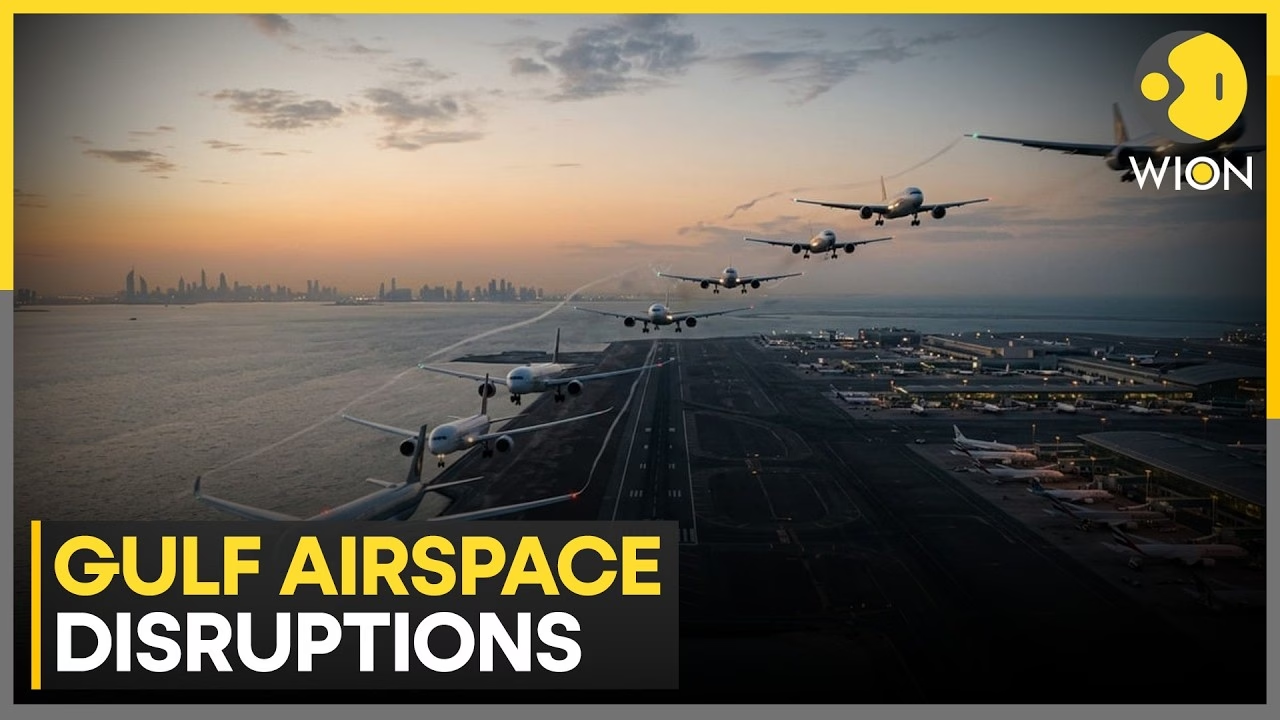
Airline stocks across Asia and Europe extended losses on Tuesday as the escalating U.S. and Israeli air war against Iran disrupted major travel routes, drove up fuel prices, and left tens of thousands of passengers stranded across the Middle East and beyond.
Key Gulf aviation hubs, including Dubai, the world’s busiest international airport handling more than 1,000 flights daily, remained closed for a fourth straight day. The shutdown has cut off a crucial air bridge between Asia and Europe and forced travelers to scramble for alternative routes or emergency repatriation flights.
“We can’t get home, we can’t go back to work, we can’t get the kids back to school,” said Tatiana Leclerc, a French tourist stranded in Thailand after her flight via Middle East hubs was canceled.
Across the Gulf, governments and airlines rushed to organize limited evacuation flights even as explosions were reported in Tehran and Beirut. Ambra Chessa, an Italian passenger in Dubai, said she boarded an unscheduled charter flight with only an hour’s notice, while another traveler, Carolina Raggi, paid 1,500 euros for a last-minute seat arranged through Italy’s foreign ministry portal.

Some passengers opted to remain in place. Kirill Lechleide, a German tourist in Dubai, said missile interceptions overhead were frightening but traveling overland was considered too risky. “The safest place to be is the hotel,” she said.
Oil prices have surged about 30 percent this year amid the widening conflict, threatening airline profitability as jet fuel costs rise. Ryanair CEO Michael O’Leary said the carrier was hedged at around $67 a barrel for the next 12 months, limiting near-term impact. Brent crude was trading above $83 a barrel.
Qantas Airways CEO Vanessa Hudson described the oil spike as significant for the industry despite strong fuel hedging. Qantas shares fell 1.8 percent for a second consecutive session. Other carriers, including Singapore Airlines and Cathay Pacific, also maintain fuel hedging programs.
In Asia, Japan Airlines shares dropped 6.4 percent, Korean Air Lines fell 10.3 percent, and Cathay Pacific declined about three percent. Major Chinese airlines, including Air China, China Eastern Airlines and China Southern Airlines, closed down between two and four percent.
European airline stocks also slid sharply, with Lufthansa and Air France-KLM among carriers posting losses of five to eight percent. U.S. airlines, including United Airlines, Delta Air Lines, American Airlines and Southwest Airlines, fell around four percent.
Aviation data firm Cirium reported more than 19,000 flights to the Middle East have been canceled since Saturday. Tourism Economics warned the conflict could slash regional visitor spending by $34 billion to $56 billion this year.
“It’s the biggest shutdown we’ve seen since the COVID pandemic,” said Paul Charles, CEO of luxury travel consultancy PC Agency, noting that cargo disruptions alone could cost billions of dollars.
With Russian airspace largely closed to Western airlines since 2022, carriers are now forced into narrower corridors over the Middle East, increasing flight times and fuel consumption as they reroute around war zones. Demand for alternatives to Gulf carriers has surged, with ticket prices rising on routes such as Hong Kong to London.
Industry analysts say the financial impact will vary widely depending on airlines’ fuel hedging strategies, cargo exposure and rerouting capacity. Karen Li of J.P. Morgan said investors are likely to differentiate airlines based on these factors rather than treating the sector as a single block as the crisis unfolds.
