
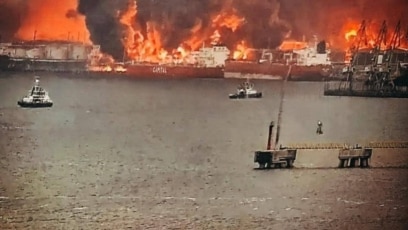
Ukraine has launched a series of drone strikes targeting major Russian oil export infrastructure near the Baltic Sea, with satellite imagery and verified videos showing several facilities burning for days after the attacks.
BBC Verify confirmed that at least three strategic oil sites in Russia’s Leningrad region have been hit since March 23. The targeted facilities include the major Baltic ports of Ust-Luga and Primorsk, as well as the inland Kirishi oil refinery.
Ukraine’s drone forces commander Robert Brovdi said Ust-Luga was struck again on Monday night in an effort to keep fires burning at the site.
Authorities in Russia reported casualties from the latest attack. Leningrad region governor Alexander Drozdenko said three people, including two children, were injured, adding that Russian air defenses shot down 38 drones during the incident.

The targeted ports are crucial to Russia’s energy exports. Analysis by the Finland-based Centre for Research on Energy and Clean Air (Crea) shows that approximately 20 percent of Russia’s total oil exports pass through Ust-Luga, while another 22 percent depart from Primorsk.
Satellite images captured by intelligence firm Vantor on March 27 revealed massive plumes of black smoke rising from oil storage facilities in Ust-Luga. Additional satellite imagery showed fires at Primorsk on March 24 and visible damage at the Kirishi refinery days later.
BBC Verify’s examination of the images suggests that at least eight oil storage tanks were destroyed or damaged in Primorsk, while another eight tanks were hit at Ust-Luga. At the Kirishi refinery, at least two storage tanks appear to have been damaged.
Heat-detection data from NASA’s FIRMS satellite monitoring system indicated that fires were still burning at Primorsk early Monday morning and at Ust-Luga later the same day.
Verified videos circulating online also show thick smoke columns rising above the Primorsk port following the attacks, highlighting the scale of the damage.
Brovdi said Ukraine’s operation against the Baltic facilities began on March 23 and was designed to target what he described as Russia’s “oil arteries,” including refining capacity and crude export infrastructure.
Ukraine’s military has identified the Kirishi refinery as one of Russia’s three largest oil-processing plants and says it produces fuel that supports Russian military operations.
The strikes appear to have had an immediate impact on Russia’s export operations. Recent shipping data shows that no oil tankers were loaded at any of Russia’s three Baltic ports on March 26 and 27. According to Crea, this marks the first time since the start of Russia’s full-scale invasion of Ukraine in 2022 that such ports have gone two consecutive days without loading oil shipments.
Reuters calculations based on market data estimate that the initial wave of attacks temporarily halted around 40 percent of Russia’s oil export capacity on March 25.
Despite the disruption, Russia’s oil revenues have remained strong. Crea estimates the country earned about £7.1 billion from oil exports during the final three weeks of March, with global prices rising sharply amid supply disruptions linked to the ongoing US-Israel conflict with Iran.
Ukrainian President Volodymyr Zelensky said on Monday that some international allies have asked Kyiv to scale back attacks on Russia’s energy infrastructure because of concerns about worsening the global energy crisis. He said such strikes would stop only if Russia halted its own attacks on Ukraine’s energy systems.
Analysts believe the strikes are part of a broader strategy to weaken Russia’s wartime revenue. Alexander Lord, an analyst at UK-based intelligence firm Sybelline, said Kyiv is likely trying to counter the financial gains Russia has recently enjoyed from high oil and gas prices.
However, Lord warned that the longer the conflict continues, the more likely it becomes that the United States could pressure Ukraine to limit these strikes as part of wider efforts to stabilize global oil prices.
