
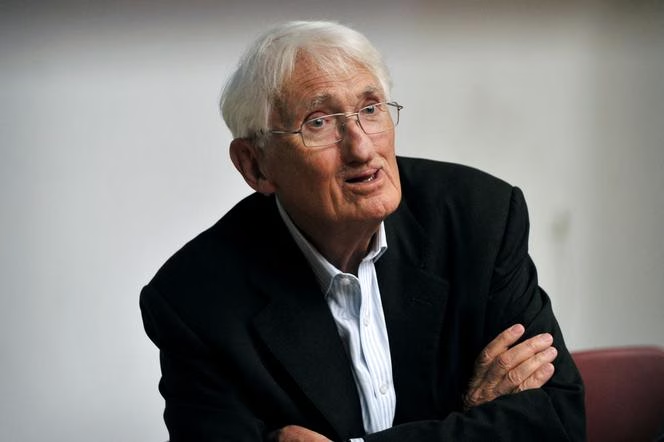
Jürgen Habermas, the renowned German philosopher whose work on communication, rationality and social theory reshaped modern intellectual thought, has died at the age of 96.
His publisher, Suhrkamp, confirmed that Habermas died on Saturday in Starnberg, near Munich, Germany. Over a career spanning more than six decades, Habermas became one of the most influential thinkers of the modern era, widely recognized for his contributions to philosophy, sociology and political theory.
Habermas’ ideas helped shape debates about democracy, communication and public discourse. His most famous work, the two-volume “Theory of Communicative Action,” explored how rational communication forms the basis of social cooperation and democratic life.
Born on June 18, 1929, in Düsseldorf, Habermas grew up in nearby Gummersbach, where his father served as the head of the local chamber of commerce. His formative years were deeply shaped by the collapse of Nazi Germany in 1945. At the time he was 15 years old, an experience he later described as pivotal in guiding him toward philosophy and social theory.

Reflecting on the end of World War II, Habermas said that realizing the criminal nature of the Nazi regime profoundly influenced his intellectual path. The confrontation with Germany’s past became a central element of his philosophical outlook and his lifelong engagement with democracy and public responsibility.
During the 1960s, Habermas developed a complex relationship with the student protest movements sweeping through West Germany and other parts of the world. While he sympathized with many of the movement’s goals, he also warned against radicalization and famously cautioned against what he described as the danger of “left-wing fascism.” In later years, however, he acknowledged that the student protests helped bring about a fundamental liberalization of German society.
In the 1980s, Habermas played a central role in the “Historians’ Dispute,” a major intellectual debate in Germany about how the country should interpret the legacy of the Third Reich. Habermas strongly opposed arguments by some conservative historians who attempted to compare Nazi crimes with atrocities committed by other regimes, such as those under Soviet leader Joseph Stalin. He argued that such comparisons risked diminishing the unique scale and moral gravity of Nazi crimes.
Beyond academia, Habermas frequently engaged in public debate on political and social issues. He supported the election of center-left Chancellor Gerhard Schröder in 1998 and later criticized the leadership style of Chancellor Angela Merkel, arguing that her technocratic approach lacked broader political vision.
Habermas also consistently advocated for stronger European political integration. He criticized what he saw as insufficient commitment among German political leaders and institutions toward building a more politically unified Europe. In 2017, he praised French President Emmanuel Macron for proposing ambitious reforms for the European Union and for bringing renewed energy to discussions about Europe’s future.
German Chancellor Friedrich Merz paid tribute to Habermas following news of his death, describing him as one of the most important thinkers of modern times. Merz said Habermas’ sociological and philosophical work had influenced generations of scholars and public intellectuals across Europe and around the world.
Habermas’ early life also played a role in shaping his philosophical interests. He was born with a cleft palate and underwent several operations during childhood, which affected his speech. The experience deeply influenced his thinking about language and communication, central themes that would later define his academic work.
He often reflected on the significance of spoken language as a shared foundation for human understanding and social life. At the same time, he emphasized the power of written communication, noting that writing can conceal the imperfections of speech while enabling ideas to reach broader audiences.
Habermas remained intellectually active well into his later years, continuing to publish essays and commentary on global politics, democracy and the future of Europe.
His wife, Ute Habermas-Wesselhoeft, died in 2025. The couple had three children: Tilmann, Judith and Rebekka, who died in 2023.
With his passing, scholars say the world has lost one of the most influential philosophical voices of the 20th and early 21st centuries.
